
[Paper Review] Humanoid Locomotion as Next Token Prediction
A causal transformer is trained to autoregressively predict tokenized sensorimotor trajectories for humanoid locomotion, enabling zero-shot real-world walking by leveraging diverse data sources including incomplete modalities.
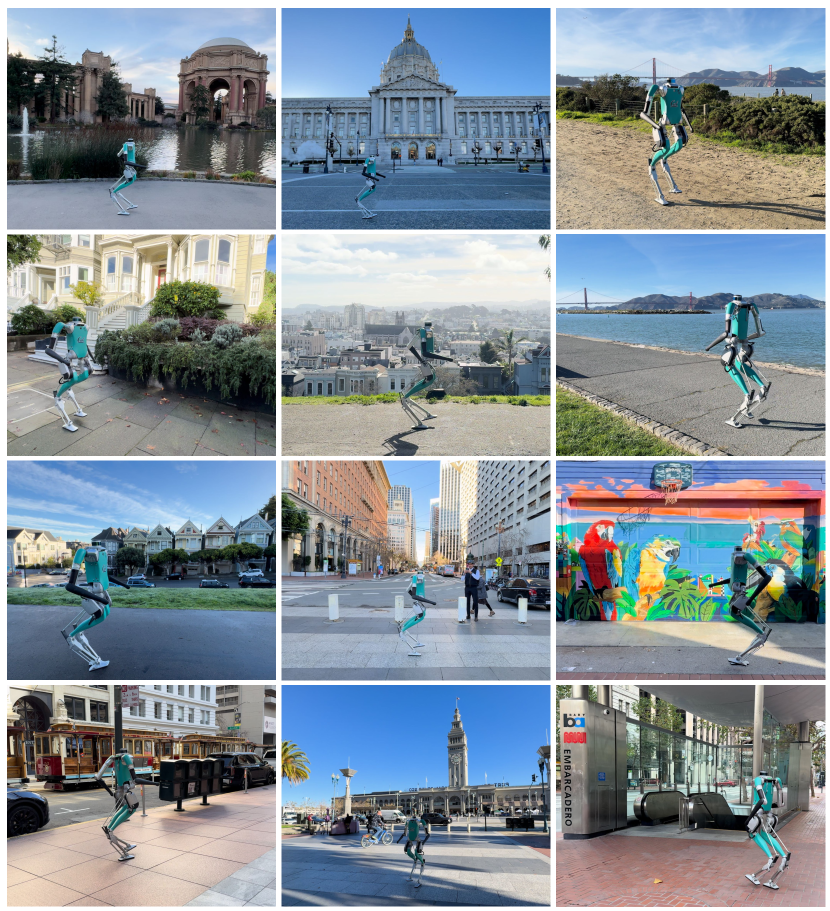
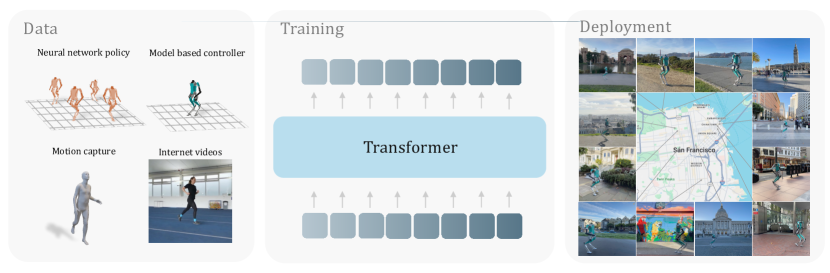
We cast real-world humanoid control as a next token prediction problem, akin to predicting the next word in language. Our model is a causal transformer trained via autoregressive prediction of sensorimotor trajectories. To account for the multi-modal nature of the data, we perform prediction in a modality-aligned way, and for each input token predict the next token from the same modality. This general formulation enables us to leverage data with missing modalities, like video trajectories without actions. We train our model on a collection of simulated trajectories coming from prior neural network policies, model-based controllers, motion capture data, and YouTube videos of humans. We show that our model enables a full-sized humanoid to walk in San Francisco zero-shot. Our model can transfer to the real world even when trained on only 27 hours of walking data, and can generalize to commands not seen during training like walking backward. These findings suggest a promising path toward learning challenging real-world control tasks by generative modeling of sensorimotor trajectories.
Motivation & Objective
- Motivate learning real-world humanoid control via generative modeling of sensorimotor trajectories.
- Develop a modality-aligned autoregressive transformer that can handle incomplete data sources.
- Show that training on diverse sources (including human videos) enables zero-shot deployment in the real world.
- Investigate how prediction quality relates to locomotion performance and generalization.
Proposed method
- Tokenize sensorimotor trajectories into tokens and train a causal transformer to model p(t) autoregressively via negative log-likelihood.
- Align predictions by modeling the next token from the same modality as the input token.
- Handle missing modalities by masking with [M] tokens and ignoring loss on masked parts.
- Train on heterogeneous data sources (neural policies, model-based controllers, MoCap, YouTube videos) with joint or staged strategies.
- Use separate modality projections and a shared transformer, with positional embeddings and causal self-attention.
Experimental results
Research questions
- RQ1Can autoregressive transformer models trained on diverse sensorimotor data achieve real-world humanoid locomotion without reinforcement learning at test time?
- RQ2How does modality alignment, missing data handling, and joint vs staged training affect performance and generalization?
- RQ3To what extent can models trained on incomplete data (e.g., human videos) transfer to a full humanoid in the real world?
- RQ4What is the relationship between next-token prediction error and locomotion tracking performance?
- RQ5How does scaling data, context length, and model size affect locomotion quality and generalization to unseen commands?
Key findings
- The model enables a full-sized humanoid to walk in San Francisco zero-shot across varied surfaces.
- Zero-shot real-world deployment is possible with as little as 27 hours of walking data.
- Prediction error correlates with tracking performance (r = 0.87).
- Inclusion of incomplete trajectories (with missing actions) improves performance over using complete data alone.
- Aligned modality predictions outperform non-aligned setups in both tracking and next-token prediction tasks.
- The approach generalizes to unseen commands, including backward walking, and scales with data, context, and model size.
Read this paper
Open the full text in the Nubint reader and ask about any passage as you read.
Read this paper on NubintThis review was generated by AI from the original paper. Please check the paper before citing it.