
[Paper Review] HuntGPT: Integrating Machine Learning-Based Anomaly Detection and Explainable AI with Large Language Models (LLMs)
HuntGPT combines a Random Forest-based network anomaly detector trained on KDD99 with XAI (SHAP/LIME) and an OpenAI GPT-3.5 Turbo chatbot to deliver explainable, actionable intrusion detection insights via a Gradio dashboard. The study evaluates technical accuracy and response readability of the AI-assisted system.
Machine learning (ML) is crucial in network anomaly detection for proactive threat hunting, reducing detection and response times significantly. However, challenges in model training, maintenance, and frequent false positives impact its acceptance and reliability. Explainable AI (XAI) attempts to mitigate these issues, allowing cybersecurity teams to assess AI-generated alerts with confidence, but has seen limited acceptance from incident responders. Large Language Models (LLMs) present a solution through discerning patterns in extensive information and adapting to different functional requirements. We present HuntGPT, a specialized intrusion detection dashboard applying a Random Forest classifier using the KDD99 dataset, integrating XAI frameworks like SHAP and Lime for user-friendly and intuitive model interaction, and combined with a GPT-3.5 Turbo, it delivers threats in an understandable format. The paper delves into the system's architecture, components, and technical accuracy, assessed through Certified Information Security Manager (CISM) Practice Exams, evaluating response quality across six metrics. The results demonstrate that conversational agents, supported by LLM and integrated with XAI, provide robust, explainable, and actionable AI solutions in intrusion detection, enhancing user understanding and interactive experience.
Motivation & Objective
- Motivate the use of ML-based anomaly detection in threat hunting to reduce detection time and improve response quality.
- Propose a dashboard (HuntGPT) that integrates a Random Forest detector with SHAP and LIME explanations and a GPT-based conversational agent.
- Enhance analyst trust and usability by combining explainability with interactive AI-assisted analysis.
- Evaluate the prototype's technical accuracy and readability of AI-generated explanations and responses.
Proposed method
- Train and deploy a Random Forest classifier on the KDD99 intrusion detection dataset for anomaly detection.
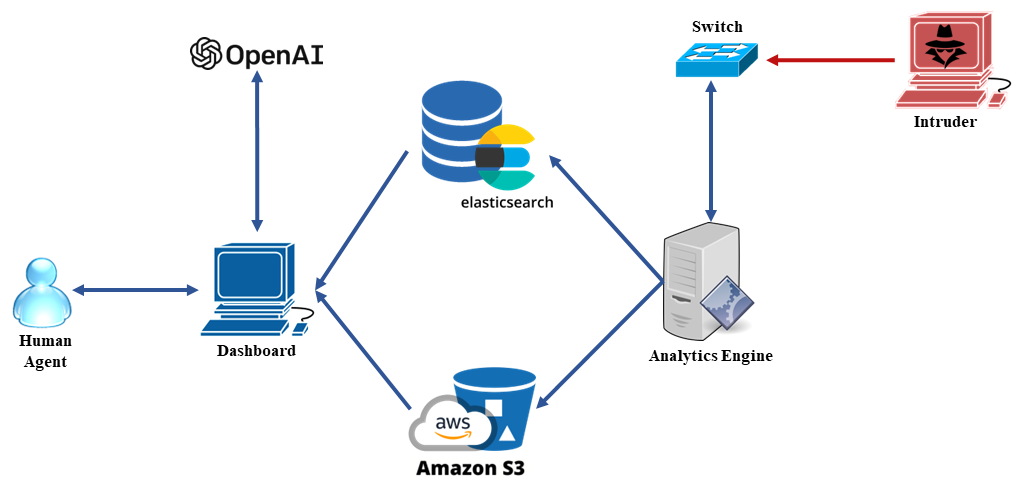
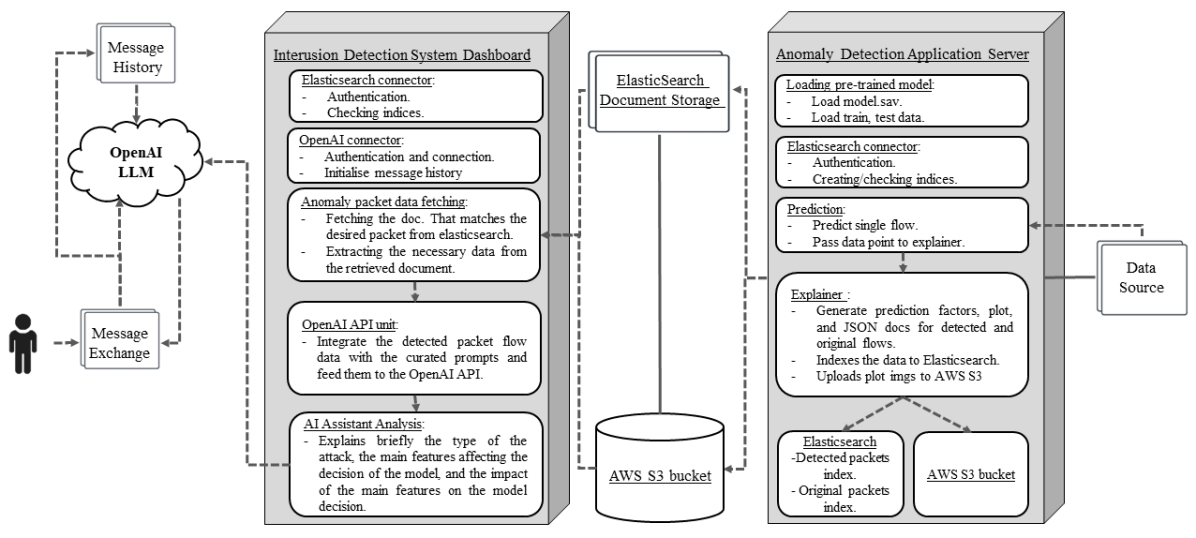
- Integrate SHAP and LIME explainability frameworks to generate feature-level explanations and visual plots stored in Elasticsearch and AWS S3.
- Attach a GPT-3.5 Turbo conversational agent via OpenAI API to deliver explainable threat analyses through the IDS dashboard.
- Use a three-layer architecture (Analytics engine, Data Storage with Elasticsearch, and UI with Gradio) to separate concerns and enable modular development.
- Evaluate technical accuracy against cybersecurity certification prep materials (CISM) and assess readability of AI explanations using six readability metrics.
Experimental results
Research questions
- RQ1Can an LLM-powered chatbot paired with XAI explanations provide accurate and actionable insights for detected network anomalies?
- RQ2Does integrating SHAP and LIME explanations improve analyst trust and understanding of ML-based anomaly detections?
- RQ3What is the cognitive readability of AI-generated anomaly explanations and chatbot responses in a cybersecurity context?
- RQ4How well does the system perform in terms of practical cybersecurity knowledge as measured against standard certifications?
Key findings
- GPT-3.5 Turbo demonstrated substantial cybersecurity knowledge with success rates of 72% to 82.5% on standardized exams used in the study.
- Readability analyses indicate generated explanations and chatbot responses are generally at a graduate or equivalent level, yet remain comprehensible to users with basic college education.
- The HuntGPT prototype delivers explainable anomaly detections via AI-generated explanations, interactive discussions, and a downloadable incident report.
- The architecture supports modular development with Elasticsearch storage, AWS S3 plots, and a Gradio UI integrated with OpenAI’s API for seamless analyst interaction.
- Conversational agent–driven explanations can aid in generating actionable AI-supported responses within intrusion detection contexts.
Read this paper
Open the full text in the Nubint reader and ask about any passage as you read.
Read this paper on NubintThis review was generated by AI from the original paper. Please check the paper before citing it.