
[Paper Review] Hybrid Kerr-electro-optic frequency combs on thin-film lithium niobate
This paper demonstrates a hybrid Kerr-electro-optic frequency comb on thin-film lithium niobate, achieving 2,589 lines spaced at 29.308 GHz over a 75.9 THz bandwidth, with on-chip stabilization of the soliton spacing.
Optical frequency combs are indispensable links between the optical and microwave domains, enabling a wide range of applications including precision spectroscopy, ultrastable frequency generation, and timekeeping. Chip-scale integration miniaturizes bulk implementations onto photonic chips, offering highly compact, stable, and power-efficient frequency comb sources. State of the art integrated frequency comb sources are based on resonantly-enhanced Kerr effect and, more recently, on electro-optic effect. While the former can routinely reach octave-spanning bandwidths and the latter feature microwave-rate spacings, achieving both in the same material platform has been challenging. Here, we leverage both strong Kerr nonlinearity and efficient electro-optic phase modulation available in the ultralow-loss thin-film lithium niobate photonic platform, to demonstrate a hybrid Kerr-electro-optic frequency comb with stabilized spacing. In our approach, a dissipative Kerr soliton is first generated, and then electro-optic division is used to realize a frequency comb with 2,589 comb lines spaced by 29.308 GHz and spanning 75.9 THz (588 nm) end-to-end. Further, we demonstrate electronic stabilization and control of the soliton spacing, naturally facilitated by our approach. The broadband, microwave-rate comb in this work overcomes the spacing-span tradeoff that exists in all integrated frequency comb sources, and paves the way towards chip-scale solutions for complex tasks such as laser spectroscopy covering multiple bands, micro- and millimeter-wave generation, and massively parallel optical communications.
Motivation & Objective
- Motivate chip-scale, broadband optical–microwave frequency combs with both large span and small spacing.
- Leverage strong Kerr nonlinearity and electro-optic (EO) division on thin-film lithium niobate (TFLN).
- Demonstrate self-starting dissipative Kerr solitons (DKS) on TFLN and cascade EO sideband generation to divide spacing to microwave rates.
- Integrate Kerr soliton sources with high-speed EO phase modulation to realize a fully integrated hybrid Kerr-EO comb.
- Show electronic stabilization of the soliton spacing via feedback on a generated difference frequency Δf.
Proposed method
- Generate octave-spanning DKS on dispersion-engineered TFLN microresonators with on-chip pump powers around 100–372 mW.
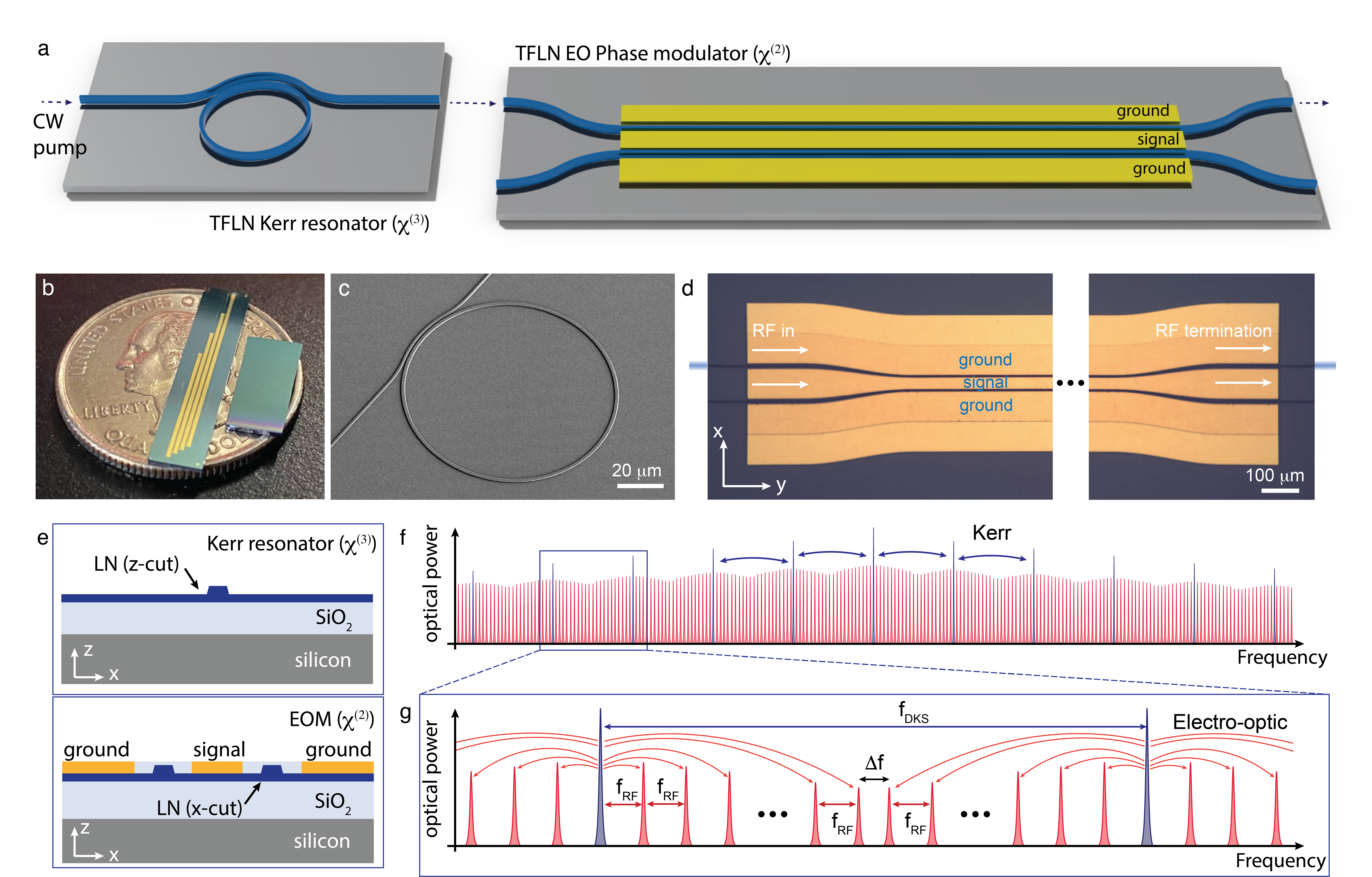
- Use a 2 cm-long integrated EO phase modulator on TFLN to create sidebands around each DKS line at multiples of the EO drive frequency (f_RF).
- Divide the THz-scale DKS spacing f_DKS by EO sidebands to yield a microwave-rate comb with spacing f_RF.
- Define and measure f_DKS, f_RF, and Δf with Δf = f_DKS − N·f_RF, where N is the number of EO sidebands needed for full division.
- Phase-lock Δf to a microwave reference to stabilize f_DKS via feedback to the DKS pump.
- Characterize modulator Vπ, EO bandwidth, and cross-wavelength performance across the telecom bands.
Experimental results
Research questions
- RQ1Can a hybrid Kerr-EO approach on thin-film lithium niobate deliver both large optical bandwidth and microwave-rate comb spacing on a single chip?
- RQ2What is the achievable division factor N when fully dividing a THz-scale Kerr soliton spacing with integrated EO modulation?
- RQ3Can the EO-divided comb be stabilized electronically by locking the EO-difference frequency Δf to a microwave reference?
- RQ4How do Kerr soliton generation and EO modulation couple across multiple wavelengths on TFLN for a broadband, chip-scale comb?
Key findings
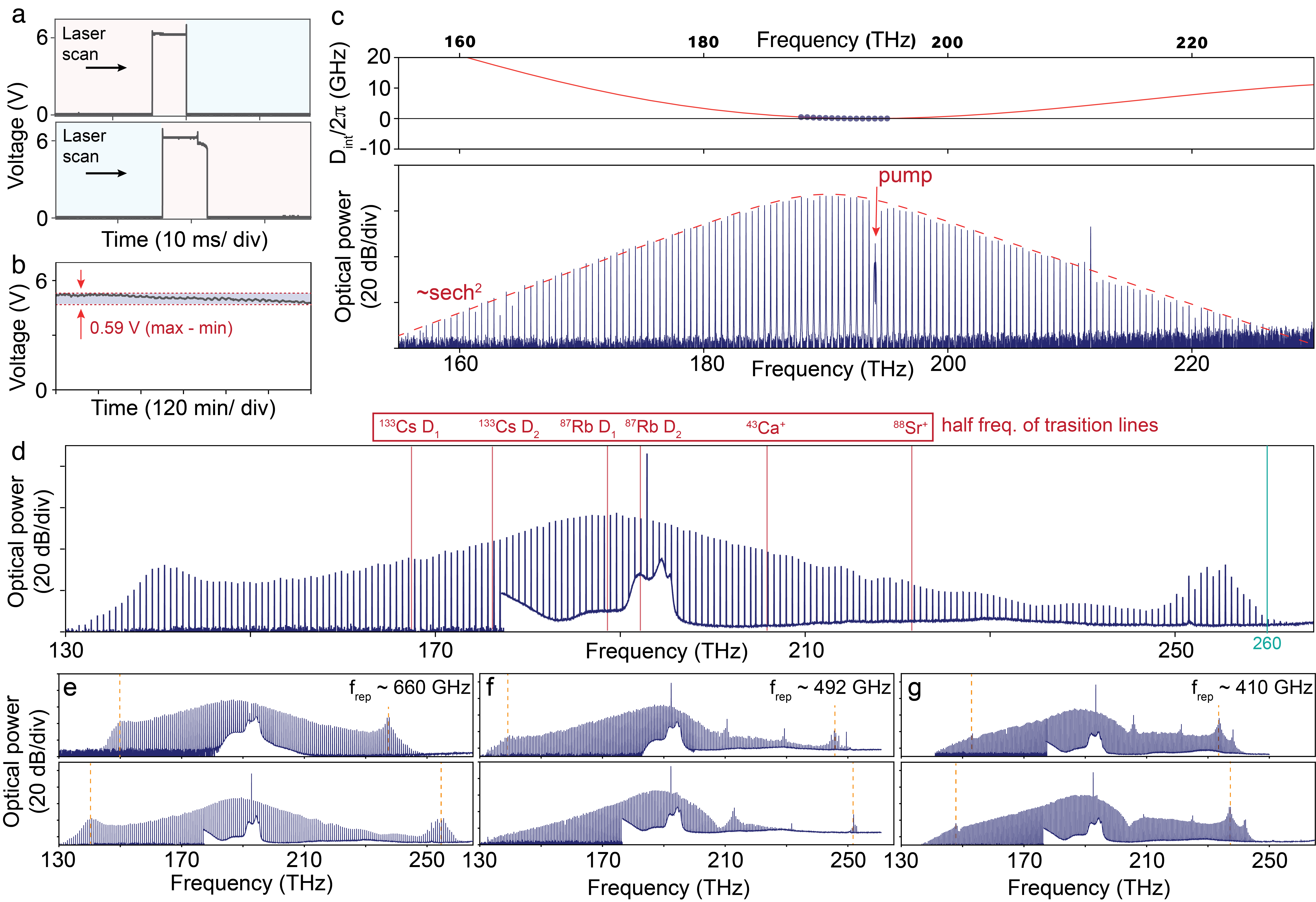
- An octave-spanning DKS on thin-film lithium niobate with 660 GHz spacing was demonstrated (131.3–263.2 THz range).
- A 2 cm EO modulator achieved a 29.158 GHz modulation frequency, dividing the DKS spacing by N=14 to yield a 29.308 GHz hybrid comb.
- The hybrid Kerr-EO comb spans 75.9 THz end-to-end, covering 588 nm, with both Kerr and EO processes on-chip.
- Δf can be measured as an EO beatnote and locked to a microwave reference, stabilizing f_DKS via feedback to the pump.
- The Δf linewidth was shown to be ~30 kHz when locked, demonstrating coherent control of the near-THz Kerr spacing.
- The approach provides a path toward integrated microwave synthesis and dual-domain frequency references on a single photonic platform.
Read this paper
Open the full text in the Nubint reader and ask about any passage as you read.
Read this paper on NubintThis review was generated by AI from the original paper. Please check the paper before citing it.