
[Paper Review] Hybrid Quantum Graph Neural Network for Molecular Property Prediction
This paper proposes a novel gradient-free hybrid quantum-classical graph neural network (HyQCGNN) for predicting formation energies of perovskite materials, integrating quantum feature encoding via amplitude encoding and parametric quantum circuits into a graph convolutional architecture. The model achieves an R² of 0.674, demonstrating competitive performance with classical GNNs and XGBoost despite current quantum hardware limitations, suggesting promise for future quantum advantage in materials property prediction.
To accelerate the process of materials design, materials science has increasingly used data driven techniques to extract information from collected data. Specially, machine learning (ML) algorithms, which span the ML discipline, have demonstrated ability to predict various properties of materials with the level of accuracy similar to explicit calculation of quantum mechanical theories, but with significantly reduced run time and computational resources. Within ML, graph neural networks have emerged as an important algorithm within the field of machine learning, since they are capable of predicting accurately a wide range of important physical, chemical and electronic properties due to their higher learning ability based on the graph representation of material and molecular descriptors through the aggregation of information embedded within the graph. In parallel with the development of state of the art classical machine learning applications, the fusion of quantum computing and machine learning have created a new paradigm where classical machine learning model can be augmented with quantum layers which are able to encode high dimensional data more efficiently. Leveraging the structure of existing algorithms, we developed a unique and novel gradient free hybrid quantum classical convoluted graph neural network (HyQCGNN) to predict formation energies of perovskite materials. The performance of our hybrid statistical model is competitive with the results obtained purely from a classical convoluted graph neural network, and other classical machine learning algorithms, such as XGBoost. Consequently, our study suggests a new pathway to explore how quantum feature encoding and parametric quantum circuits can yield drastic improvements of complex ML algorithm like graph neural network.
Motivation & Objective
- To develop a hybrid quantum-classical graph neural network that integrates quantum feature encoding with classical graph convolution for molecular property prediction.
- To evaluate the performance of a gradient-free optimization strategy in training a quantum-enhanced graph neural network on materials datasets.
- To assess the feasibility and competitiveness of quantum-enhanced GNNs for predicting complex materials properties like formation energy.
- To explore the potential of quantum machine learning to augment classical graph neural networks in materials science.
- To provide a foundation for future research into full quantum graph neural networks using Hilbert space embeddings.
Proposed method
- The model employs a hybrid architecture combining a classical graph convolutional neural network (GCNN) with a quantum layer that uses amplitude encoding to map classical features into quantum states.
- A parameterized quantum circuit (ansatz) is applied to the encoded quantum state to enable trainable transformations and feature extraction.
- Non-gradient-based optimization (Nelder-Mead) is used to train the quantum circuit parameters, avoiding the need for differentiable quantum circuits.
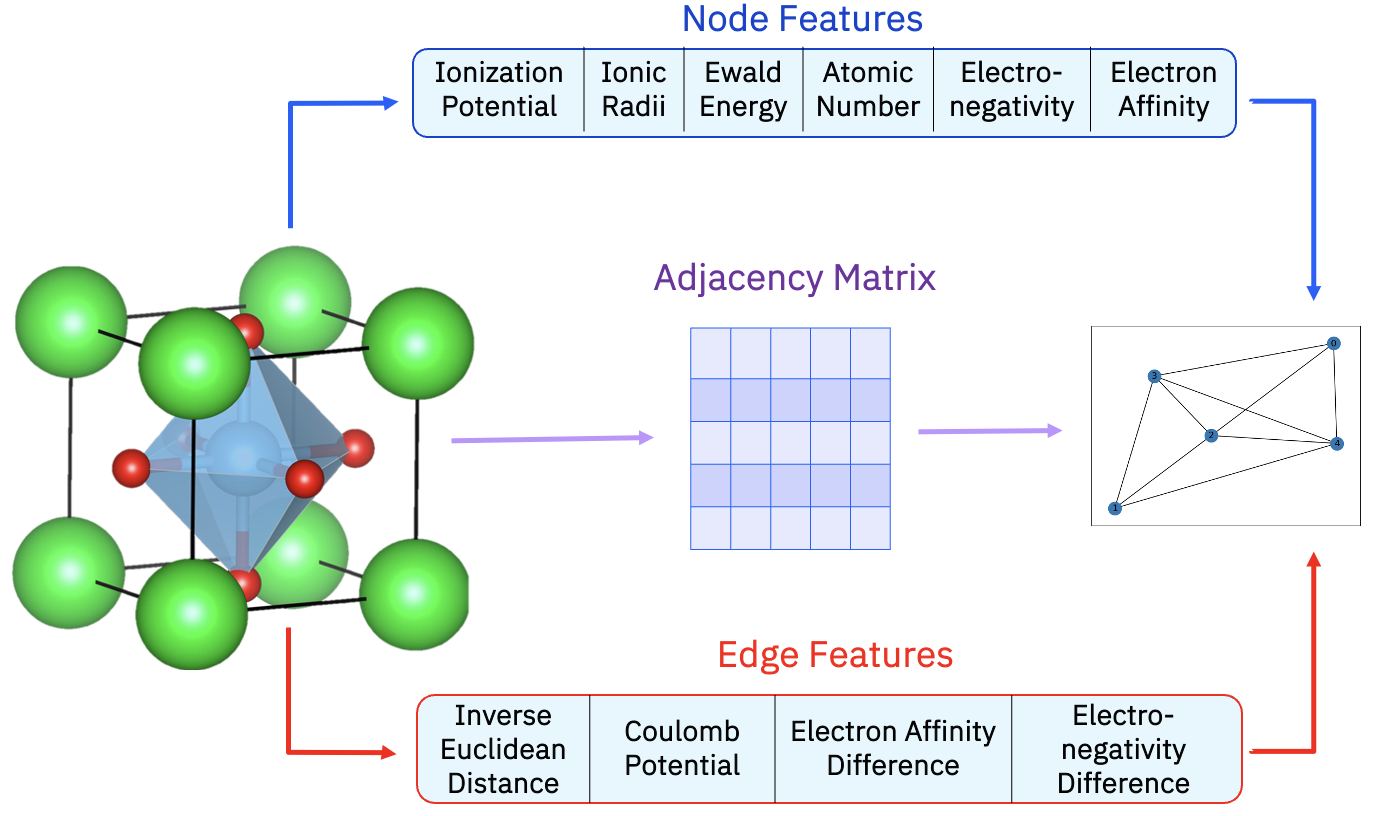
- The graph structure of perovskite materials is encoded using atomic descriptors such as electronegativity, ionization energy, and atomic number, aggregated through message-passing mechanisms.
- Model performance is evaluated using R², mean absolute error (MAE), and root mean squared error (RMSE), with comparisons to classical GNNs and XGBoost.
- Feature importance is analyzed using XGBoost to identify key atomic descriptors influencing formation energy.
Experimental results
Research questions
- RQ1Can a hybrid quantum-classical graph neural network achieve competitive performance in predicting perovskite formation energies compared to state-of-the-art classical models?
- RQ2How effective is gradient-free optimization for training quantum layers within a graph neural network architecture?
- RQ3Which atomic descriptors are most predictive of perovskite formation energy, and do they align with known physical principles?
- RQ4To what extent does quantum feature encoding enhance the representation learning capacity of graph neural networks in materials science?
- RQ5What are the current limitations of quantum-enhanced GNNs, and what improvements are needed for future quantum advantage?
Key findings
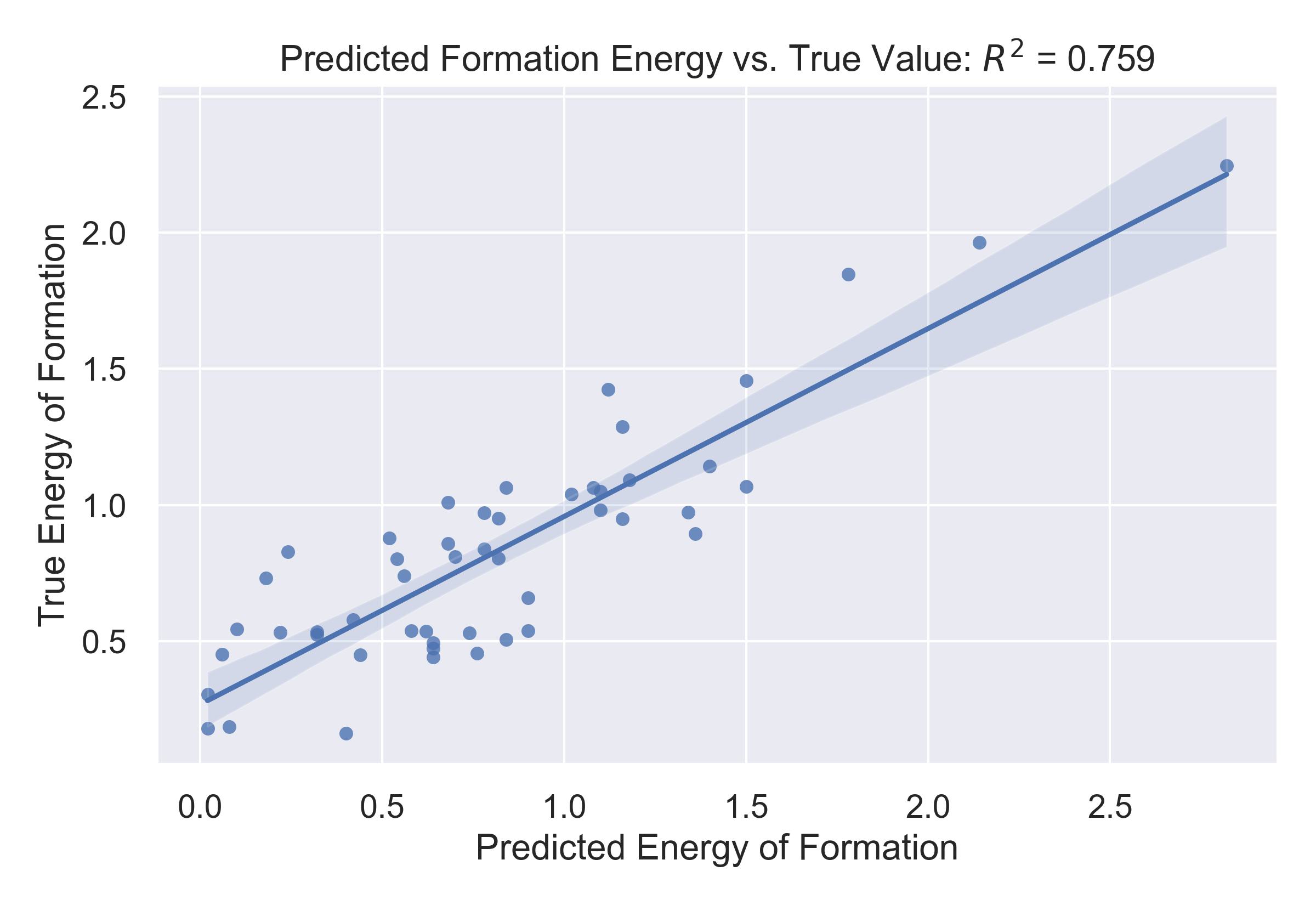
- The hybrid quantum-classical graph neural network achieved an R² score of 0.674 in predicting perovskite formation energies, demonstrating competitive performance with classical models.
- The classical GCNN and XGBoost models outperformed the hybrid model, with XGBoost achieving the highest R², indicating current classical models remain more powerful for this task.
- Feature importance analysis revealed that the first ionization energy of site A in the perovskite structure is the most influential descriptor, consistent with known stability trends in perovskites.
- The use of gradient-free optimization enabled effective training of the quantum circuit without requiring differentiable quantum hardware, expanding the applicability of quantum-enhanced models.
- Despite lower performance than classical baselines, the hybrid model's results suggest a viable pathway toward quantum advantage in materials property prediction with future improvements in quantum hardware and circuit design.
- The study highlights the potential of quantum amplitude encoding to scale efficiently with input dimensionality, supporting future exploration of full quantum graph neural networks.
Read this paper
Open the full text in the Nubint reader and ask about any passage as you read.
Read this paper on NubintThis review was generated by AI from the original paper. Please check the paper before citing it.