
[Paper Review] HyKGE: A Hypothesis Knowledge Graph Enhanced Framework for Accurate and Reliable Medical LLMs Responses
HyKGE is a novel framework that enhances medical LLMs by integrating hypothesis generation with knowledge graph (KG) retrieval to improve accuracy and reliability. It uses LLMs to generate structured hypotheses from ambiguous queries, aligns them with KG entities for targeted retrieval, and applies a fragment reranking module to refine results—demonstrating superior performance on medical QA benchmarks with reduced hallucinations and improved interpretability.
In this paper, we investigate the retrieval-augmented generation (RAG) based on Knowledge Graphs (KGs) to improve the accuracy and reliability of Large Language Models (LLMs). Recent approaches suffer from insufficient and repetitive knowledge retrieval, tedious and time-consuming query parsing, and monotonous knowledge utilization. To this end, we develop a Hypothesis Knowledge Graph Enhanced (HyKGE) framework, which leverages LLMs' powerful reasoning capacity to compensate for the incompleteness of user queries, optimizes the interaction process with LLMs, and provides diverse retrieved knowledge. Specifically, HyKGE explores the zero-shot capability and the rich knowledge of LLMs with Hypothesis Outputs to extend feasible exploration directions in the KGs, as well as the carefully curated prompt to enhance the density and efficiency of LLMs' responses. Furthermore, we introduce the HO Fragment Granularity-aware Rerank Module to filter out noise while ensuring the balance between diversity and relevance in retrieved knowledge. Experiments on two Chinese medical multiple-choice question datasets and one Chinese open-domain medical Q&A dataset with two LLM turbos demonstrate the superiority of HyKGE in terms of accuracy and explainability.
Motivation & Objective
- To address factual inaccuracies and hallucinations in medical LLMs by integrating external knowledge graphs.
- To improve alignment between user queries and high-quality structured knowledge, especially when queries are ambiguous or incomplete.
- To reduce reliance on multiple LLM interactions by enabling efficient, one-shot hypothesis-driven retrieval.
- To enhance interpretability and reliability of LLM responses in clinical decision-making contexts.
- To develop a framework that corrects false knowledge in LLM outputs using validated KG evidence.
Proposed method
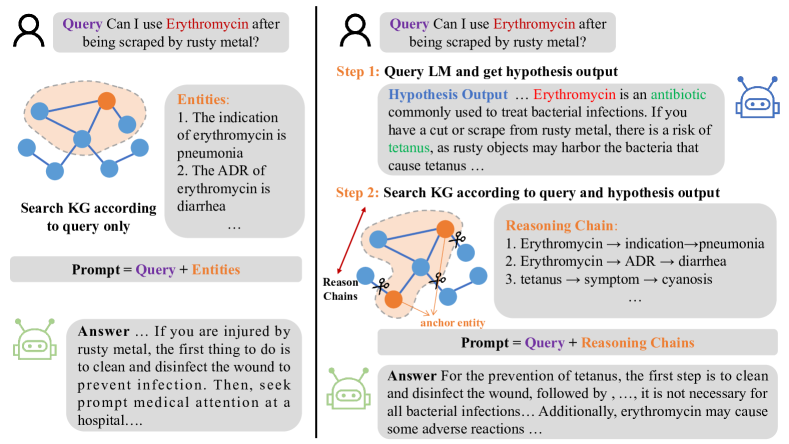
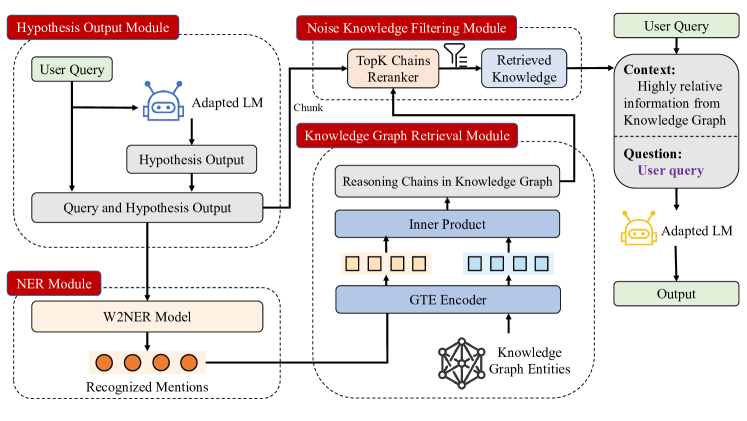
- Leverages the zero-shot reasoning capability of LLMs to generate comprehensive hypothesis documents from incomplete or vague user queries.
- Uses the hypothesis output to identify anchor entities and relationships in a knowledge graph for targeted retrieval.
- Applies a fragment reranking module that reorganizes and fuses short knowledge snippets from the KG to improve alignment with the hypothesis and query.
- Integrates hierarchical ontology (HO) and knowledge graph (KG) to validate and correct erroneous or illogical LLM-generated responses.
- Employs a two-stage process: pre-retrieval hypothesis generation and post-retrieval refinement to minimize noise and improve precision.
- Utilizes natural language prompts to guide LLMs toward generating richer, more constrained hypotheses, reducing the need for iterative interactions.
Experimental results
Research questions
- RQ1Can LLM-generated hypotheses improve the alignment between user queries and high-quality knowledge graph entities in medical QA?
- RQ2How can knowledge graph retrieval be made more efficient and accurate when user queries are ambiguous or under-constrained?
- RQ3To what extent can a fragment reranking module enhance the precision of retrieved knowledge by refining short snippets from the KG?
- RQ4Can integrating a knowledge graph correct hallucinated or incorrect responses generated by LLMs in medical reasoning tasks?
- RQ5How does the HyKGE framework improve accuracy and reliability compared to standard RAG or fine-tuned LLMs in complex medical scenarios?
Key findings
- HyKGE significantly reduces hallucinations in medical LLM responses by validating and correcting false knowledge using a structured knowledge graph.
- The framework achieves superior performance on two medical multiple-choice question datasets, demonstrating improved accuracy and reliability over baseline RAG and fine-tuned LLMs.
- The fragment reranking module enhances retrieval precision by enabling fine-grained alignment between hypothesis-derived queries and knowledge graph snippets.
- Case studies show that HyKGE successfully corrects initial LLM-generated errors—evidenced by the transition from red (initial hypothesis) to green (KG-validated answer) in reasoning chains.
- The model reduces the need for multiple LLM interactions by generating comprehensive hypotheses in a single step, improving efficiency.
- Experiments with GPT-3.5 Turbo show that HyKGE maintains high performance across diverse and complex medical queries, especially in ambiguous or specialized clinical contexts.
Read this paper
Open the full text in the Nubint reader and ask about any passage as you read.
Read this paper on NubintThis review was generated by AI from the original paper. Please check the paper before citing it.