
[Paper Review] HyperCLOVA X Technical Report
HyperCLOVA X is a Korean-language–focused family of large language models (HCX-L and HCX-S) trained on Korean, English, and code data, with instruction tuning and RLHF. It demonstrates strong Korean capabilities, competitive English performance, multilingual translation, and careful safety evaluation.
We introduce HyperCLOVA X, a family of large language models (LLMs) tailored to the Korean language and culture, along with competitive capabilities in English, math, and coding. HyperCLOVA X was trained on a balanced mix of Korean, English, and code data, followed by instruction-tuning with high-quality human-annotated datasets while abiding by strict safety guidelines reflecting our commitment to responsible AI. The model is evaluated across various benchmarks, including comprehensive reasoning, knowledge, commonsense, factuality, coding, math, chatting, instruction-following, and harmlessness, in both Korean and English. HyperCLOVA X exhibits strong reasoning capabilities in Korean backed by a deep understanding of the language and cultural nuances. Further analysis of the inherent bilingual nature and its extension to multilingualism highlights the model's cross-lingual proficiency and strong generalization ability to untargeted languages, including machine translation between several language pairs and cross-lingual inference tasks. We believe that HyperCLOVA X can provide helpful guidance for regions or countries in developing their sovereign LLMs.
Motivation & Objective
- Develop a Korean-language–centric LLM family aligned to Korean language and culture while maintaining strong English and code capabilities.
- Pretrain on balanced Korean-English-code data and apply instruction tuning (SFT) and RLHF for alignment.
- Evaluate on comprehensive Korean and English benchmarks to demonstrate bilingual proficiency, multilingual generalization, and safety compliance.
- Showcase multilingual abilities including cross-lingual reasoning and machine translation across Asian languages.
- Discuss safety, red-teaming, and responsible AI considerations with a view toward sovereign LLM development.
Proposed method
- Transformer decoder architecture with rotary position embeddings and pre-normalization.
- Morpheme-aware byte-level BPE tokenizer with 100,000 vocab size optimized for Korean.
- Joint PSM & SPM pretraining to enable in-filling capabilities.
- Supervised Fine-Tuning (SFT) to improve instruction following across domains.
- Reinforcement Learning from Human Feedback (RLHF) using PPO with a reward model and KL penalty to align with human preferences.
- Sequence-level unlikelihood training integrated with PPO to reduce repetition; asynchronous, event-driven alignment pipeline on NSML with CLOps and MLflow.
Experimental results
Research questions
- RQ1How does HyperCLOVA X perform on Korean-specific benchmarks versus English benchmarks and multilingual baselines?
- RQ2What are the cross-lingual capabilities and translation performance between Korean and other languages?
- RQ3Can instruction-tuning in one language yield instruction-following capabilities in another (cross-lingual transfer)?
- RQ4How effective are safety and alignment procedures in mitigating harmful content while preserving utility?
- RQ5What insights arise from bilingual/multilingual evaluation about sovereign LLM development and regional AI policy?
Key findings
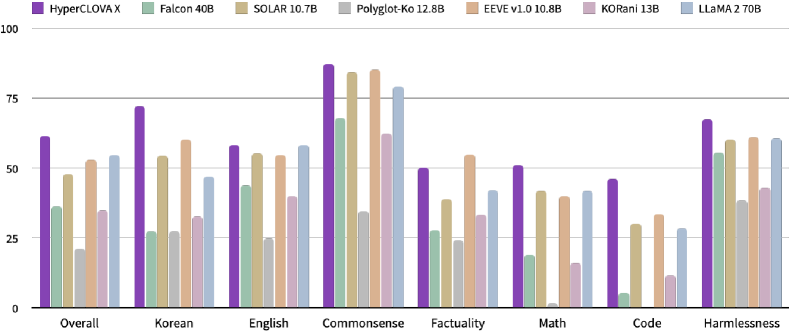
- HCX-L achieves leading performance on comprehensive Korean benchmarks compared to Korean-focused baselines.
- HCX-L attains English benchmark performance competitive with the largest LLaMA 2 model on English tasks.
- HCX models show strong cross-lingual transfer and superior Korean-English bilingual capabilities.
- Cross-lingual translation between Korean and languages like Japanese and Chinese reaches state-of-the-art levels in untargeted languages.
- Safety evaluations and red-teaming, combined with SFT/RLHF and reinforcement techniques, support responsible AI deployment in a sovereign context.
Read this paper
Open the full text in the Nubint reader and ask about any passage as you read.
Read this paper on NubintThis review was generated by AI from the original paper. Please check the paper before citing it.