
[Paper Review] HyperHuman: Hyper-Realistic Human Generation with Latent Structural Diffusion
HyperHuman proposes a unified latent diffusion framework that jointly denoises RGB, depth, and surface-normal maps to generate hyper-realistic, controllable human images. By leveraging a large-scale dataset (HumanVerse) and a structure-aware diffusion model with shared timesteps and spatially aligned branches, it achieves state-of-the-art realism, diversity, and structural coherence in text-to-image human generation.
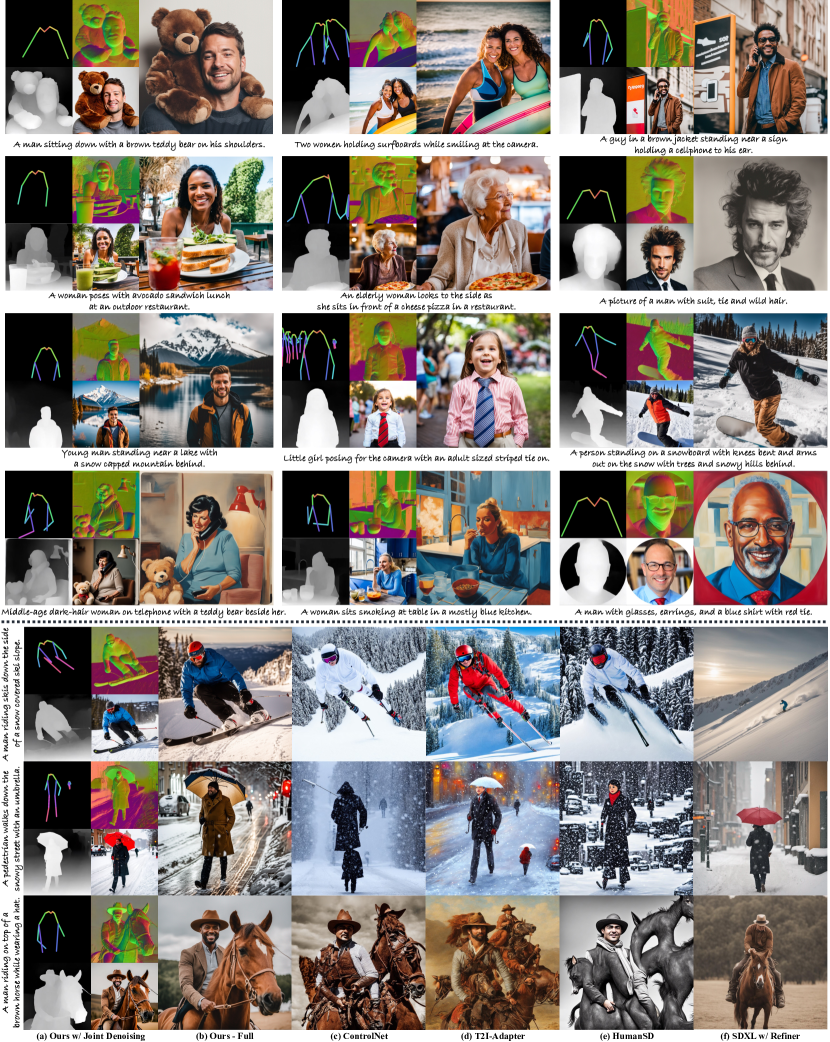
Despite significant advances in large-scale text-to-image models, achieving hyper-realistic human image generation remains a desirable yet unsolved task. Existing models like Stable Diffusion and DALL-E 2 tend to generate human images with incoherent parts or unnatural poses. To tackle these challenges, our key insight is that human image is inherently structural over multiple granularities, from the coarse-level body skeleton to fine-grained spatial geometry. Therefore, capturing such correlations between the explicit appearance and latent structure in one model is essential to generate coherent and natural human images. To this end, we propose a unified framework, HyperHuman, that generates in-the-wild human images of high realism and diverse layouts. Specifically, 1) we first build a large-scale human-centric dataset, named HumanVerse, which consists of 340M images with comprehensive annotations like human pose, depth, and surface normal. 2) Next, we propose a Latent Structural Diffusion Model that simultaneously denoises the depth and surface normal along with the synthesized RGB image. Our model enforces the joint learning of image appearance, spatial relationship, and geometry in a unified network, where each branch in the model complements to each other with both structural awareness and textural richness. 3) Finally, to further boost the visual quality, we propose a Structure-Guided Refiner to compose the predicted conditions for more detailed generation of higher resolution. Extensive experiments demonstrate that our framework yields the state-of-the-art performance, generating hyper-realistic human images under diverse scenarios. Project Page: https://snap-research.github.io/HyperHuman/
Motivation & Objective
- Address the challenge of generating hyper-realistic human images with coherent anatomy and natural poses, which current text-to-image models like Stable Diffusion and DALL·E 2 fail to achieve.
- Overcome limitations in existing controllable generation methods that treat pose, depth, and normal maps as isolated controls, leading to structural inconsistencies.
- Enable diverse, high-fidelity in-the-wild human image synthesis under diverse text and skeleton conditions, with improved realism and layout diversity.
- Develop a unified framework that jointly models image appearance, spatial relationships, and geometric structure through latent diffusion.
- Improve visual quality through a structure-guided refiner that enhances high-resolution generation using predicted structural conditions.
Proposed method
- Construct a large-scale human-centric dataset, HumanVerse, containing 340 million in-the-wild images with comprehensive annotations: human pose, depth, surface-normal, and image captions.
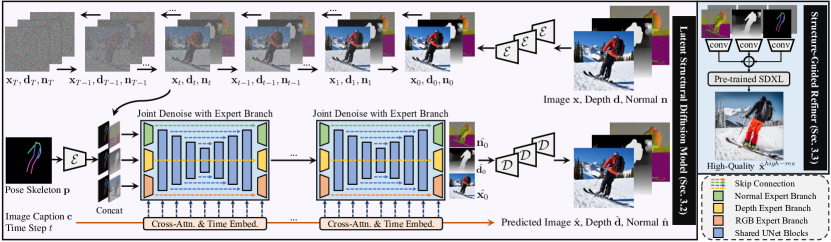
- Design a Latent Structural Diffusion Model that simultaneously denoises RGB, depth, and surface-normal maps in a unified network, using replicated U-Net blocks as structural expert branches.
- Ensure spatial alignment among modalities by sampling the same noise timestep for all branches and using channel-wise concatenation for cross-modality feature fusion.
- Apply an improved noise schedule with zero-terminal SNR to reduce low-frequency information leakage in monotonous structural maps (depth and normal).
- Introduce a Structure-Guided Refiner that composites predicted structural conditions to generate higher-resolution (1024×1024) images with enhanced detail.
- Train the model end-to-end using a multi-task loss combining L2 errors for depth and normal maps and standard diffusion objectives for RGB.
Experimental results
Research questions
- RQ1Can joint denoising of RGB, depth, and surface-normal maps in a unified diffusion framework significantly improve the realism and structural coherence of generated human images?
- RQ2How does modeling multi-granularity human structure—ranging from skeletal pose to fine geometric details—impact the quality and diversity of text-to-image generation?
- RQ3To what extent does using a shared noise schedule and spatially aligned branches improve feature fusion and consistency between appearance and structure?
- RQ4Can a structure-guided refiner effectively enhance high-resolution image generation by composing predicted structural conditions?
- RQ5How does the proposed method compare to existing T2I models and controllable generation baselines in terms of realism, diversity, and user preference?
Key findings
- HyperHuman achieves a Fréchet Inception Distance (FID) of 17.18 and CLIP-FID of 7.82 on COCO-Val Human, outperforming all baselines including SD 2.1, SDXL, and ControlNet.
- The ablation study shows that simultaneous denoising of RGB, depth, and normal maps with two DownBlock and UpBlock replicas yields the best performance (FID: 17.18, CLIP-FID: 7.82).
- Using different timesteps for each modality degrades performance significantly (FID: 29.36), confirming the importance of synchronized denoising for feature fusion.
- The model reduces depth and normal prediction errors (L2: 502.1 and 121.6) compared to ablation variants, indicating improved spatial alignment.
- User preference studies show that 89.24% of users prefer HyperHuman over SD 2.1, 98.06% over T2I-Adapter, and 99.08% over HumanSD, confirming superior realism and controllability.
- The framework successfully generates both photo-realistic and stylized images at 1024×1024 resolution, demonstrating scalability and robustness across diverse conditions.
Read this paper
Open the full text in the Nubint reader and ask about any passage as you read.
Read this paper on NubintThis review was generated by AI from the original paper. Please check the paper before citing it.