
[Paper Review] HyperINR: A Fast and Predictive Hypernetwork for Implicit Neural Representations via Knowledge Distillation
HyperINR introduces a fast, predictive hypernetwork that generates weights for compact implicit neural representations (INRs) using multiresolution hash encoders and knowledge distillation. By enabling sub-millisecond INR generation (up to 100× faster than prior methods), it achieves real-time, photo-realistic volume rendering and superior generalization for unseen parameters in scientific visualization tasks.
Implicit Neural Representations (INRs) have recently exhibited immense potential in the field of scientific visualization for both data generation and visualization tasks. However, these representations often consist of large multi-layer perceptrons (MLPs), necessitating millions of operations for a single forward pass, consequently hindering interactive visual exploration. While reducing the size of the MLPs and employing efficient parametric encoding schemes can alleviate this issue, it compromises generalizability for unseen parameters, rendering it unsuitable for tasks such as temporal super-resolution. In this paper, we introduce HyperINR, a novel hypernetwork architecture capable of directly predicting the weights for a compact INR. By harnessing an ensemble of multiresolution hash encoding units in unison, the resulting INR attains state-of-the-art inference performance (up to 100x higher inference bandwidth) and can support interactive photo-realistic volume visualization. Additionally, by incorporating knowledge distillation, exceptional data and visualization generation quality is achieved, making our method valuable for real-time parameter exploration. We validate the effectiveness of the HyperINR architecture through a comprehensive ablation study. We showcase the versatility of HyperINR across three distinct scientific domains: novel view synthesis, temporal super-resolution of volume data, and volume rendering with dynamic global shadows. By simultaneously achieving efficiency and generalizability, HyperINR paves the way for applying INR in a wider array of scientific visualization applications.
Motivation & Objective
- Address the high inference cost of large implicit neural representations (INRs) that hinder interactive visualization in scientific applications.
- Overcome the trade-off between model efficiency and generalization in parameterized INRs, especially for unseen simulation or visualization parameters.
- Enable real-time parameter exploration by drastically reducing INR generation latency while preserving high-quality data and visualization output.
- Achieve state-of-the-art performance in both inference speed and generalization through a novel hypernetwork architecture and knowledge distillation.
- Support diverse scientific visualization tasks such as novel view synthesis, temporal super-resolution, and dynamic shadow rendering with a unified, efficient framework.
Proposed method
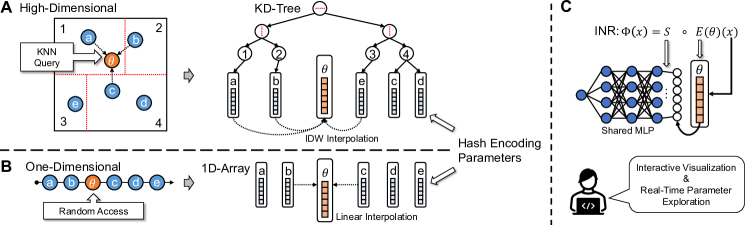
- Design a hypernetwork that predicts the weights of a shared, compact MLP-based INR using multiple small, multiresolution hash encoders as conditional inputs.
- Organize hash encoders in a spatial data structure to enable efficient nearest-neighbor search and interpolation based on input parameters.
- Implement a deeply embedded weight interpolation mechanism that combines interpolated encoder weights with the shared MLP weights to form a complete INR.
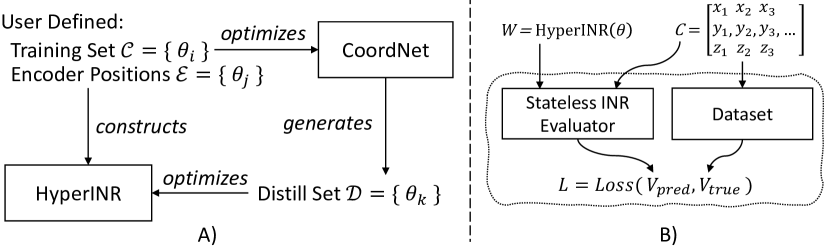
- Leverage knowledge distillation with CoordNet as the teacher model to transfer high-fidelity generalization capabilities to the smaller HyperINR.
- Use on-demand or pre-computed distillation sets to train HyperINR, optimizing for both performance and training efficiency.
- Integrate the resulting HyperINR with Wu et al.'s state-of-the-art INR rendering algorithm to enable interactive volumetric path tracing.
Experimental results
Research questions
- RQ1Can a hypernetwork architecture achieve both sub-millisecond INR generation and high generalization for unseen parameters in scientific visualization?
- RQ2How does knowledge distillation from a large teacher model (CoordNet) improve the generalization of a compact hypernetwork-based INR?
- RQ3To what extent does using multiple multiresolution hash encoders improve performance compared to a single large encoder?
- RQ4Can the proposed method support real-time, interactive volume rendering with complex effects like dynamic global shadows?
- RQ5What is the impact of distillation set size and on-demand generation on training efficiency and model performance?
Key findings
- HyperINR achieves up to 100× higher inference bandwidth than CoordNet, enabling INR generation in under 1 ms, which supports real-time interactive volume rendering.
- The method outperforms data interpolation in temporal super-resolution tasks, accurately predicting shadow movement and maintaining visual coherence where interpolation fails.
- Knowledge distillation significantly enhances generalization, allowing HyperINR to generate high-quality visualizations for unseen parameters, even in complex scenarios like dynamic shadows.
- The use of pre-computed distillation sets improved training speed by up to 8× on an NVIDIA A100, though GPU memory limits remain a bottleneck for large sets.
- Ablation studies confirm that multiresolution hash encoders provide better performance than single-encoder baselines, with performance gains diminishing in higher-dimensional parameter spaces.
- Rendering with HyperINR achieved a ~2× speedup by avoiding secondary rays, demonstrating efficiency gains in the rendering pipeline.
Read this paper
Open the full text in the Nubint reader and ask about any passage as you read.
Read this paper on NubintThis review was generated by AI from the original paper. Please check the paper before citing it.