
[Paper Review] HyperSINDy: Deep Generative Modeling of Nonlinear Stochastic Governing Equations
HyperSINDy introduces a variational inference-based deep generative model that discovers sparse, interpretable stochastic differential equations from high-dimensional data by using a variational encoder and hypernetwork to parameterize random ordinary differential equations with noise-driven coefficients. It enables accurate, scalable discovery of governing equations with uncertainty quantification, outperforming prior methods in high-dimensional stochastic systems.
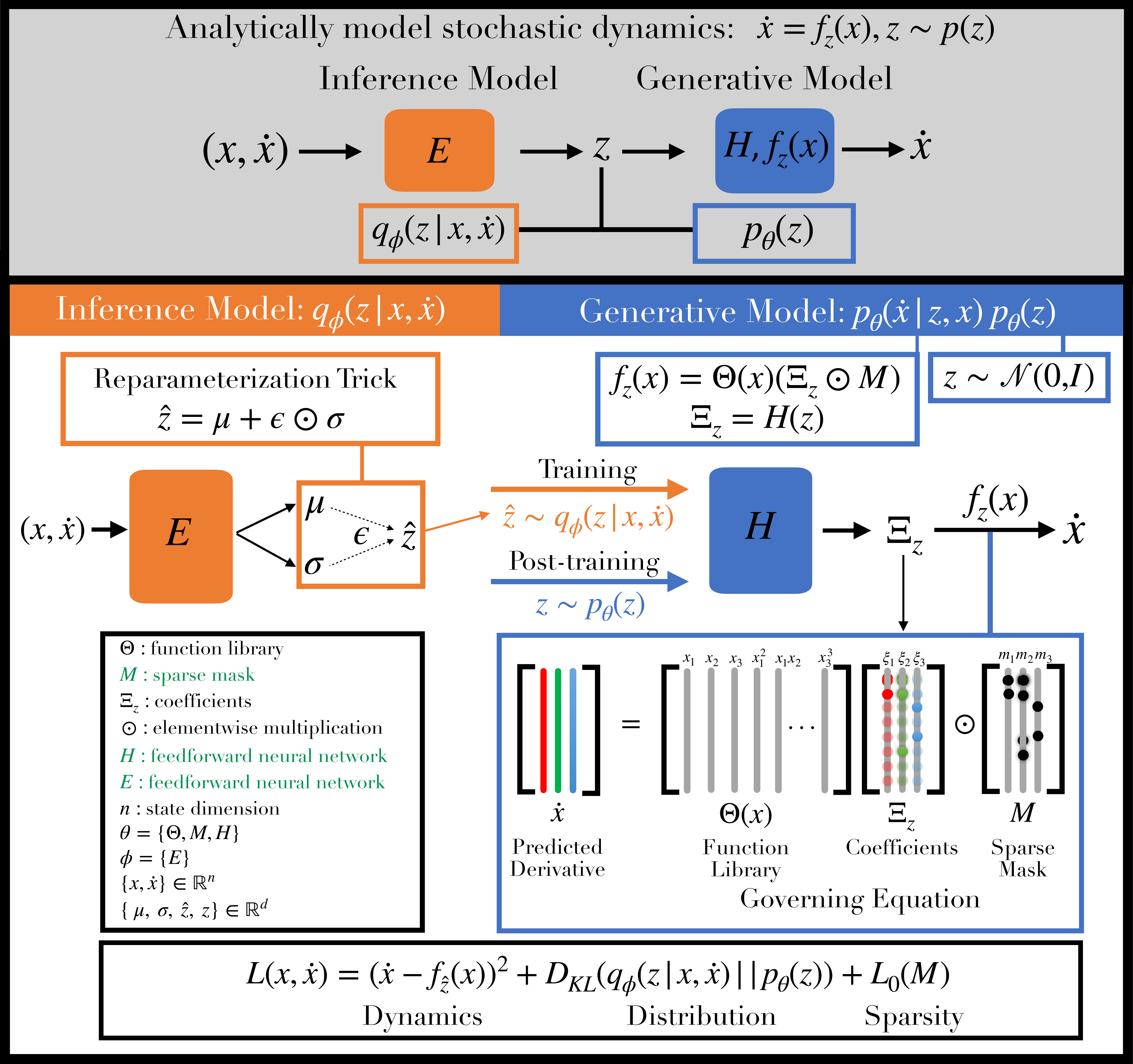
The discovery of governing differential equations from data is an open frontier in machine learning. The sparse identification of nonlinear dynamics (SINDy) \citep{brunton_discovering_2016} framework enables data-driven discovery of interpretable models in the form of sparse, deterministic governing laws. Recent works have sought to adapt this approach to the stochastic setting, though these adaptations are severely hampered by the curse of dimensionality. On the other hand, Bayesian-inspired deep learning methods have achieved widespread success in high-dimensional probabilistic modeling via computationally efficient approximate inference techniques, suggesting the use of these techniques for efficient stochastic equation discovery. Here, we introduce HyperSINDy, a framework for modeling stochastic dynamics via a deep generative model of sparse governing equations whose parametric form is discovered from data. HyperSINDy employs a variational encoder to approximate the distribution of observed states and derivatives. A hypernetwork \citep{ha_hypernetworks_2016} transforms samples from this distribution into the coefficients of a differential equation whose sparse form is learned simultaneously using a trainable binary mask \citep{louizos_learning_2018}. Once trained, HyperSINDy generates stochastic dynamics via a differential equation whose coefficients are driven by a Gaussian white noise. In experiments, HyperSINDy accurately recovers ground truth stochastic governing equations, with learned stochasticity scaling to match that of the data. Finally, HyperSINDy provides uncertainty quantification that scales to high-dimensional systems. Taken together, HyperSINDy offers a promising framework for model discovery and uncertainty quantification in real-world systems, integrating sparse equation discovery methods with advances in statistical machine learning and deep generative modeling.
Motivation & Objective
- To address the challenge of discovering interpretable, sparse stochastic differential equations from high-dimensional data, where traditional methods suffer from the curse of dimensionality.
- To integrate sparse identification of nonlinear dynamics (SINDy) with deep generative modeling and variational inference for scalable uncertainty quantification in stochastic systems.
- To enable the discovery of both functional form and coefficients of stochastic ODEs through a parameterized, noise-driven random ODE framework.
- To overcome computational bottlenecks in existing stochastic SINDy methods by leveraging amortized inference and hypernetworks for efficient, scalable learning.
- To provide a unified framework that generates physically interpretable models while accurately capturing stochastic behavior and variance scaling.
Proposed method
- A variational autoencoder (VAE) is used to infer a latent distribution over observed states and their time derivatives, enabling efficient posterior approximation.
- A hypernetwork maps latent samples into coefficients of a sparse ordinary differential equation (ODE), with the functional form of the ODE learned jointly via a trainable binary mask.
- The coefficients are parameterized as stochastic functions driven by Gaussian white noise, forming a random ODE (RDE) that models inherent system uncertainty.
- The model is trained end-to-end using stochastic gradient variational inference, minimizing a variational lower bound (ELBO) on the log-likelihood of observed trajectories.
- A differentiable ODE solver is used to generate trajectories from the learned RDE, enabling backpropagation through time for model optimization.
- The framework supports uncertainty quantification by sampling from the latent space and generating diverse, plausible stochastic dynamics.
Experimental results
Research questions
- RQ1Can a deep generative model effectively discover sparse, interpretable stochastic governing equations from high-dimensional data while maintaining computational tractability?
- RQ2How well can a variational inference-based approach with a hypernetwork capture the true drift and diffusion behavior of stochastic dynamical systems?
- RQ3Can the framework scale to high-dimensional stochastic systems (e.g., 10D Lorenz-96) where existing analytical SINDy methods fail?
- RQ4To what extent does the learned stochasticity in the coefficient parameters match the variance observed in real data?
- RQ5How does the model’s uncertainty quantification compare to ground truth when generating trajectories from the discovered random ODE?
Key findings
- HyperSINDy accurately recovers the ground truth drift and diffusion terms in a 2D stochastic Lotka-Volterra system, with Kramers-Moyal coefficient estimates closely matching the true system behavior.
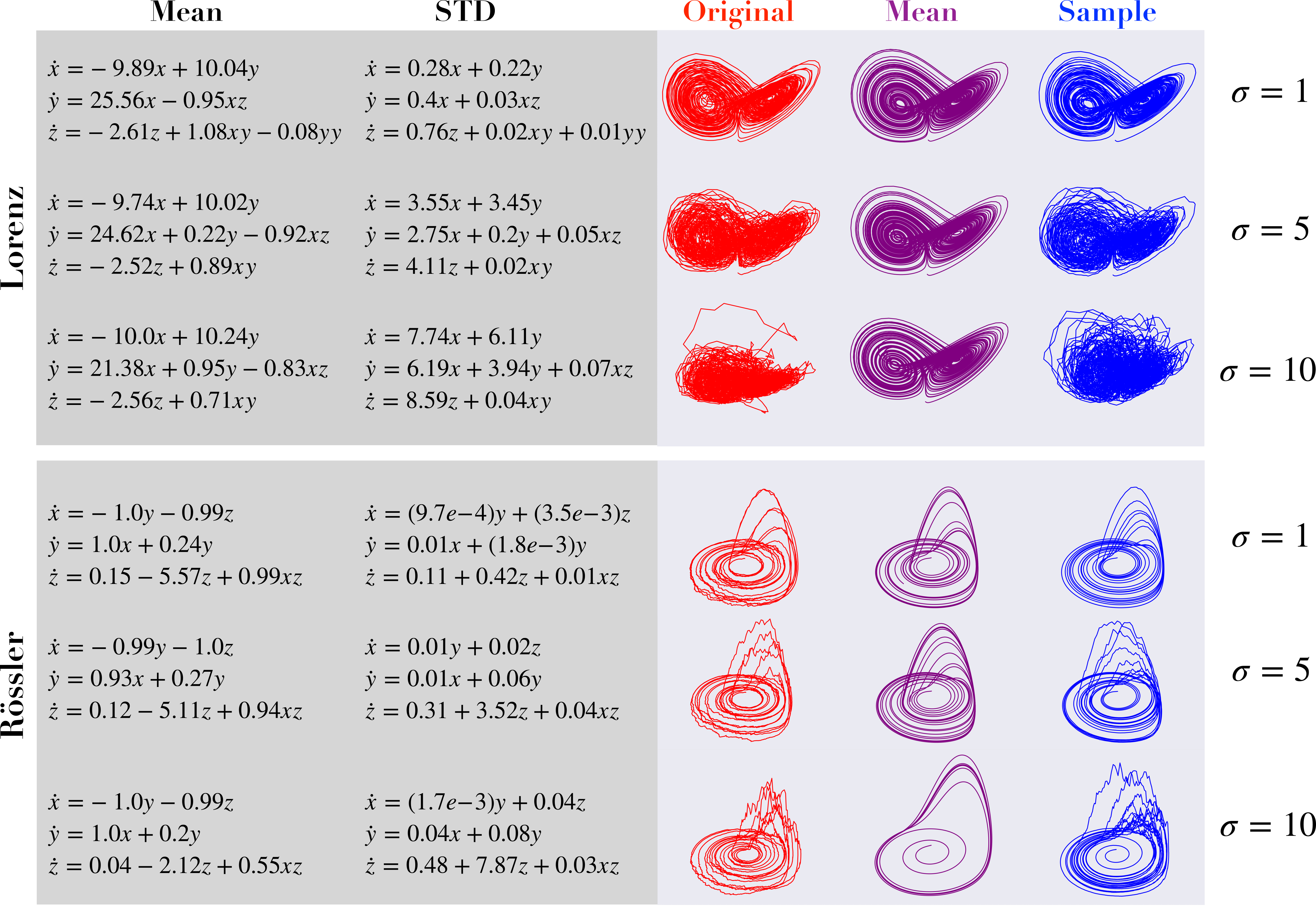
- The model successfully identifies all terms in a 10-dimensional stochastic Lorenz-96 system, including correctly learning high-variance coefficients for the stochastic forcing terms.
- Sample trajectories generated by HyperSINDy closely match the stochastic dynamical behavior of ground truth trajectories, even in high-dimensional settings.
- The learned stochasticity in the coefficient parameters scales proportionally to the observed data variance, demonstrating accurate uncertainty modeling.
- HyperSINDy outperforms the stochastic SINDy baseline in capturing state-dependent diffusion behavior, particularly in high-dimensional and complex systems.
- The framework enables scalable uncertainty quantification and model discovery in systems with more than two spatial dimensions, overcoming limitations of prior methods.
Read this paper
Open the full text in the Nubint reader and ask about any passage as you read.
Read this paper on NubintThis review was generated by AI from the original paper. Please check the paper before citing it.