
[Paper Review] HyPoradise: An Open Baseline for Generative Speech Recognition with Large Language Models
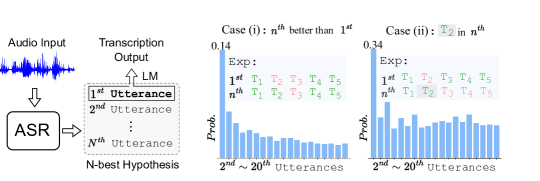
This paper introduces HyPoradise, the first open benchmark for generative speech recognition error correction using large language models (LLMs). It proposes a novel dataset with 334,000 N-best hypothesis–transcription pairs across diverse speech domains, enabling LLMs to generate corrected transcriptions directly instead of re-ranking. The method achieves significant WER reduction, surpassing traditional re-ranking bounds by leveraging LLMs to recover missing tokens and correct errors using contextual reasoning.
Advancements in deep neural networks have allowed automatic speech recognition (ASR) systems to attain human parity on several publicly available clean speech datasets. However, even state-of-the-art ASR systems experience performance degradation when confronted with adverse conditions, as a well-trained acoustic model is sensitive to variations in the speech domain, e.g., background noise. Intuitively, humans address this issue by relying on their linguistic knowledge: the meaning of ambiguous spoken terms is usually inferred from contextual cues thereby reducing the dependency on the auditory system. Inspired by this observation, we introduce the first open-source benchmark to utilize external large language models (LLMs) for ASR error correction, where N-best decoding hypotheses provide informative elements for true transcription prediction. This approach is a paradigm shift from the traditional language model rescoring strategy that can only select one candidate hypothesis as the output transcription. The proposed benchmark contains a novel dataset, HyPoradise (HP), encompassing more than 334,000 pairs of N-best hypotheses and corresponding accurate transcriptions across prevalent speech domains. Given this dataset, we examine three types of error correction techniques based on LLMs with varying amounts of labeled hypotheses-transcription pairs, which gains a significant word error rate (WER) reduction. Experimental evidence demonstrates the proposed technique achieves a breakthrough by surpassing the upper bound of traditional re-ranking based methods. More surprisingly, LLM with reasonable prompt and its generative capability can even correct those tokens that are missing in N-best list. We make our results publicly accessible for reproducible pipelines with released pre-trained models, thus providing a new evaluation paradigm for ASR error correction with LLMs.
Motivation & Objective
- To address the robustness gap in automatic speech recognition (ASR) under adverse conditions such as noise, accents, and speaking styles.
- To overcome the limitations of traditional language model rescoring, which discards N-best hypotheses after selecting the top candidate.
- To propose a new paradigm for ASR error correction by leveraging LLMs to generate corrected transcriptions from N-best hypotheses.
- To establish a reproducible, open-source benchmark with diverse, real-world speech domains to evaluate LLM-enhanced ASR systems.
- To enable zero-shot, few-shot, and fine-tuning settings for practical deployment in low-resource or domain-specific scenarios.
Proposed method
- The authors construct the HyPoradise (HP) dataset, comprising over 334,000 pairs of N-best hypotheses and ground-truth transcriptions from state-of-the-art ASR systems across noisy, accented, and contextually complex speech domains.
- The benchmark supports three settings: zero-shot (no labeled data), few-shot (a few in-domain pairs), and fine-tuning (sufficient training data), simulating real-world deployment constraints.
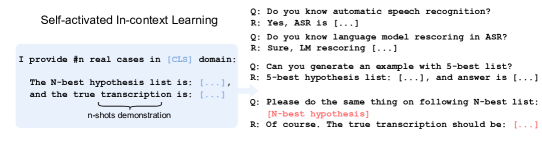
- LLMs are prompted to generate the correct transcription directly from the N-best hypotheses, using few-shot in-context learning or fine-tuning, rather than selecting from the list.
- The method leverages the generative capability of LLMs to recover missing or incorrect tokens not present in the N-best list, enabling correction beyond re-ranking.
- Evaluation is conducted using Word Error Rate (WER), with plans to extend to structured annotations like entity spans and dependency parsing for richer evaluation.
- The framework is publicly released with pre-trained models, code, and a HuggingFace dataset card to ensure reproducibility and community contribution.
Experimental results
Research questions
- RQ1Can LLMs generate more accurate transcriptions than traditional re-ranking by leveraging multiple N-best hypotheses?
- RQ2To what extent can LLMs recover tokens missing from the N-best list through contextual reasoning?
- RQ3How effective are zero-shot and few-shot LLM prompting strategies for ASR error correction in low-resource or domain-specific settings?
- RQ4Does the proposed generative correction approach surpass the performance upper bound of conventional rescoring methods?
- RQ5How robust is the LLM-based correction across diverse speech domains, including noise, accents, and out-of-vocabulary terms?
Key findings
- The proposed LLM-based generative correction method achieves a significant reduction in Word Error Rate (WER), outperforming traditional re-ranking techniques.
- The method surpasses the performance upper bound of conventional rescoring by recovering missing or incorrect tokens not present in the N-best list.
- In zero-shot and few-shot settings, LLMs with appropriate prompting achieve strong error correction performance, demonstrating generalization across domains.
- The model can correctly infer and generate correct words even when they are entirely absent from the N-best hypotheses, leveraging contextual and linguistic knowledge.
- The HyPoradise benchmark enables reproducible evaluation and has been actively maintained with updates to include noise-robust and multilingual ASR scenarios.
- The dataset and models are publicly available via GitHub and HuggingFace, supporting community extension and long-term maintenance.
Read this paper
Open the full text in the Nubint reader and ask about any passage as you read.
Read this paper on NubintThis review was generated by AI from the original paper. Please check the paper before citing it.