
[Paper Review] HYTREL: Hypergraph-enhanced Tabular Data Representation Learning
HyTrel treats tables as hypergraphs to capture row/column permutation invariances, high-order interactions, and hierarchical structure, enabling efficient pretraining and state-of-the-art performance on several tabular tasks with minimal pretraining.
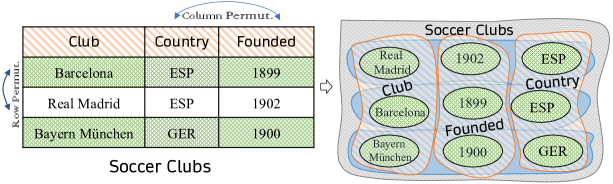
Language models pretrained on large collections of tabular data have demonstrated their effectiveness in several downstream tasks. However, many of these models do not take into account the row/column permutation invariances, hierarchical structure, etc. that exist in tabular data. To alleviate these limitations, we propose HYTREL, a tabular language model, that captures the permutation invariances and three more structural properties of tabular data by using hypergraphs - where the table cells make up the nodes and the cells occurring jointly together in each row, column, and the entire table are used to form three different types of hyperedges. We show that HYTREL is maximally invariant under certain conditions for tabular data, i.e., two tables obtain the same representations via HYTREL iff the two tables are identical up to permutations. Our empirical results demonstrate that HYTREL consistently outperforms other competitive baselines on four downstream tasks with minimal pretraining, illustrating the advantages of incorporating the inductive biases associated with tabular data into the representations. Finally, our qualitative analyses showcase that HYTREL can assimilate the table structures to generate robust representations for the cells, rows, columns, and the entire table.
Motivation & Objective
- Motivate robust tabular representations that respect intrinsic table invariances and hierarchy.
- Propose a hypergraph-based model to encode cells, rows, columns, and the entire table.
- Demonstrate that HyTrel achieves permutation-invariant representations and efficient pretraining.
- Evaluate HyTrel on multiple downstream tasks to establish performance gains over baselines.
Proposed method
- Represent each table as a hypergraph with cells as nodes and row/column/table as hyperedges.
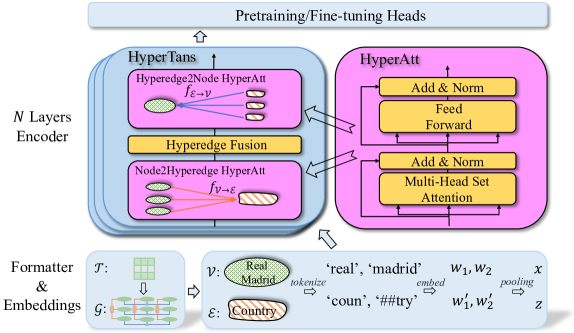
- Use an embedding layer for cells and for hyperedges initialized from captions, headers, and table content.
- Encode the hypergraph with stacked HyperTrans layers comprising HyperAtt (node-to-edge and edge-to-node) and Hyperedge Fusion blocks.
- Adopt a permutation-invariant set-attention mechanism within HyperAtt to preserve table invariances.
- Pretrain with ELECTRA and contrastive objectives on 27M tables from Wikipedia/Common Crawl, then fine-tune on downstream tasks.
- Provide theoretical grounding that HyTrel achieves maximal invariance under row/column permutations via incidence matrix representations.
Experimental results
Research questions
- RQ1Can HyTrel learn table representations that are invariant to independent row and column permutations?
- RQ2Does modeling tabular data as hypergraphs capture high-order interactions and hierarchical structure effectively?
- RQ3Do ELECTRA and contrastive pretraining objectives complement HyTrel across different tabular tasks?
- RQ4How does HyTrel compare to flattened-table TaLMs in permutational robustness and downstream performance?
Key findings
- HyTrel yields permutation-invariant representations, remaining stable under arbitrary row/column permutations.
- HyTrel captures hierarchical table structure and high-order interactions, improving task performance.
- With minimal pretraining, HyTrel approaches or matches state-of-the-art baselines and can outperform fully pretrained TaBERT in some settings.
- ELECTRA pretraining generally outperforms contrastive pretraining on CTA, CPA, and TTD, while contrastive helps TSP.
- HyTrel shows strong robustness and efficiency, performing well without extensive pretraining.
Read this paper
Open the full text in the Nubint reader and ask about any passage as you read.
Read this paper on NubintThis review was generated by AI from the original paper. Please check the paper before citing it.