
[Paper Review] Idempotent Generative Network
This paper introduces the Idempotent Generative Network (IGN), a novel generative model trained to be idempotent—meaning applying it multiple times yields no further change after the first application. By optimizing for $f(f(z)) = f(z)$, IGN projects inputs from any distribution (e.g., noise, corrupted images) onto the target data manifold (e.g., real images) in one step, enabling consistent latent space manipulation and zero-shot image-to-image translation with a single model.
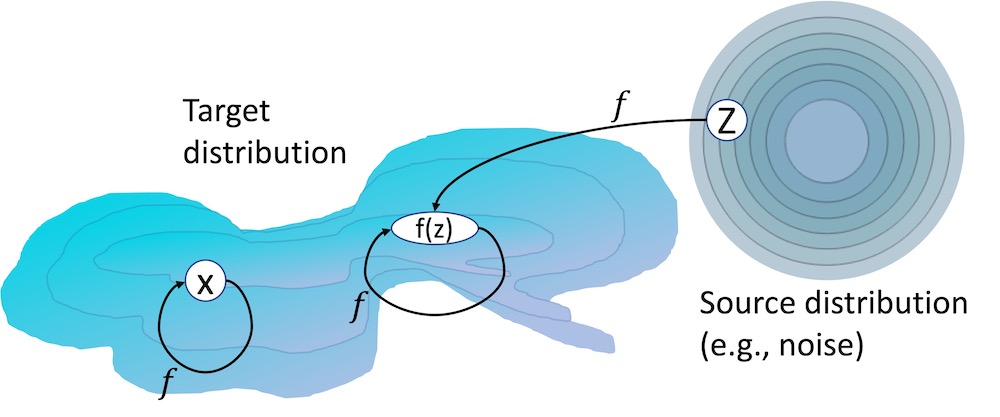
We propose a new approach for generative modeling based on training a neural network to be idempotent. An idempotent operator is one that can be applied sequentially without changing the result beyond the initial application, namely $f(f(z))=f(z)$. The proposed model $f$ is trained to map a source distribution (e.g, Gaussian noise) to a target distribution (e.g. realistic images) using the following objectives: (1) Instances from the target distribution should map to themselves, namely $f(x)=x$. We define the target manifold as the set of all instances that $f$ maps to themselves. (2) Instances that form the source distribution should map onto the defined target manifold. This is achieved by optimizing the idempotence term, $f(f(z))=f(z)$ which encourages the range of $f(z)$ to be on the target manifold. Under ideal assumptions such a process provably converges to the target distribution. This strategy results in a model capable of generating an output in one step, maintaining a consistent latent space, while also allowing sequential applications for refinement. Additionally, we find that by processing inputs from both target and source distributions, the model adeptly projects corrupted or modified data back to the target manifold. This work is a first step towards a ``global projector'' that enables projecting any input into a target data distribution.
Motivation & Objective
- To develop a unified generative model capable of projecting diverse inputs—such as noise, sketches, or corrupted images—onto a target data manifold (e.g., real images) in a single step.
- To address the limitation of existing models that require specific input types (e.g., latent noise in GANs or noised images in diffusion models) by enabling a single model to handle arbitrary inputs.
- To achieve consistent latent space properties and support both one-step generation and sequential refinement, combining advantages of GANs and diffusion models.
- To explore a new paradigm in generative modeling based on idempotence, where the model acts as a global projector to the data manifold.
- To enable zero-shot image-to-image translation without requiring inversion or conditional conditioning, by training the model to map any input to the target distribution via idempotent projection.
Proposed method
- Train a neural network $f$ to be idempotent, satisfying $f(f(z)) = f(z)$, so that repeated applications do not alter the output beyond the first application.
- Define the target manifold as the set of all inputs $x$ for which $f(x) = x$, ensuring real data samples are invariant under the model’s transformation.
- Optimize $f$ to map source distribution samples $z \sim \mathcal{P}_z$ onto this target manifold using the idempotence loss $\mathcal{L}_{\text{idem}} = \|f(f(z)) - f(z)\|^2$.
- Introduce a tightness loss $\mathcal{L}_{\text{tight}}$ to prevent trivial solutions by ensuring $f(f(z)) \neq f(z)$ for non-target inputs, balancing the idempotence objective.
- Use a self-adversarial training scheme where $f$ acts as both generator and discriminator, with a discriminator $\delta$ measuring the distance $D(f(y), y)$ to guide $f$ toward low-energy, stable projections.
- Leverage a residual U-Net architecture for $f$, trained with a combination of idempotence, reconstruction, and tightness losses, enabling high-fidelity image generation and refinement.
Experimental results
Research questions
- RQ1Can a single generative model be trained to project arbitrary inputs (e.g., noise, corrupted images) onto a target data manifold in one step using idempotence?
- RQ2Does enforcing idempotence $f(f(z)) = f(z)$ lead to stable, consistent, and high-quality generation without requiring iterative refinement or conditional conditioning?
- RQ3Can the model maintain a consistent latent space while allowing sequential applications for refinement, similar to diffusion models, but with one-step generation like GANs?
- RQ4To what extent can the model generalize to zero-shot image-to-image translation tasks without requiring inversion or fine-tuning?
- RQ5How does the self-adversarial training scheme—where the model acts as both generator and discriminator—enable stable optimization without mode collapse?
Key findings
- The model achieves one-step generation of high-fidelity images from any input distribution, including noise and corrupted images, by projecting them onto the target data manifold via idempotence.
- The idempotent training objective $f(f(z)) = f(z)$ ensures that once a sample is projected onto the target manifold, further applications do not alter it, enabling stable and consistent inference.
- The model maintains a consistent latent space, allowing for easy interpolation and manipulation, unlike diffusion models that rely on iterative denoising paths.
- The self-adversarial training scheme, where $f$ acts as both generator and discriminator, enables effective optimization without alternating training steps, simplifying the training process.
- The model successfully performs zero-shot image-to-image translation, projecting degraded or modified inputs (e.g., sketches, low-quality images) back to the real image manifold without requiring inversion or conditional supervision.
- Despite suffering from blurriness common in autoencoders, repeated applications of the model can refine artifacts and improve perceptual quality, suggesting potential for iterative refinement in high-fidelity generation.
![Figure 2: Two distinct pathways to enforce Idempotence: By updating $f$ so it maps $f(z)$ into the $\{f(y)=y\}$ area (updating through first instatiation, ${\color[rgb]{1,0,0}\Delta f}$ ) or by expanding the $\{f(y)=y\}$ area so that for a given $y=f(z)$ , we get $f(y)=y$ (updating through second in](https://ar5iv.labs.arxiv.org/html/2311.01462/assets/figs/tight.jpg)
Better researchstarts right now
From reading papers to final review, dramatically reduce your research time.
No credit card · Free plan available
This review was created by AI and reviewed by human editors.