
[Paper Review] Identification of core-periphery structure in networks
This paper proposes a statistically principled algorithm for identifying core-periphery structure in networks using maximum-likelihood fitting of a stochastic block model via expectation-maximization and belief propagation. The method successfully detects core-periphery structure in real and synthetic networks, with no detectability threshold—making it effective even for very weak structural signals.
Many networks can be usefully decomposed into a dense core plus an outlying, loosely-connected periphery. Here we propose an algorithm for performing such a decomposition on empirical network data using methods of statistical inference. Our method fits a generative model of core-periphery structure to observed data using a combination of an expectation--maximization algorithm for calculating the parameters of the model and a belief propagation algorithm for calculating the decomposition itself. We find the method to be efficient, scaling easily to networks with a million or more nodes and we test it on a range of networks, including real-world examples as well as computer-generated benchmarks, for which it successfully identifies known core-periphery structure with low error rate. We also demonstrate that the method is immune from the detectability transition observed in the related community detection problem, which prevents the detection of community structure when that structure is too weak. There is no such transition for core-periphery structure, which is detectable, albeit with some statistical error, no matter how weak it is.
Motivation & Objective
- To develop a first-principles method for detecting core-periphery structure in undirected networks using statistical inference.
- To overcome limitations of existing heuristic methods by employing a generative model and maximum-likelihood estimation.
- To demonstrate robustness and scalability on large networks, including real-world examples like the Internet and political blog networks.
- To show that core-periphery structure is detectable regardless of signal strength, unlike community detection which faces a detectability threshold.
- To provide a scalable, efficient algorithm suitable for networks with up to a million nodes.
Proposed method
- Uses a stochastic block model tailored for core-periphery structure, with distinct connection probabilities between core-core, core-periphery, and periphery-periphery node pairs.
- Applies an expectation-maximization (EM) algorithm to estimate model parameters from observed network data.
- Employs belief propagation to compute the most likely core-periphery assignment for each node given the estimated parameters.
- Implements a linearized belief propagation approximation to improve computational efficiency and scalability.
- Combines EM and belief propagation in an iterative inference framework to jointly optimize model parameters and node assignments.
- Uses a generative model approach that treats the network as a random process, enabling principled statistical inference.
Experimental results
Research questions
- RQ1Can core-periphery structure be reliably detected in networks with weak or subtle structural signals?
- RQ2How does the performance of the proposed method compare to existing heuristic approaches on real and synthetic networks?
- RQ3Does the method scale efficiently to large networks with over a million nodes?
- RQ4Is there a detectability threshold for core-periphery structure, analogous to the one in community detection?
- RQ5To what extent does the algorithm distinguish core nodes based on structural role rather than just degree?
Key findings
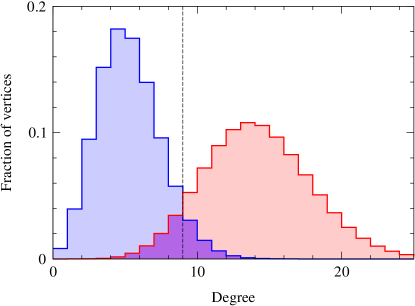
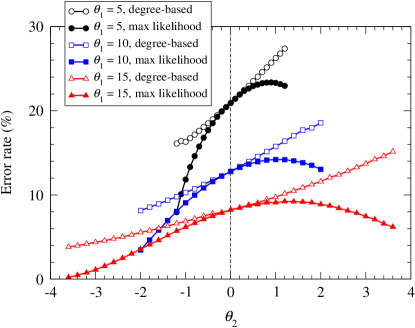
- The algorithm successfully identifies known core-periphery structure in benchmark networks with low error rates.
- It scales efficiently to networks with over a million nodes, demonstrating practical applicability to large-scale systems.
- The method detects core-periphery structure even when the signal is extremely weak, with no detectability threshold—unlike community detection.
- In the Internet AS network, the algorithm correctly identifies a small set of backbone nodes as core, while placing most edge nodes in the periphery, even when some high-degree nodes are peripheral due to network position.
- In the political blog network, the algorithm identifies distinct cores within both conservative and liberal communities, corresponding to prominent, influential blogs such as Daily Kos and National Review.
- The belief propagation approximation enables fast inference, and the linearized version maintains accuracy while improving computational speed.
Read this paper
Open the full text in the Nubint reader and ask about any passage as you read.
Read this paper on NubintThis review was generated by AI from the original paper. Please check the paper before citing it.