
[Paper Review] Identifying Misinformation Spreaders: A Graph-Based Semi-Supervised Learning Approach
This paper proposes a graph-based semi-supervised learning approach using Graph Neural Networks (GNNs) to identify misinformation spreaders in online social networks, focusing on the MediaEval 2022 FakeNews challenge. It evaluates GCN, GraphSAGE, and DGCNN models, with DGCNN achieving the highest accuracy (69.85%) and AUC (73.07%) by transforming node classification into graph classification via 3-hop ego-network subgraphs.
In this paper we proposed a Graph-Based conspiracy source detection method for the MediaEval task 2022 FakeNews: Corona Virus and Conspiracies Multimedia Analysis Task. The goal of this study was to apply SOTA graph neural network methods to the problem of misinformation spreading in online social networks. We explore three different Graph Neural Network models: GCN, GraphSAGE and DGCNN. Experimental results demonstrate that DGCNN outperforms in terms of accuracy.
Motivation & Objective
- To address the challenge of detecting misinformation spreaders in online social networks, where fake news spreads rapidly and is hard to verify.
- To explore the effectiveness of graph neural networks in modeling the propagation patterns of misinformation versus real news.
- To compare the performance of GCN, GraphSAGE, and DGCNN in classifying users as misinformation spreaders or regular users.
- To improve detection accuracy by transforming node-level classification into graph-level classification using ego-network subgraphs.
- To provide a scalable, inductive solution for identifying malicious actors in social media networks using limited labeled data.
Proposed method
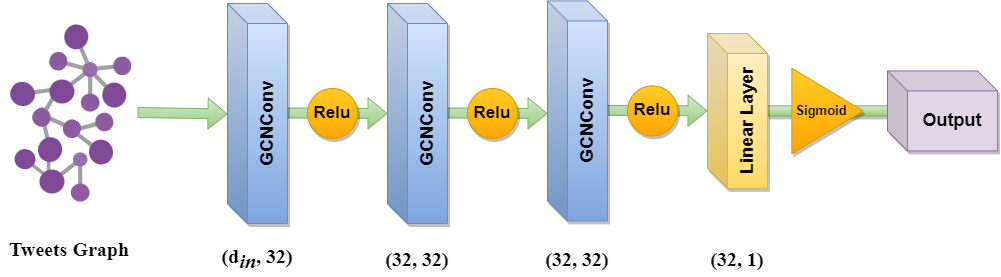
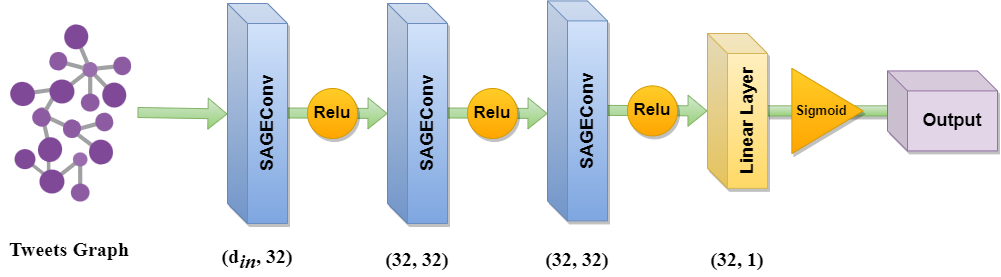
- Constructs 3-hop ego-network subgraphs around each labeled node to convert node classification into graph classification.
- Employs GCN, GraphSAGE, and DGCNN models to learn node and graph-level representations using message passing and neighborhood aggregation.
- Uses Binary Cross Entropy loss and Adam optimizer with a base learning rate of 1e-5 and dropout rate of 0.5 for training.
- Applies 1D-MaxPooling between 1D-Conv layers in DGCNN to aggregate node embeddings into graph-level representations.
- Leverages semi-supervised learning to exploit both labeled and unlabeled nodes in the social network graph.
- Uses feature aggregation from local neighborhoods to generate inductive node embeddings, particularly in GraphSAGE and DGCNN.
Experimental results
Research questions
- RQ1How do different GNN architectures (GCN, GraphSAGE, DGCNN) perform in identifying misinformation spreaders in social networks?
- RQ2Can transforming node classification into graph classification via ego-network subgraphs improve detection performance?
- RQ3What is the impact of inductive learning (as in GraphSAGE and DGCNN) versus transductive learning (as in GCN) on misinformation detection?
- RQ4How effective is DGCNN in capturing graph-level structural patterns for classifying misinformation spreaders compared to other models?
- RQ5To what extent can semi-supervised graph learning improve performance when only a small fraction of users are labeled?
Key findings
- DGCNN achieved the highest accuracy of 69.85%, significantly outperforming GCN (60.54%) and GraphSAGE (65.79%).
- DGCNN recorded the best Matthews correlation coefficient (MCC) of 36.24, indicating strong correlation between predicted and actual labels.
- The Area Under the ROC Curve (AUC) for DGCNN reached 73.07%, the highest among all models, showing superior discrimination ability.
- GraphSAGE showed better performance than GCN, with a 5.25% improvement in accuracy and a 12.35% improvement in MCC.
- The use of 3-hop ego-network subgraphs enabled effective graph-level representation learning, enhancing model generalization.
- Despite the strong performance of DGCNN, the overall accuracy remains moderate due to class distribution imbalance between misinformation spreaders and regular users.
Read this paper
Open the full text in the Nubint reader and ask about any passage as you read.
Read this paper on NubintThis review was generated by AI from the original paper. Please check the paper before citing it.