
[Paper Review] Identifying visible tissue in intraoperative ultrasound: a method and application
This paper proposes a topological method for identifying visible tissue in intraoperative ultrasound during brain surgery by detecting acoustic shadows and generating confidence maps of perceptual salience. Using iterative Gaussian filtering, 2D point cloud construction, and Vietoris-Rips complex topology, the approach achieves 87% binary classification accuracy for acoustic shadow detection and an RMSE of 0.174 in confidence map alignment with probe perpendicularity, enabling improved guidance for robotic and clinical ultrasound use.
Purpose: Intraoperative ultrasound scanning is a demanding visuotactile task. It requires operators to simultaneously localise the ultrasound perspective and manually perform slight adjustments to the pose of the probe, making sure not to apply excessive force or breaking contact with the tissue, whilst also characterising the visible tissue. Method: To analyse the probe-tissue contact, an iterative filtering and topological method is proposed to identify the underlying visible tissue, which can be used to detect acoustic shadow and construct confidence maps of perceptual salience. Results: For evaluation, datasets containing both in vivo and medical phantom data are created. A suite of evaluations is performed, including an evaluation of acoustic shadow classification. Compared to an ablation, deep learning, and statistical method, the proposed approach achieves superior classification on in vivo data, achieving an F_beta score of 0.864, in comparison to 0.838, 0.808, 0.808. A novel framework for evaluating the confidence estimation of probe tissue contact is created. The phantom data is captured specifically for this, and comparison is made against two established methods. The proposed method produced the superior response, achieving an average normalised root mean square error of 0.168, in comparison to 1.836 and 4.542. Evaluation is also extended to determine the algorithm's robustness to parameter perturbation, speckle noise, data distribution shift, and capability for guiding a robotic scan. Conclusion: The results of this comprehensive set of experiments justify the potential clinical value of the proposed algorithm, which can be used to support clinical training and robotic ultrasound automation.
Motivation & Objective
- To address the challenge of inconsistent tissue visualization in intraoperative ultrasound due to probe-tissue contact and angle issues.
- To develop a method that automatically identifies visible tissue and perceptual salience in real-time during neurosurgical US scanning.
- To create a robust, non-data-driven framework for acoustic shadow detection that supports both clinical training and robot-assisted scanning.
- To produce confidence maps that reflect probe perpendicularity and tissue contact quality, enabling feedback for optimal imaging.
Proposed method
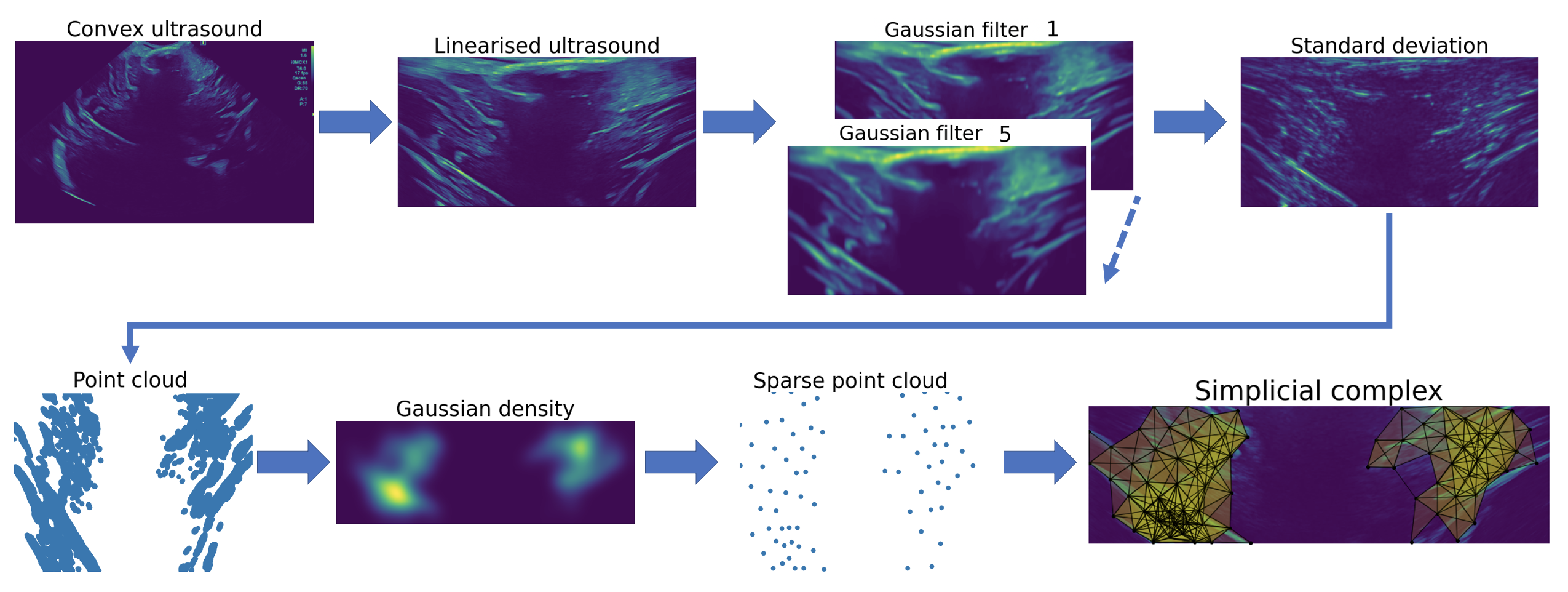
- Applying iterative Gaussian filters to enhance high-resolution features in ultrasound images.
- Constructing a 2D point cloud from filtered image data and applying density weighting to sparsify the representation.
- Building a 2D Vietoris-Rips complex to model the topological structure of tissue boundaries and acoustic shadows.
- Using geometric constraints and triangulation (with parameter ε) to detect scan lines affected by acoustic shadowing.
- Generating confidence maps that reflect perceptual salience by modeling expected confidence behavior as a normal distribution during probe tilting.
- Validating the system using in vivo and phantom data with quantitative metrics including RMSE and classification accuracy.
Experimental results
Research questions
- RQ1Can a topological approach detect acoustic shadows in intraoperative ultrasound images with higher accuracy than existing methods?
- RQ2How well can the generated confidence maps reflect the true probe-tissue contact quality and perpendicularity?
- RQ3Does the method remain robust under parameter perturbations common in clinical ultrasound settings?
- RQ4Can the framework support real-time feedback for robotic ultrasound systems or clinical training?
- RQ5How does the method perform on unseen data, particularly in the absence of large annotated datasets?
Key findings
- The method achieved a binary classification accuracy of 0.87 for acoustic shadow detection on unseen data, outperforming baseline methods.
- The confidence map generation achieved an average RMSE of 0.174 across five probe tilting sequences, closely matching the expected normal distribution of perceptual salience.
- The algorithm demonstrated high robustness to individual parameter perturbations, with all performance metrics (ACC, TNR, TPR, PPV) remaining above 0.8 under variation.
- The confidence maps produced by the method showed intuitive behavior, starting near 0 and peaking near 1 at optimal probe angles, indicating strong perceptual alignment.
- The method is less dependent on large annotated datasets, making it suitable for clinical applications where data collection is difficult and expertise-intensive.
- The framework shows strong potential for integration into robotic ultrasound systems and for training neurosurgeons in probe handling and tissue visualization.
Read this paper
Open the full text in the Nubint reader and ask about any passage as you read.
Read this paper on NubintThis review was generated by AI from the original paper. Please check the paper before citing it.