
[Paper Review] iFormer: Integrating ConvNet and Transformer for Mobile Application
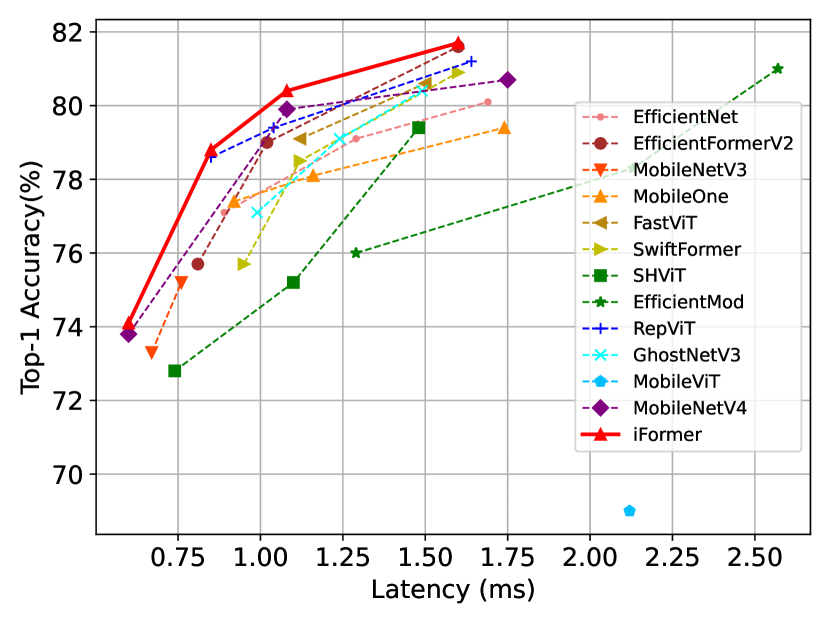
iFormer is a mobile-friendly hybrid vision network that merges fast convolutional blocks with an efficient single-head modulation self-attention mechanism to achieve state-of-the-art latency–accuracy trade-offs on mobile Vision tasks, including 80.4% Top-1 on ImageNet-1K at 1.10 ms on iPhone 13.
We present a new family of mobile hybrid vision networks, called iFormer, with a focus on optimizing latency and accuracy on mobile applications. iFormer effectively integrates the fast local representation capacity of convolution with the efficient global modeling ability of self-attention. The local interactions are derived from transforming a standard convolutional network, extit{i.e.}, ConvNeXt, to design a more lightweight mobile network. Our newly introduced mobile modulation attention removes memory-intensive operations in MHA and employs an efficient modulation mechanism to boost dynamic global representational capacity. We conduct comprehensive experiments demonstrating that iFormer outperforms existing lightweight networks across various tasks. Notably, iFormer achieves an impressive Top-1 accuracy of 80.4\% on ImageNet-1k with a latency of only 1.10 ms on an iPhone 13, surpassing the recently proposed MobileNetV4 under similar latency constraints. Additionally, our method shows significant improvements in downstream tasks, including COCO object detection, instance segmentation, and ADE20k semantic segmentation, while still maintaining low latency on mobile devices for high-resolution inputs in these scenarios.
Motivation & Objective
- Motivate and design lightweight mobile vision networks that balance latency and accuracy.
- Integrate fast local convolutional representations with efficient global attention.
- Develop a memory-efficient attention variant suitable for on-device inference.
- Evaluate the architecture across image classification, object detection, instance segmentation, and semantic segmentation.
Proposed method
- Start from a ConvNeXt-based lightweight backbone to capture local representations.
- Introduce a single-head modulation self-attention (SHMA) to model global context with reduced memory costs.
- Fuse outputs from a convolutional branch and the SHMA branch to enable dynamic information exchange.
- Use conditional positional encodings (CPE) to inject dynamic positional information.
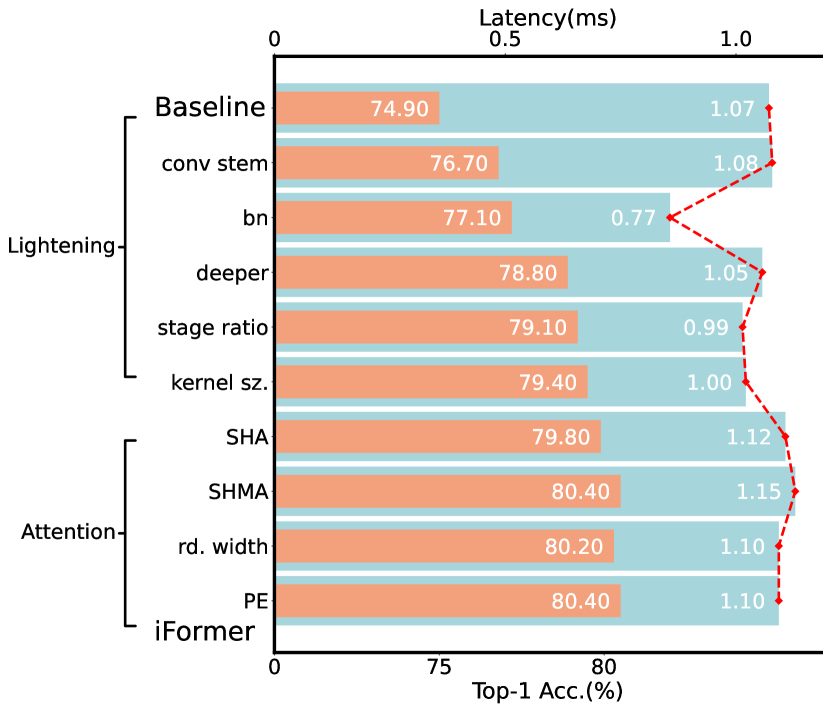
- Experiment with wider/narrower blocks, kernel sizes, and activation/normalization choices to optimize latency on mobile hardware.
Experimental results
Research questions
- RQ1How can we achieve state-of-the-art latency-accuracy trade-offs for mobile vision tasks by integrating CNNs and transformers?
- RQ2Does a single-head modulation attention mechanism provide competitive global modeling with lower memory and latency costs on mobile devices?
- RQ3What architectural and training choices maximize on-device performance without distillation or reparameterization?
Key findings
- iFormer achieves 80.4% Top-1 accuracy on ImageNet-1K with 1.10 ms latency on an iPhone 13 (no distillation or reparameterization).
- Single-head modulation attention (SHMA) reduces memory access and maintains competitive accuracy compared with multi-head attention baselines (SHA baseline 1.25x faster than MHA).
- iFormer-L surpasses several lightweight baselines in downstream tasks such as object detection (MS COCO) and semantic segmentation (ADE20K) with lower mobile latency for high-resolution inputs.
- Modulation attention with conditional positional encodings yields the bestPareto-optimal accuracy-latency trade-off among tested variants.
- The architecture achieves strong results across image classification, object detection, instance segmentation, and semantic segmentation on mobile hardware.
Read this paper
Open the full text in the Nubint reader and ask about any passage as you read.
Read this paper on NubintThis review was generated by AI from the original paper. Please check the paper before citing it.