
[Paper Review] iGibson 1.0: a Simulation Environment for Interactive Tasks in Large Realistic Scenes
iGibson 1.0 is a physics-based simulation environment with 15 interactive home-sized scenes (108 rooms) offering high-quality virtual sensors, domain randomization, motion planning, and a human interface to study navigation and manipulation in large realistic environments, enabling robust sensorimotor learning and imitation learning.
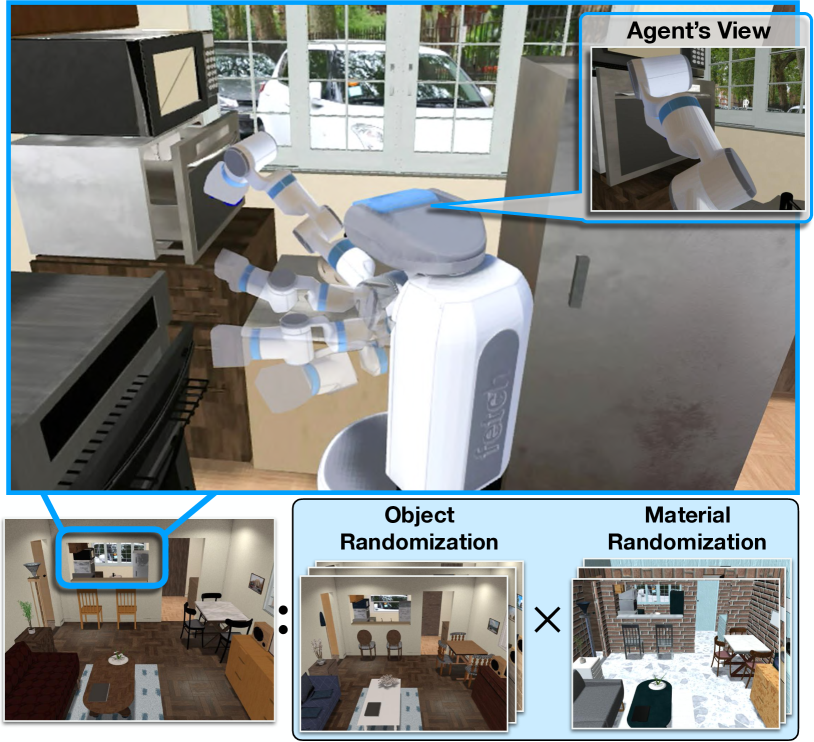
We present iGibson 1.0, a novel simulation environment to develop robotic solutions for interactive tasks in large-scale realistic scenes. Our environment contains 15 fully interactive home-sized scenes with 108 rooms populated with rigid and articulated objects. The scenes are replicas of real-world homes, with distribution and the layout of objects aligned to those of the real world. iGibson 1.0 integrates several key features to facilitate the study of interactive tasks: i) generation of high-quality virtual sensor signals (RGB, depth, segmentation, LiDAR, flow and so on), ii) domain randomization to change the materials of the objects (both visual and physical) and/or their shapes, iii) integrated sampling-based motion planners to generate collision-free trajectories for robot bases and arms, and iv) intuitive human-iGibson interface that enables efficient collection of human demonstrations. Through experiments, we show that the full interactivity of the scenes enables agents to learn useful visual representations that accelerate the training of downstream manipulation tasks. We also show that iGibson 1.0 features enable the generalization of navigation agents, and that the human-iGibson interface and integrated motion planners facilitate efficient imitation learning of human demonstrated (mobile) manipulation behaviors. iGibson 1.0 is open-source, equipped with comprehensive examples and documentation. For more information, visit our project website: http://svl.stanford.edu/igibson/
Motivation & Objective
- Develop an embodied agent framework for interactive tasks in large, realistic indoor scenes.
- Provide high-quality virtual sensor signals (RGB, depth, LiDAR, flow, normals, segmentation) for robust perception learning.
- Enable domain randomization over materials, shapes, and object instances to improve generalization.
- Integrate sampling-based motion planners for collision-free navigation and manipulation.
- Offer a human-iGibson interface to efficiently collect demonstrations for imitation learning.
Proposed method
- Present fifteen fully interactive scenes (108 rooms) modeled after real homes with articulated objects and material/dynamics annotations.
- Provide a physics-based renderer with PBR materials and rendering that uses scene/material maps for realism.
- Support domain randomization over object instances and material properties to broaden training distributions.
- Incorporate LiDAR and other virtual sensors (RGB, depth, normals, flow, segmentation) for rich perception signals.
- Integrate open-source motion planners (RRT, BiRRT, lazyPRM) with acceleration-bounded shortcuts for smoother trajectories.
- Offer a human-iGibson interface (mouse/keyboard) to collect demonstrations and assist with planner-assisted tasks.
Experimental results
Research questions
- RQ1How does domain randomization and realistic sensor signals affect generalization of navigation policies to unseen scenes?
- RQ2Can policies trained with iGibson generalize when using LiDAR, RGB, or depth inputs in new environments?
- RQ3Do human demonstrations collected via the iGibson interface support effective imitation learning for manipulation and mobile manipulation?
- RQ4Does training with fully interactive scenes enable learning visual representations that accelerate downstream manipulation tasks?
Key findings
- Policies trained with domain randomization show improved generalization in depth-based PointGoal navigation (SPL 0.27 to 0.40; 31.25% to 44.75% success).
- RGB-based object navigation improves from 49.75% to 57.5% success with material randomization.
- LiDAR-based PointGoal navigation transfers with 33% success in iGibson Rs_int and 24% in a real-world apartment (0 adaptation).
- Imitation learning using the human-iGibson interface achieves 98% success on pick-and-place tasks in simulation.
- Mobile manipulation imitation learning achieves 70% success on evaluation episodes.
- Pretraining with interaction-based representations accelerates downstream manipulation task learning (PushDrawer/PushCabinet) via improved sample efficiency.
Read this paper
Open the full text in the Nubint reader and ask about any passage as you read.
Read this paper on NubintThis review was generated by AI from the original paper. Please check the paper before citing it.