
[Paper Review] Image sensing with multilayer, nonlinear optical neural networks
This paper presents a multilayer, nonlinear optical neural network (ONN) pre-processor for image sensing that uses a commercial image intensifier as a parallel, optoelectronic, optical-to-optical nonlinear activation function. It achieves up to 800:1 compression ratios while maintaining high accuracy in tasks like object identification and cell-organelle classification, outperforming linear ONN encoders due to depth and nonlinearity.
Optical imaging is commonly used for both scientific and technological applications across industry and academia. In image sensing, a measurement, such as of an object's position, is performed by computational analysis of a digitized image. An emerging image-sensing paradigm breaks this delineation between data collection and analysis by designing optical components to perform not imaging, but encoding. By optically encoding images into a compressed, low-dimensional latent space suitable for efficient post-analysis, these image sensors can operate with fewer pixels and fewer photons, allowing higher-throughput, lower-latency operation. Optical neural networks (ONNs) offer a platform for processing data in the analog, optical domain. ONN-based sensors have however been limited to linear processing, but nonlinearity is a prerequisite for depth, and multilayer NNs significantly outperform shallow NNs on many tasks. Here, we realize a multilayer ONN pre-processor for image sensing, using a commercial image intensifier as a parallel optoelectronic, optical-to-optical nonlinear activation function. We demonstrate that the nonlinear ONN pre-processor can achieve compression ratios of up to 800:1 while still enabling high accuracy across several representative computer-vision tasks, including machine-vision benchmarks, flow-cytometry image classification, and identification of objects in real scenes. In all cases we find that the ONN's nonlinearity and depth allowed it to outperform a purely linear ONN encoder. Although our experiments are specialized to ONN sensors for incoherent-light images, alternative ONN platforms should facilitate a range of ONN sensors. These ONN sensors may surpass conventional sensors by pre-processing optical information in spatial, temporal, and/or spectral dimensions, potentially with coherent and quantum qualities, all natively in the optical domain.
Motivation & Objective
- To overcome the performance bottleneck in conventional image sensors by replacing digitized image processing with analog, optical pre-processing.
- To enable high-compression, low-latency image sensing by designing optical components that perform computational encoding rather than traditional imaging.
- To demonstrate that multilayer, nonlinear ONNs can significantly outperform single-layer, linear ONNs in image sensing tasks.
- To validate the feasibility of using a commercial image intensifier as a nonlinear activation function in an optical neural network for real-world image sensing applications.
- To explore the potential of ONN-based sensors to surpass conventional sensors in speed, energy efficiency, and photon economy by processing information natively in the optical domain.
Proposed method
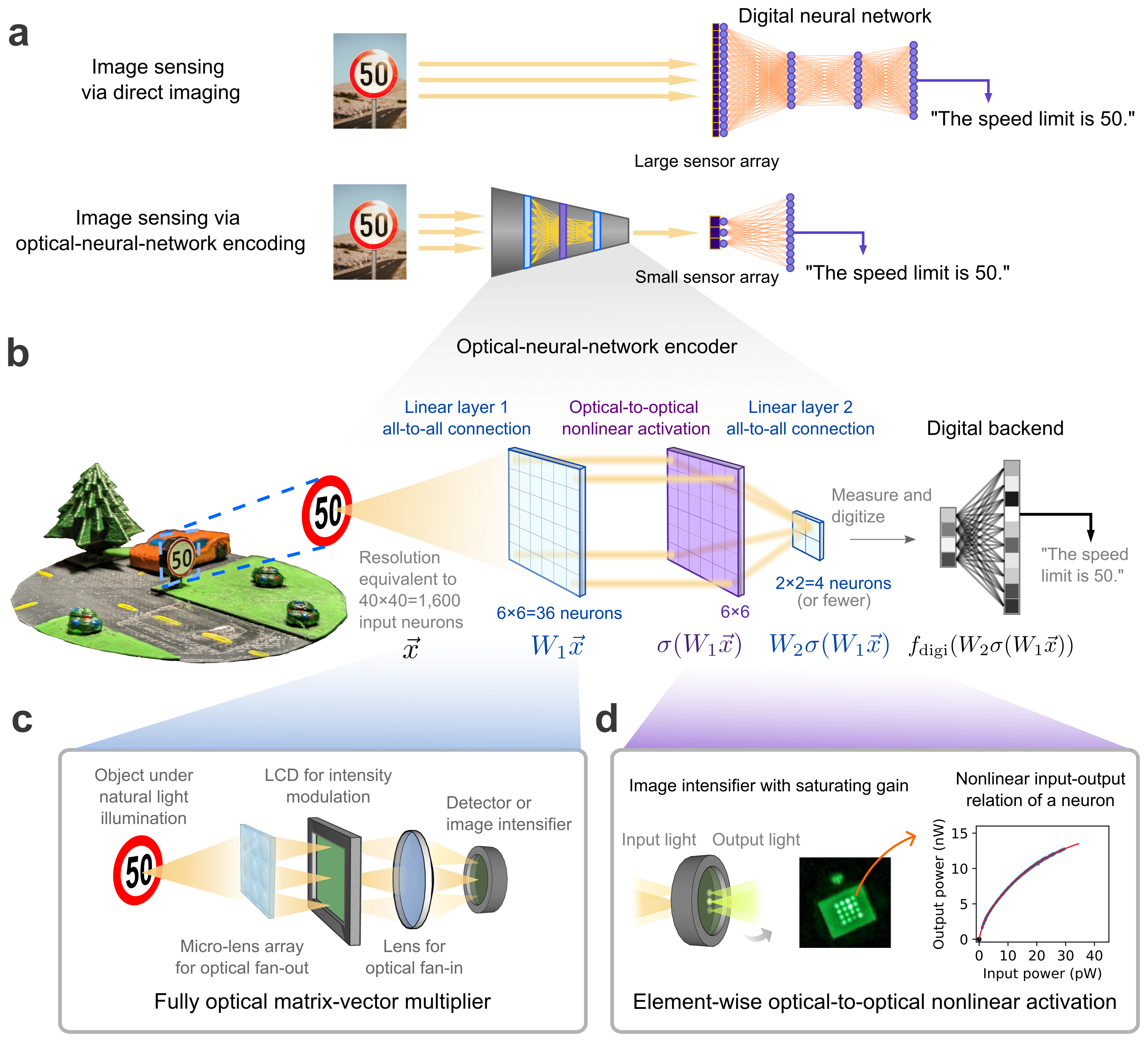
- The authors implement a multilayer ONN pre-processor using a commercial image intensifier to provide parallel, optoelectronic, optical-to-optical nonlinear activation, enabling true nonlinear processing.
- The system uses a wide, 100×100 input image dimension and applies a 200-dimensional bottleneck layer in a 2-layer fully connected ONN, with deeper architectures (e.g., CNN1 and CNN3) incorporating optical convolutional layers.
- Non-negative weights are enforced to match incoherent light conditions, and physical noise is emulated during simulation to reflect real-world optical limitations.
- The optical encoder maps high-dimensional images into a compressed latent space, which is then decoded by a linear classifier to perform tasks such as object recognition and cell-organelle classification.
- The design includes trainable batch normalization layers followed by ReLU-like activation, realizable via threshold-linear behavior in optically controlled VCSELs or LED arrays.
- Pooling operations are implemented via optical summation (AvgPool) or threshold-limited activation (MaxPool), with the latter approximated by limiting energy input to suppress secondary responses.
Experimental results
Research questions
- RQ1Can a multilayer, nonlinear optical neural network achieve significantly higher image compression ratios than linear ONN encoders while preserving classification accuracy?
- RQ2Does the inclusion of nonlinearity and depth in an optical pre-processor lead to measurable performance gains in real-world image-sensing tasks?
- RQ3Can a commercial image intensifier function effectively as a parallel, optoelectronic, optical-to-optical nonlinear activation function in an ONN architecture?
- RQ4To what extent can optical neural networks pre-process images in spatial, temporal, and/or spectral dimensions to enable faster, lower-power, and more photon-efficient sensing?
- RQ5How does the performance of incoherent-light-based ONN encoders compare to their coherent-light counterparts, especially in terms of achievable accuracy and compression efficiency?
Key findings
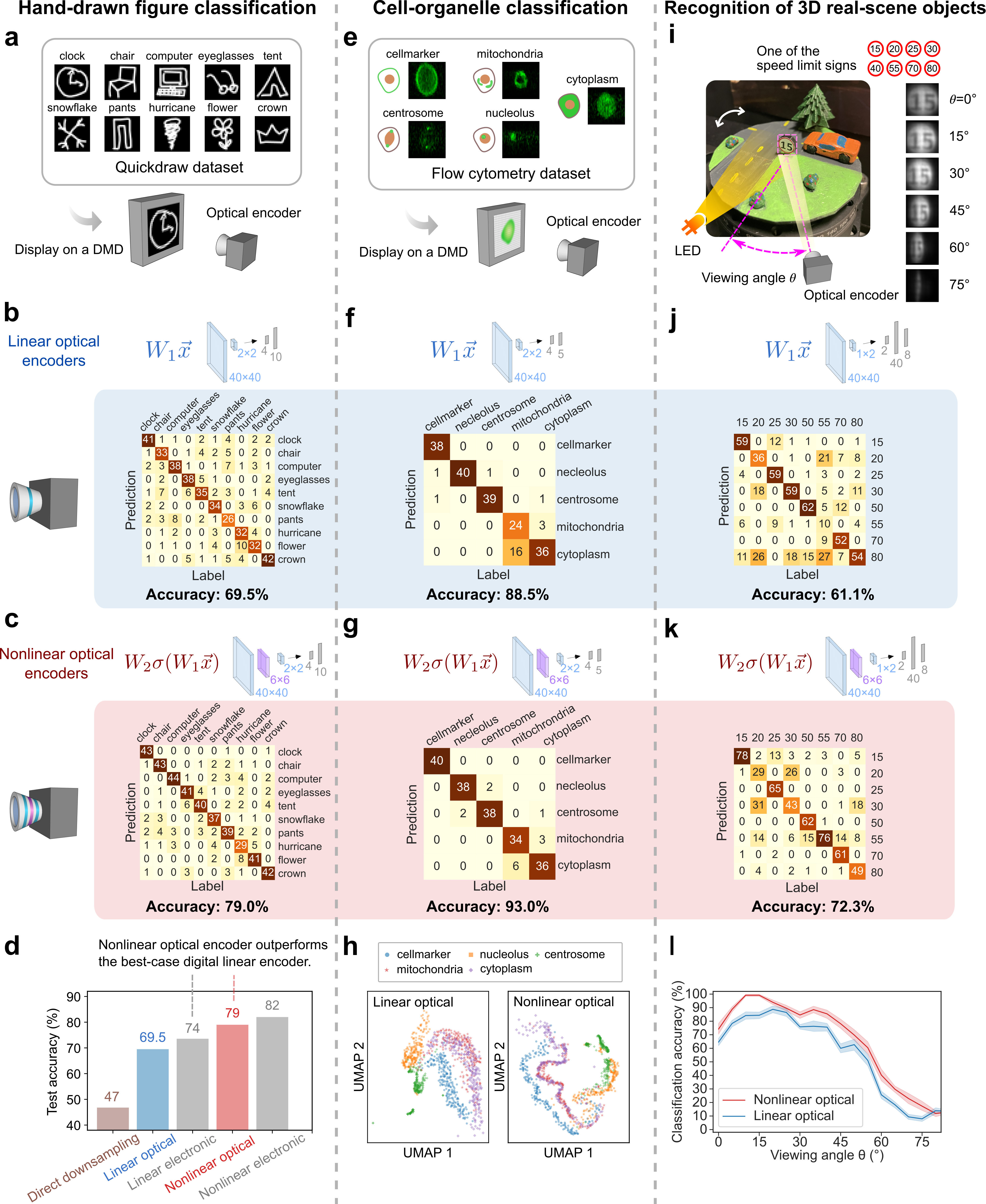
- The nonlinear, multilayer ONN pre-processor achieved compression ratios up to 800:1, reducing a 10,000-dimensional input image to a two-dimensional output vector while maintaining high classification accuracy.
- Deeper ONN architectures (e.g., CNN3 with three optical convolutional layers) outperformed shallower and linear ONN encoders, especially at high compression ratios, demonstrating the advantage of depth and nonlinearity.
- The system achieved high accuracy in 10-class cell-organelle classification from cytometry images, with performance approaching that of a ResNet-18 classifier trained on the same data, indicating strong representational capacity.
- The use of a commercial image intensifier as a nonlinear activation function enabled effective optical-to-optical transformation with minimal electronic feedback, supporting parallel, real-time processing.
- Simulations showed that non-negative weights (incoherent light) limited performance relative to real-valued weights, indicating that coherent-light ONNs could achieve even better results.
- The results suggest that ONN-based sensors can surpass conventional sensors by pre-processing optical data in the analog domain, enabling faster, smaller, and more energy-efficient image sensing.
Read this paper
Open the full text in the Nubint reader and ask about any passage as you read.
Read this paper on NubintThis review was generated by AI from the original paper. Please check the paper before citing it.