
[Paper Review] Image Steganography based on Style Transfer
This paper proposes a novel image steganography method that embeds secret messages during neural style transfer, disguising stego images as naturally stylized artwork. By integrating secret data into the latent space of a content image during style transformation, the approach achieves high visual quality and strong resistance to deep learning-based steganalysis, outperforming prior methods like STNet in security under all detection scenarios.
Image steganography is the art and science of using images as cover for covert communications. With the development of neural networks, traditional image steganography is more likely to be detected by deep learning-based steganalysis. To improve upon this, we propose image steganography network based on style transfer, and the embedding of secret messages can be disguised as image stylization. We embed secret information while transforming the content image style. In latent space, the secret information is integrated into the latent representation of the cover image to generate the stego images, which are indistinguishable from normal stylized images. It is an end-to-end unsupervised model without pre-training. Extensive experiments on the benchmark dataset demonstrate the reliability, quality and security of stego images generated by our steganographic network.
Motivation & Objective
- To address the vulnerability of traditional image steganography to deep learning-based steganalysis by leveraging style transfer for camouflage.
- To design an end-to-end, unsupervised steganography model that avoids pre-training and reduces computational overhead.
- To improve stego image realism by embedding secrets during the stylization process, making them indistinguishable from natural artistic images.
- To enhance security by making steganalysis difficult, even when the steganalyzer knows the model architecture but not the training iteration.
Proposed method
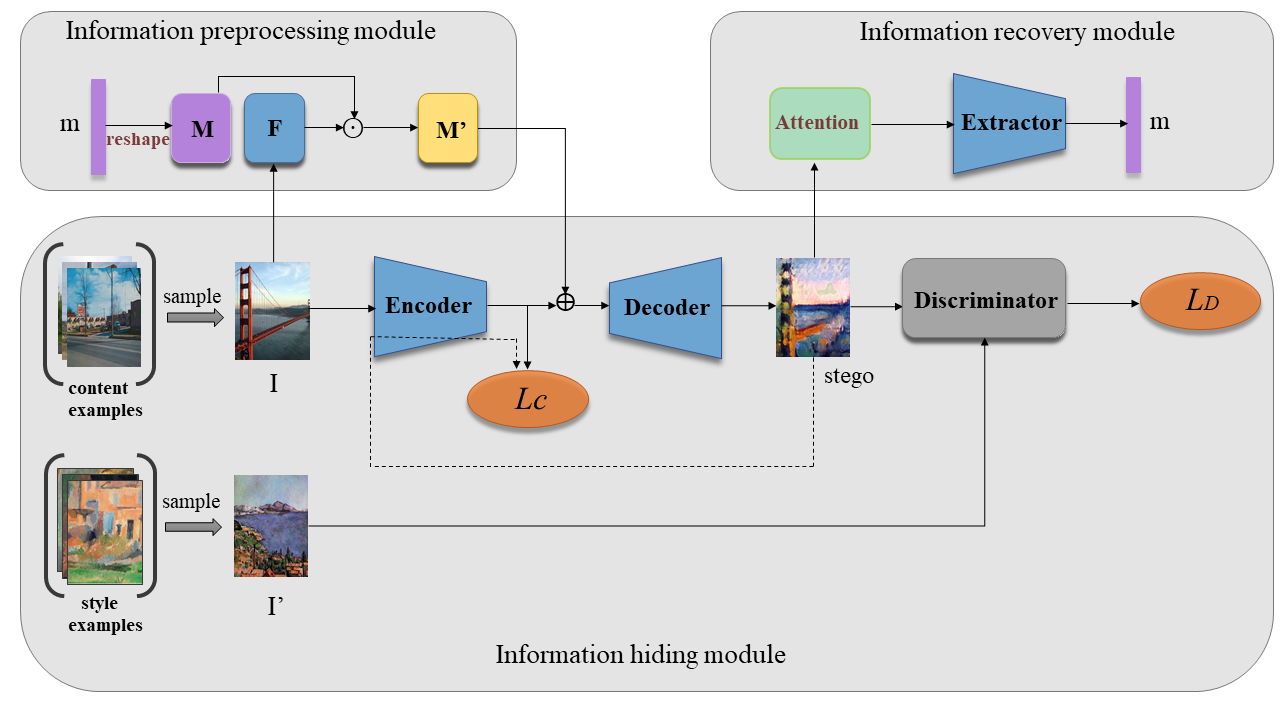
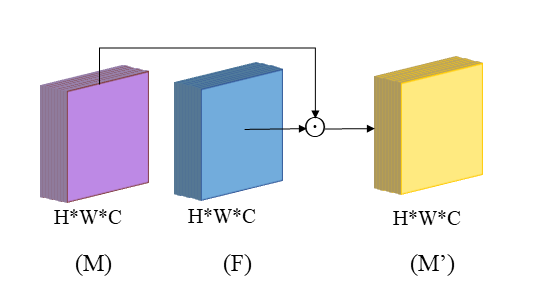
- The method uses an encoder-decoder architecture with an information preprocessing module that maps secret messages into a feature vector using dot product with high-pass filtered content features.
- Secret information is embedded in the latent representation of the content image during style transfer, via concatenation of processed secret features with encoded content features.
- The decoder generates the stylized stego image, while a discriminator ensures the output is indistinguishable from real artistic images by optimizing for realism.
- A separate extractor network with channel attention is trained to recover the secret message from the stego image, using optimized filters from the first layer of the network.
- The entire system is end-to-end and unsupervised, eliminating the need for pre-training on large datasets.
- The model generates subtly different stylized outputs across training iterations, even for the same input and message, increasing resistance to steganalysis.
Experimental results
Research questions
- RQ1Can secret messages be effectively hidden within the latent space of neural style transfer without degrading image quality or attracting suspicion?
- RQ2How does the proposed method perform in terms of stego image quality and visual realism compared to existing steganographic models?
- RQ3To what extent does embedding data during style transfer improve resistance to deep learning-based steganalysis compared to models that embed after stylization?
- RQ4Does the model’s ability to generate diverse outputs across training iterations hinder steganalysis network training?
- RQ5Can the proposed extractor achieve high recovery accuracy without relying on pre-trained models?
Key findings
- The proposed method achieves a message recovery accuracy of 0.55 for an ignorant steganalyzer, which is equivalent to random guessing, indicating strong resistance to detection.
- For a knowledgeable steganalyzer, the detection accuracy is 0.60, representing a 20% reduction compared to STNet, which had 0.87 under the same conditions.
- Under the omniscient steganalyzer scenario, the detection accuracy is 0.71, a 22% reduction compared to STNet’s 0.93, demonstrating superior security.
- Stego images maintain high visual quality, with SSIM values of 0.93 for Cézanne and 0.93 for Gauguin styles, comparable to or better than STNet.
- The model generates artistically realistic images that resemble oil paintings, with subtle variations across training iterations, enhancing security through output diversity.
- The addition of channel attention in the extractor significantly improves secret recovery accuracy, contributing to the robustness of the system.
Better researchstarts right now
From reading papers to final review, dramatically reduce your research time.
No credit card · Free plan available
This review was created by AI and reviewed by human editors.