
[Paper Review] Image to Sphere: Learning Equivariant Features for Efficient Pose Prediction
This paper proposes Image2Sphere (I2S), a novel method that projects image features onto a 2-sphere and uses SO(3)-equivariant spherical convolutions to predict probability distributions over 3D object rotations. By leveraging Fourier-basis parametrized filters and SO(3) equivariance, I2S achieves state-of-the-art performance on PASCAL3D+ and effectively models complex symmetries without prior knowledge.
Predicting the pose of objects from a single image is an important but difficult computer vision problem. Methods that predict a single point estimate do not predict the pose of objects with symmetries well and cannot represent uncertainty. Alternatively, some works predict a distribution over orientations in $\mathrm{SO}(3)$. However, training such models can be computation- and sample-inefficient. Instead, we propose a novel mapping of features from the image domain to the 3D rotation manifold. Our method then leverages $\mathrm{SO}(3)$ equivariant layers, which are more sample efficient, and outputs a distribution over rotations that can be sampled at arbitrary resolution. We demonstrate the effectiveness of our method at object orientation prediction, and achieve state-of-the-art performance on the popular PASCAL3D+ dataset. Moreover, we show that our method can model complex object symmetries, without any modifications to the parameters or loss function. Code is available at https://dmklee.github.io/image2sphere.
Motivation & Objective
- To address the limitations of point-estimate pose regression in handling object symmetries and uncertainty.
- To improve sample efficiency in learning distributions over SO(3) by exploiting SO(3) equivariance in 2D image inputs.
- To model complex, unknown symmetries in object poses without modifying loss functions or network parameters.
- To enable high-resolution, uncertainty-aware pose prediction from single images using equivariant feature learning.
- To demonstrate superior performance on real-world benchmarks like PASCAL3D+ and synthetic datasets such as ModelNet10-SO(3).
Proposed method
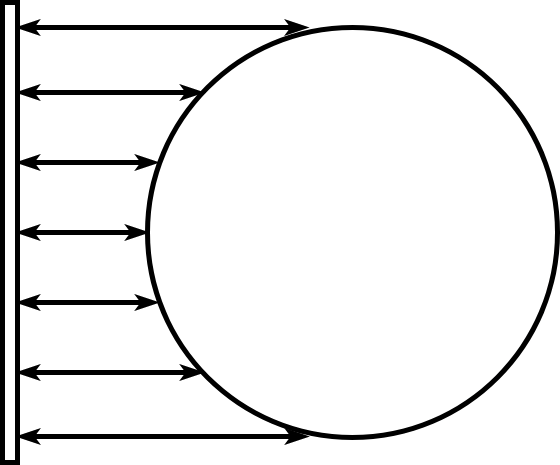
- Project features from a 2D convolutional neural network onto the surface of a half 2-sphere via orthographic projection.
- Apply spherical convolution with filters parametrized in the Fourier basis of S² to produce SO(3)-equivariant signals.
- Use SO(3) group convolution to generate a probability distribution over 3D rotations in the Fourier domain.
- Leverage the Fourier basis of SO(3) to efficiently represent detailed, multi-modal distributions over rotations.
- Combine non-equivariant CNN features with equivariant spherical layers to balance expressivity and inductive bias.
- Train end-to-end using rotation matrices as supervision, requiring no symmetry-specific modifications.

Experimental results
Research questions
- RQ1Can SO(3)-equivariant processing of image-derived features improve sample efficiency and accuracy in 3D pose estimation?
- RQ2How well can a method based on spherical convolutions model complex object symmetries without prior symmetry annotations?
- RQ3Does using the Fourier basis for filter parametrization outperform spatial or projection-based alternatives in SO(3) pose prediction?
- RQ4How does the proposed method compare to implicit modeling and parametric multi-modal distribution approaches in modeling uncertainty?
- RQ5Can the method generalize to novel object categories with unknown symmetries during inference?
Key findings
- I2S achieves state-of-the-art performance on the PASCAL3D+ dataset, with 62.3% accuracy at 15° error and 46.3° median error.
- On the ModelNet10-SO(3) benchmark with limited training views, I2S achieves 62.3% Acc@15 and 64.0% Acc@30, outperforming all ablation variants and baselines.
- The method successfully models ambiguous poses due to symmetries (e.g., cylinders, cones) and partial occlusions, predicting bimodal or multimodal distributions without architectural changes.
- Ablation studies show that spatial projection to the sphere is critical for performance, while filter parametrization via the Fourier basis is more effective than spatial filters or MLPs.
- I2S significantly outperforms an MLP-based Fourier basis parametrization (36.0% Acc@15) and a discrete icosahedral group convolution variant (45.5% Acc@15).
- The method demonstrates strong generalization to novel object instances and complex symmetries not seen during training, confirming its expressivity and robustness.
Read this paper
Open the full text in the Nubint reader and ask about any passage as you read.
Read this paper on NubintThis review was generated by AI from the original paper. Please check the paper before citing it.