
[Paper Review] ImageDream: Image-Prompt Multi-view Diffusion for 3D Generation
ImageDream introduces an image-prompt, multi-view diffusion framework with canonical camera coordination and multi-level controllers to improve geometry and texture in 3D generation from a single image, outperforming prior SoTA methods in geometry quality and image-text alignment.
We introduce "ImageDream," an innovative image-prompt, multi-view diffusion model for 3D object generation. ImageDream stands out for its ability to produce 3D models of higher quality compared to existing state-of-the-art, image-conditioned methods. Our approach utilizes a canonical camera coordination for the objects in images, improving visual geometry accuracy. The model is designed with various levels of control at each block inside the diffusion model based on the input image, where global control shapes the overall object layout and local control fine-tunes the image details. The effectiveness of ImageDream is demonstrated through extensive evaluations using a standard prompt list. For more information, visit our project page at https://Image-Dream.github.io.
Motivation & Objective
- Motivate 3D object generation from a single image with improved geometric accuracy over text-only or image-only baselines.
- Leverage canonical camera coordination to simplify mapping from input image to 3D views and enhance multi-view consistency.
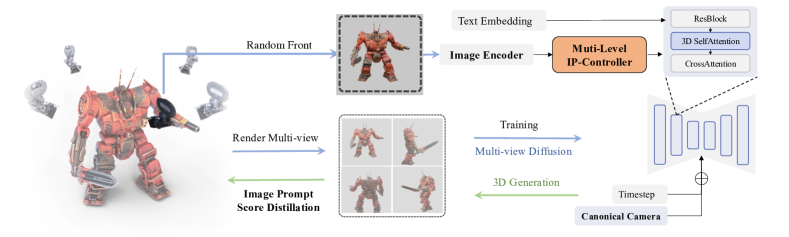
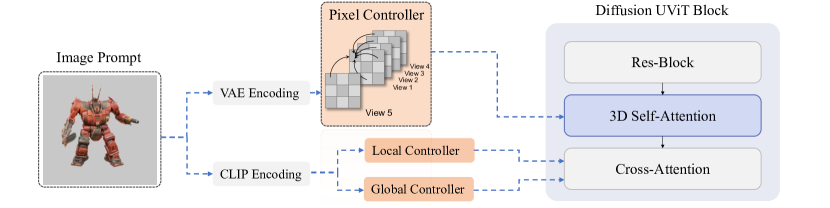
- Introduce a multi-level image-prompt controller (global, local, and pixel) to guide diffusion across architectural blocks.
- Integrate image-prompt diffusion into a NeRF-based SDS pipeline to produce coherent 3D assets with refined textures.
Proposed method
- Adopt a canonical world-coordination where the default view is the object’s front view to align image prompts with multi-view diffusion.
- Train a multi-view diffusion network (MVDiffusion) with four orthogonal views using MV loss and MV-SDS to optimize a NeRF-based 3D model.
- Introduce a global image-prompt adaptor (MLP) and cross-attention to fuse image features with text-conditioned diffusion using decoupled attention.
- Incorporate a local image-prompt controller using CLIP hidden features with a resampling step to prevent over-exposure and instability.
- Add a pixel controller by concatenating the input image as a fifth frame in 3D self-attention to enforce image-driven texture details across views.
- Apply image-prompt score distillation with background and camera-parameter alignment to improve geometric fidelity during NeRF optimization.
Experimental results
Research questions
- RQ1Can image prompts improve 3D geometry and texture quality beyond existing image-conditioned 3D diffusion methods?
- RQ2Does canonical camera coordination improve multi-view consistency and geometric accuracy for single-image to 3D generation?
- RQ3What is the impact of multi-level image-prompt controllers (global, local, pixel) on diffusion guidance and final 3D quality?
- RQ4How does image-prompt SDS interact with NeRF optimization to produce coherent 3D assets?
Key findings
- ImageDream substantially improves object geometry accuracy over prior SoTA methods such as Magic123 and Zero123 in zero-shot single-image 3D generation.
- The pixel controller enhances texture and CLIP-based image alignment across views, yielding better image-prompt similarity after fusion.
- Global and local controllers contribute to balancing semantic alignment and visual detail; the combination with pixel control provides the strongest performance.
- Quantitative metrics show ImageDream variants achieving higher CLIP scores and a modified Quality-only Inception Score (QIS) on diffusion and post-3D fusion stages compared to baselines.
- User studies indicate ImageDream (especially with the pixel controller) is preferred over SD-XL, MVDream, Zero123, Magic123, and SyncDreamer for geometry quality and IP similarity.
- Ablation reveals limitations when image prompts overly constrain fine facial details, suggesting future work on intrinsic/extrinsic property estimation or increased randomness in training prompts.
Read this paper
Open the full text in the Nubint reader and ask about any passage as you read.
Read this paper on NubintThis review was generated by AI from the original paper. Please check the paper before citing it.