
[Paper Review] IML-ViT: Benchmarking Image Manipulation Localization by Vision Transformer
IML-ViT introduces a ViT-based model for image manipulation localization that preserves high resolution, employs multi-scale supervision, and uses edge-focused supervision, achieving state-of-the-art results across multiple public datasets. It is proposed as a new benchmark for IML.
Advanced image tampering techniques are increasingly challenging the trustworthiness of multimedia, leading to the development of Image Manipulation Localization (IML). But what makes a good IML model? The answer lies in the way to capture artifacts. Exploiting artifacts requires the model to extract non-semantic discrepancies between manipulated and authentic regions, necessitating explicit comparisons between the two areas. With the self-attention mechanism, naturally, the Transformer should be a better candidate to capture artifacts. However, due to limited datasets, there is currently no pure ViT-based approach for IML to serve as a benchmark, and CNNs dominate the entire task. Nevertheless, CNNs suffer from weak long-range and non-semantic modeling. To bridge this gap, based on the fact that artifacts are sensitive to image resolution, amplified under multi-scale features, and massive at the manipulation border, we formulate the answer to the former question as building a ViT with high-resolution capacity, multi-scale feature extraction capability, and manipulation edge supervision that could converge with a small amount of data. We term this simple but effective ViT paradigm IML-ViT, which has significant potential to become a new benchmark for IML. Extensive experiments on three different mainstream protocols verified our model outperforms the state-of-the-art manipulation localization methods. Code and models are available at https://github.com/SunnyHaze/IML-ViT.
Motivation & Objective
- Identify key discrepancies between Image Manipulation Localization (IML) and traditional segmentation.
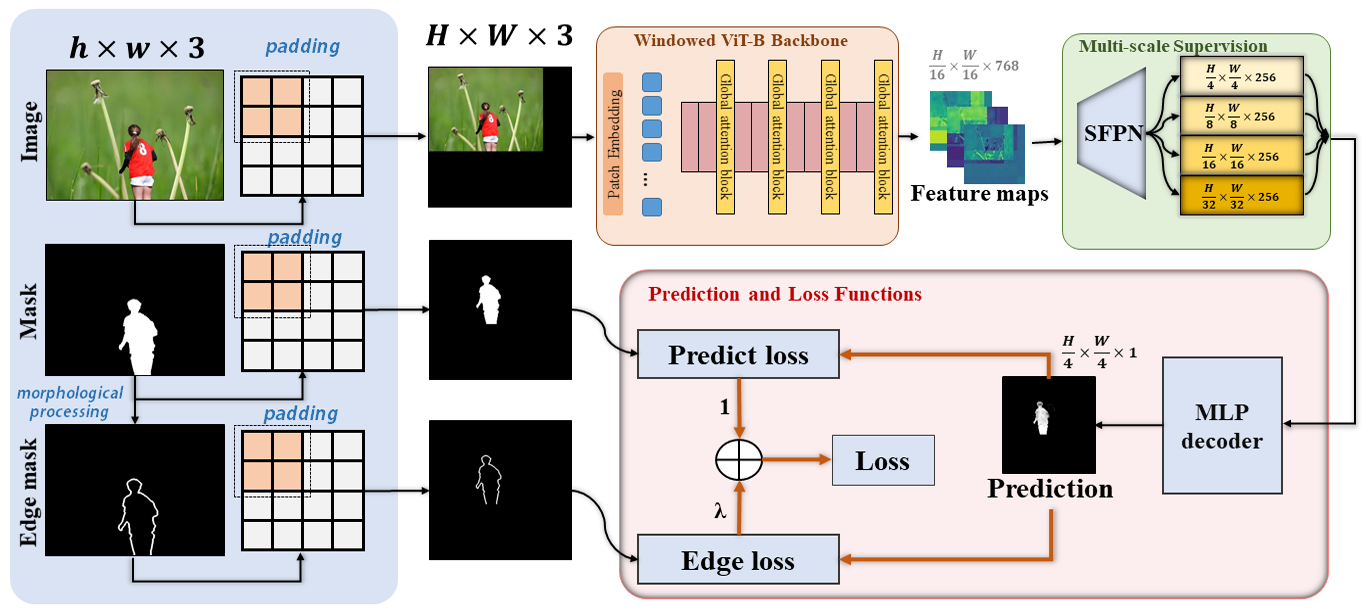
- Propose a ViT-based IML model that preserves resolution, uses edge supervision, and incorporates multi-scale features.
- Demonstrate that ViT with windowed attention and MAE pre-training can outperform CNN-based IML methods on cross-dataset benchmarks.
- Show robustness to common distortions (JPEG, Gaussian blur) and advocate for open benchmarks and fair cross-dataset evaluation.
Proposed method
- Use a high-resolution Vision Transformer (ViT) with windowed attention to balance accuracy and computation.
- Pad images to a fixed 1024x1024 resolution to preserve artifacts without resizing artifacts.
- Incorporate a simple feature pyramid network (SFPN) for multi-scale supervision.
- Adopt a lightweight MLP decoder head (à la SegFormer) for final pixel-wise predictions.
- Introduce edge supervision via a morphology-based edge loss that emphasizes tampered-region boundaries and combine with segmentation loss.
- Pre-train ViT with MAE on ImageNet-1k to improve generalization on small IML datasets.

Experimental results
Research questions
- RQ1Can a pure ViT backbone effectively model non-semantic artifacts for IML tasks?
- RQ2Does preserving full image resolution and adding edge supervision improve localization of manipulated regions across diverse datasets?
- RQ3What is the impact of multi-scale supervision on cross-dataset generalization for IML?
- RQ4How does MAE-based pre-training influence ViT-based IML performance on limited data?
Key findings
- IML-ViT achieves state-of-the-art performance in both F1 and AUC on five public IML benchmarks.
- Preserving original image resolution via zero-padding (1024x1024) is beneficial for artifact preservation and model learning.
- Edge supervision is crucial for stable convergence and high performance; without it, training can diverge.
- Multi-scale supervision provides generalization benefits, particularly on datasets with diverse manipulation types.
- MAE pre-training on ImageNet-1k is essential for ViT-based IML due to limited data, enabling better convergence and generalization.
- IML-ViT demonstrates strong cross-dataset robustness, including resistance to JPEG compression and Gaussian blur.
Read this paper
Open the full text in the Nubint reader and ask about any passage as you read.
Read this paper on NubintThis review was generated by AI from the original paper. Please check the paper before citing it.