
[Paper Review] Impression Network for Video Object Detection
This paper proposes Impression Network, a novel feature-level video object detection framework that uses an iterative impression feature aggregation mechanism to enhance low-quality frames by propagating high-level features from sparse keyframes. By fusing features across long-range segments with minimal computational overhead, it achieves 20 fps inference speed and surpasses per-frame baselines in accuracy on ImageNet VID, offering a new paradigm for efficient, accurate video feature enhancement.
Video object detection is more challenging compared to image object detection. Previous works proved that applying object detector frame by frame is not only slow but also inaccurate. Visual clues get weakened by defocus and motion blur, causing failure on corresponding frames. Multi-frame feature fusion methods proved effective in improving the accuracy, but they dramatically sacrifice the speed. Feature propagation based methods proved effective in improving the speed, but they sacrifice the accuracy. So is it possible to improve speed and performance simultaneously? Inspired by how human utilize impression to recognize objects from blurry frames, we propose Impression Network that embodies a natural and efficient feature aggregation mechanism. In our framework, an impression feature is established by iteratively absorbing sparsely extracted frame features. The impression feature is propagated all the way down the video, helping enhance features of low-quality frames. This impression mechanism makes it possible to perform long-range multi-frame feature fusion among sparse keyframes with minimal overhead. It significantly improves per-frame detection baseline on ImageNet VID while being 3 times faster (20 fps). We hope Impression Network can provide a new perspective on video feature enhancement. Code will be made available.
Motivation & Objective
- To address the trade-off between speed and accuracy in video object detection, especially under image degradation such as defocus and motion blur.
- To enable efficient long-range multi-frame feature fusion without incurring high computational costs.
- To mimic human visual perception by accumulating temporal impressions to improve detection on low-quality frames.
- To maintain real-time inference speed while outperforming frame-by-frame detection baselines.
- To provide a task-agnostic, feature-level framework that enhances video feature quality for downstream detection.
Proposed method
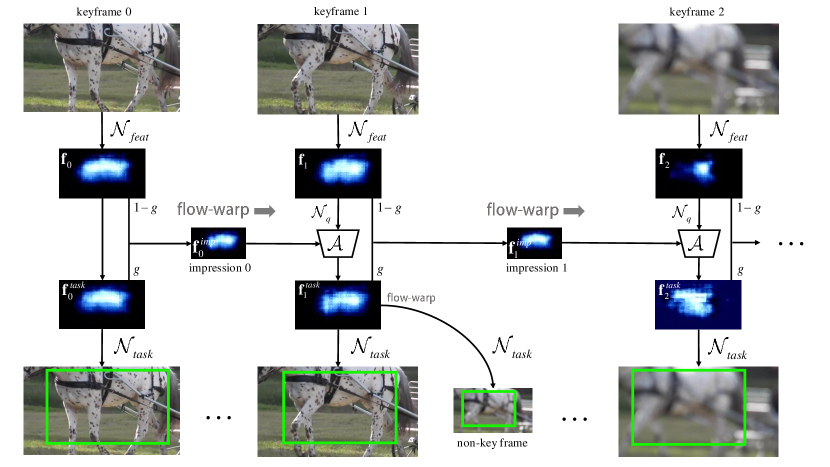
- The framework splits videos into fixed-length segments and selects one central keyframe per segment for deep feature extraction using a backbone like ResNet-101.
- A flow-guided feature propagation mechanism reuses keyframe features across non-keyframes to maintain real-time speed.
- An impression feature is iteratively updated by absorbing features from each new keyframe, acting as a cumulative memory of high-level object cues.
- The task-specific feature for each keyframe is a weighted combination of its own feature and the propagated impression feature, enabling feature enhancement on degraded frames.
- The impression feature is updated via a recursive aggregation rule: $ I_{t} = (1-g)I_{t-1} + g \cdot f_t $, where $ g $ controls the temporal influence range.
- The method requires only one flow estimation per segment pair, minimizing the cost of spatial alignment and enabling efficient long-range fusion.
Experimental results
Research questions
- RQ1Can a feature-level method achieve both high speed and high accuracy in video object detection by leveraging temporal context?
- RQ2How can long-range feature fusion be performed efficiently without sacrificing inference speed?
- RQ3To what extent can a cumulative impression of past features improve detection on low-quality frames with weak visual cues?
- RQ4What is the optimal keyframe selection strategy to minimize flow-guided feature propagation error?
- RQ5How does the impression mechanism compare to existing feature aggregation and propagation techniques in terms of accuracy and efficiency?
Key findings
- Impression Network achieves 20 fps inference speed, which is three times faster than the per-frame baseline, while significantly improving detection accuracy.
- The method outperforms state-of-the-art aggregation-based methods like FGFA, achieving 75.5% mAP on ImageNet VID with only 50ms inference time.
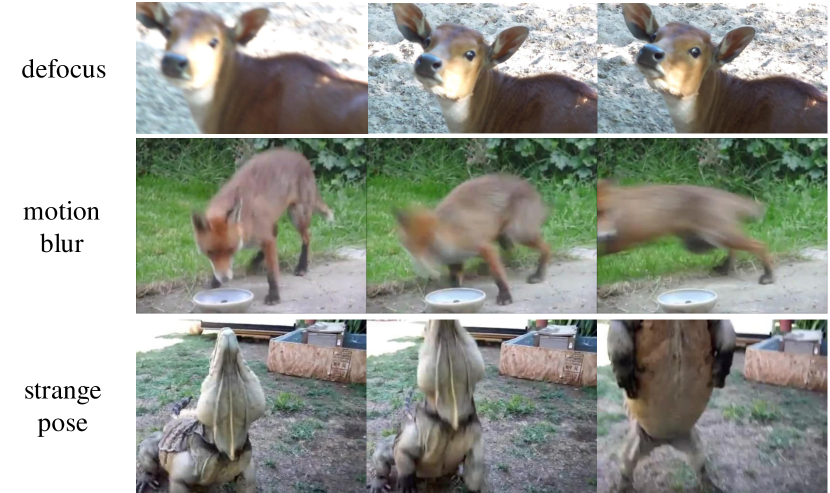
- The impression mechanism improves detection on defocused and blurred frames by propagating high-quality features from earlier keyframes, as demonstrated in Figure 5 and Figure 1.
- Setting the aggregation weight $ g $ to 1.0 allows full temporal context utilization, resulting in the highest mAP, indicating that long-range feature fusion enhances robustness.
- Central keyframe selection minimizes average feature propagation distance $ \bar{d} $, reducing flow error and improving performance, as confirmed by Table 2.
- The method maintains a smooth accuracy-speed trade-off across varying segment lengths, outperforming both per-frame baselines and Deep Feature Flow in the high-speed regime.
Read this paper
Open the full text in the Nubint reader and ask about any passage as you read.
Read this paper on NubintThis review was generated by AI from the original paper. Please check the paper before citing it.