
[Paper Review] Improved Baselines with Visual Instruction Tuning
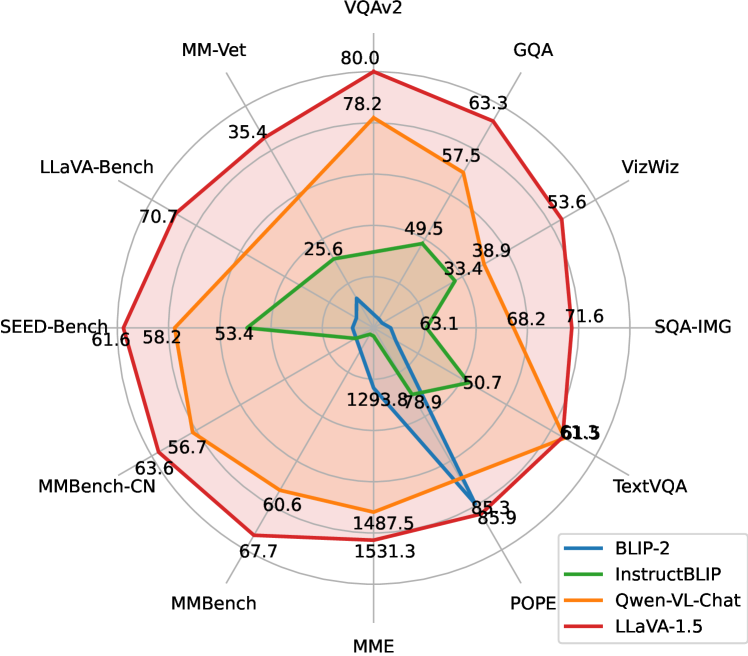
The paper shows that simple modifications to LLaVA—a fully-connected vision-language cross-modal connector (MLP) and academic-task-oriented VQA data with response formatting prompts—yield state-of-the-art results across 11 benchmarks with a 13B model trained on 1.2M public images/texts in about one day on 8 A100 GPUs.
Large multimodal models (LMM) have recently shown encouraging progress with visual instruction tuning. In this note, we show that the fully-connected vision-language cross-modal connector in LLaVA is surprisingly powerful and data-efficient. With simple modifications to LLaVA, namely, using CLIP-ViT-L-336px with an MLP projection and adding academic-task-oriented VQA data with simple response formatting prompts, we establish stronger baselines that achieve state-of-the-art across 11 benchmarks. Our final 13B checkpoint uses merely 1.2M publicly available data, and finishes full training in ~1 day on a single 8-A100 node. We hope this can make state-of-the-art LMM research more accessible. Code and model will be publicly available.
Motivation & Objective
- Assess the data, model, and input resolution scaling effects on visual instruction tuning within the LLaVA framework.
- Demonstrate that simple architectural changes and data augmentation can yield strong baselines with limited data.
- Establish a competitive, fully open baseline using public data and moderate compute.
- Showcase the final model's strengths across academic VQA and vision-language tasks.
Proposed method
- Replace the vision-language cross-modal connector with a two-layer MLP projection.
- Append a single response-formatting prompt to VQA data to control output length and style.
- Augment training with academic-task-oriented VQA data (OKVQA, A-OKVQA, OCRVQA, TextCaps, Visual Genome, RefCOCO, etc.) to enhance fine-grained visual understanding.
- Increase input image resolution to 336px and scale up the LLM to 13B for improved visual conversation capabilities.
- Train on publicly available data only, using a lightweight pretraining regime comparable to LLaVA.
Experimental results
Research questions
- RQ1Can a simple MLP cross-modal connector improve LMM performance when added to LLaVA?
- RQ2Does incorporating academic-task-oriented VQA data with explicit response formats improve short-form and long-form visual reasoning and conversation?
- RQ3How do data scale, model size, and image resolution interact to affect performance on a broad set of vision-language benchmarks?
Key findings
- LLaVA-1.5 with an MLP connector and formatted VQA prompts achieves strong performance across 11/12 academic benchmarks, outperforming prior baselines.
- Using public data and modest compute, the final 13B model reaches state-of-the-art results on 11 benchmarks and competitive results on others.
- With only 1.2M public image-text pairs, the model finishes training in roughly one day on a single 8-A100 node.
- Increasing image resolution to 336 and adding broader VQA/OCR/region-level data substantially improves accuracy on VQA and visual reasoning tasks.
- Zero-shot formatting prompts enable constrained outputs (e.g., single-word answers or JSON) without heavy reengineering of data pipelines.

Read this paper
Open the full text in the Nubint reader and ask about any passage as you read.
Read this paper on NubintThis review was generated by AI from the original paper. Please check the paper before citing it.