
[Paper Review] Improved Online Conformal Prediction via Strongly Adaptive Online Learning
This paper introduces Strongly Adaptive Online Conformal Prediction (SAOCP) and Scale-Free Online Gradient Descent (SF-OGD) to achieve near-optimal strongly adaptive regret and approximately valid coverage for online conformal prediction under distribution shift, with strong empirical gains on time series forecasting and image classification tasks.
We study the problem of uncertainty quantification via prediction sets, in an online setting where the data distribution may vary arbitrarily over time. Recent work develops online conformal prediction techniques that leverage regret minimization algorithms from the online learning literature to learn prediction sets with approximately valid coverage and small regret. However, standard regret minimization could be insufficient for handling changing environments, where performance guarantees may be desired not only over the full time horizon but also in all (sub-)intervals of time. We develop new online conformal prediction methods that minimize the strongly adaptive regret, which measures the worst-case regret over all intervals of a fixed length. We prove that our methods achieve near-optimal strongly adaptive regret for all interval lengths simultaneously, and approximately valid coverage. Experiments show that our methods consistently obtain better coverage and smaller prediction sets than existing methods on real-world tasks, such as time series forecasting and image classification under distribution shift.
Motivation & Objective
- Motivate uncertainty quantification in online, non-stationary environments where data distribution can shift arbitrarily over time.
- Develop a strongly adaptive online conformal prediction framework that guarantees coverage on all intervals of fixed length.
- Instantiate the framework with SF-OGD as an expert and prove near-optimal strongly adaptive regret guarantees.
- Demonstrate empirical improvements in coverage and set size over existing online conformal methods on time series and distribution-shift tasks.
Proposed method
- Introduce SAOCP, a meta-algorithm that manages multiple experts, each with its own active interval, to minimize strongly adaptive regret.
- Instantiate experts as SF-OGD, an anytime variant of online gradient descent with adaptive learning rates.
- Prove SAOCP achieves SAReg(T,k) = ÃO(D sqrt(k)) for all interval lengths k, with near-optimal dependence on interval length.
- Show that SAOCP and SF-OGD achieve approximately valid coverage with respect to the 1-α quantile loss.
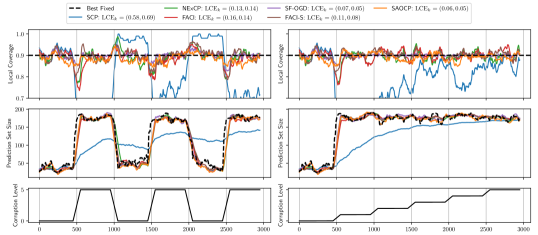
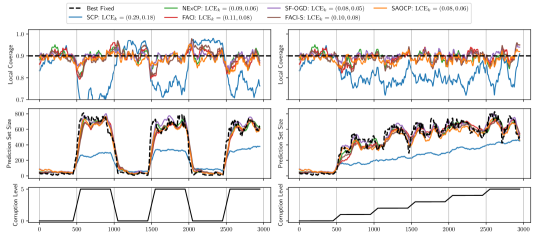
- Provide experimental comparisons against SCP, NExCP, FACI, and FACI-S on time series forecasting and image classification under distribution shift.
Experimental results
Research questions
- RQ1How can online conformal prediction be improved to provide strong guarantees not just over the entire horizon but across all sub-intervals of time?
- RQ2Can strongly adaptive regret concepts be integrated into online conformal prediction to yield interval guarantees across all interval lengths?
- RQ3Do SAOCP and SF-OGD provide approximately valid coverage while reducing the size of prediction sets under distribution shift?
- RQ4How do the proposed methods perform on real-world tasks like time series forecasting and image classification under distributional shift compared to existing baselines?
Key findings
- SAOCP achieves near-optimal strongly adaptive regret of ÃO(sqrt(k)) simultaneously for all interval lengths k.
- SAOCP and SF-OGD achieve approximately valid coverage without requiring exchangeability assumptions.
- SAOCP consistently attains better coverage and smaller prediction sets than existing online conformal methods across time series and image classification tasks.
- Experimental results on M4 time series datasets show SAOCP has best or second-best width and strongly adaptive regret across base predictors.
- SF-OGD alone already delivers strong performance and is competitive with or better than FACI variants in several settings.
Read this paper
Open the full text in the Nubint reader and ask about any passage as you read.
Read this paper on NubintThis review was generated by AI from the original paper. Please check the paper before citing it.