
[Paper Review] Improving accuracy of GPT-3/4 results on biomedical data using a retrieval-augmented language model
This study proposes a retrieval-augmented (RetA) language model that improves the accuracy and relevance of GPT-3.5 and GPT-4 on biomedical question-answering tasks by retrieving domain-specific context from a focused DLBCL corpus before generating responses. The RetA model outperformed all baseline LLMs in accuracy (12/19 questions scored 3/3) and relevance (13/19), with significantly fewer hallucinations than general-purpose models.
Large language models (LLMs) have made significant advancements in natural language processing (NLP). Broad corpora capture diverse patterns but can introduce irrelevance, while focused corpora enhance reliability by reducing misleading information. Training LLMs on focused corpora poses computational challenges. An alternative approach is to use a retrieval-augmentation (RetA) method tested in a specific domain. To evaluate LLM performance, OpenAI's GPT-3, GPT-4, Bing's Prometheus, and a custom RetA model were compared using 19 questions on diffuse large B-cell lymphoma (DLBCL) disease. Eight independent reviewers assessed responses based on accuracy, relevance, and readability (rated 1-3). The RetA model performed best in accuracy (12/19 3-point scores, total=47) and relevance (13/19, 50), followed by GPT-4 (8/19, 43; 11/19, 49). GPT-4 received the highest readability scores (17/19, 55), followed by GPT-3 (15/19, 53) and the RetA model (11/19, 47). Prometheus underperformed in accuracy (34), relevance (32), and readability (38). Both GPT-3.5 and GPT-4 had more hallucinations in all 19 responses compared to the RetA model and Prometheus. Hallucinations were mostly associated with non-existent references or fabricated efficacy data. These findings suggest that RetA models, supplemented with domain-specific corpora, may outperform general-purpose LLMs in accuracy and relevance within specific domains. However, this evaluation was limited to specific questions and metrics and may not capture challenges in semantic search and other NLP tasks. Further research will explore different LLM architectures, RetA methodologies, and evaluation methods to assess strengths and limitations more comprehensively.
Motivation & Objective
- To evaluate whether retrieval-augmented language models (RetA) can improve the factual accuracy and relevance of LLMs in biomedical question-answering compared to general-purpose LLMs.
- To investigate the extent to which hallucinations—such as fabricated references or efficacy data—occur in GPT-3.5, GPT-4, and Bing’s Prometheus when answering complex biomedical questions.
- To assess the impact of domain-specific retrieval on reducing noise and improving reliability in LLM-generated responses for clinical and biological questions on diffuse large B-cell lymphoma (DLBCL).
- To compare the readability, accuracy, and relevance of responses across multiple LLMs using a standardized evaluation framework with expert reviewers.
Proposed method
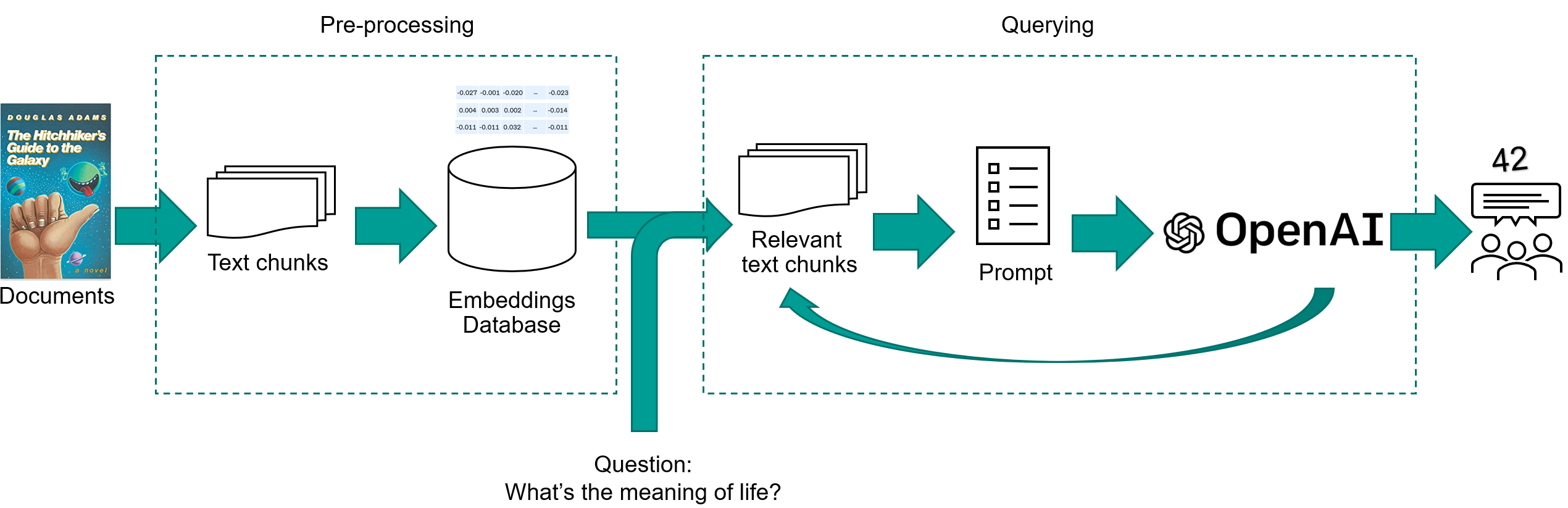
- Constructed a domain-specific corpus focused on diffuse large B-cell lymphoma (DLBCL) by collecting and preprocessing relevant biomedical literature.
- Split the corpus into smaller text chunks and embedded them using a pre-trained embedding model (e.g., OpenAI embeddings), storing them in a vector database for efficient retrieval.
- Implemented a two-stage retrieval-augmented prompting workflow: first, retrieved the most relevant document chunks using semantic similarity (e.g., cosine similarity) based on the query embedding; second, fed the retrieved context into a base LLM (e.g., text-davinci-003 or gpt-3.5-turbo) to generate a grounded response.
- Used a custom RetA pipeline where the LLM was prompted to answer only based on the provided context, minimizing reliance on internal knowledge and reducing hallucinations.
- Evaluated multiple LLMs—including GPT-3.5, GPT-4, Bing’s Prometheus, and a custom RetA model—on 19 standardized biomedical questions covering DLBCL diagnosis, treatment, subtypes, and biomarkers.
- Employed a three-point scoring system (1–3) for accuracy, relevance, and readability, assessed by eight independent reviewers to ensure objectivity and consistency.
Experimental results
Research questions
- RQ1Can a retrieval-augmented language model improve factual accuracy in biomedical question-answering compared to general-purpose LLMs like GPT-3.5 and GPT-4?
- RQ2To what extent do hallucinations—such as fabricated references or non-existent clinical data—occur in GPT-3.5, GPT-4, and Bing’s Prometheus when answering complex DLBCL-related questions?
- RQ3How does the integration of domain-specific, retrieved context affect the relevance and readability of LLM-generated responses in a clinical and biological context?
- RQ4Does a RetA approach reduce the signal-to-noise ratio in LLM outputs compared to purely autoregressive generation from a broad pre-training distribution?
Key findings
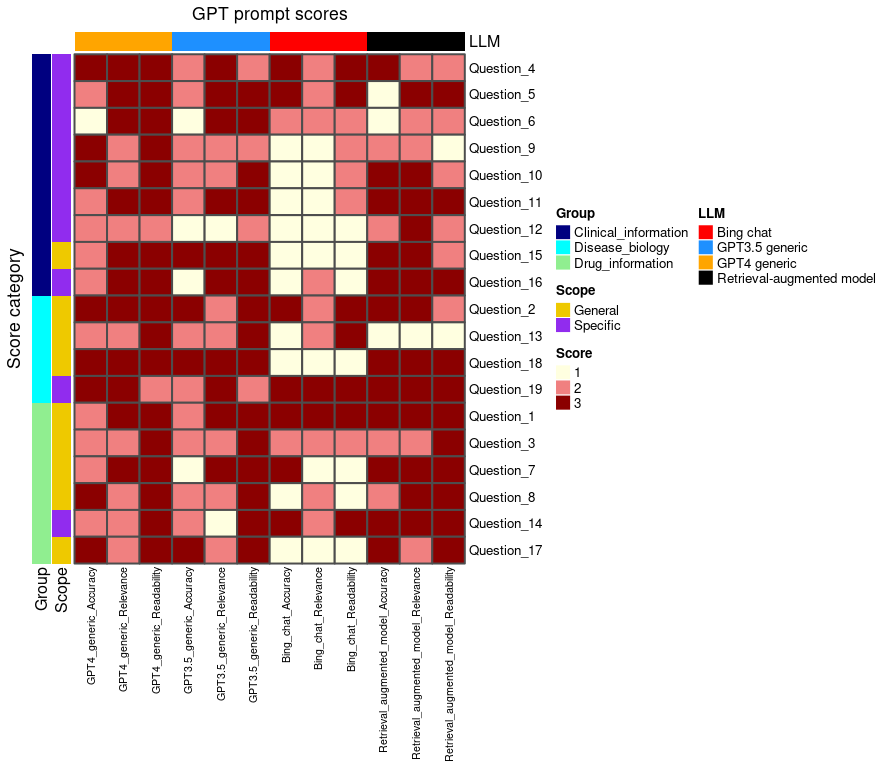
- The retrieval-augmented (RetA) model achieved the highest accuracy score (12 out of 19 questions received a 3/3 rating), significantly outperforming GPT-4 (8/19) and GPT-3.5 (7/19) in factual correctness.
- The RetA model also demonstrated the strongest relevance score (13/19 questions rated 3/3), indicating that retrieved context led to more on-topic and focused responses.
- GPT-4 received the highest readability score (17/19 questions rated 3/3), followed by GPT-3.5 (15/19), while the RetA model scored 11/19, suggesting that retrieval did not compromise clarity.
- Bing’s Prometheus performed poorly across all metrics, with only 34 out of 57 total points in accuracy and relevance, and 38 in readability, indicating limited reliability for biomedical QA.
- All general-purpose LLMs (GPT-3.5 and GPT-4) produced hallucinated content in all 19 responses, primarily in the form of non-existent references or fabricated efficacy data, whereas the RetA model significantly reduced such errors.
- The RetA model reduced hallucinations by grounding responses strictly in retrieved, domain-specific documents, demonstrating that retrieval-augmentation enhances truthfulness in specialized biomedical applications.
Read this paper
Open the full text in the Nubint reader and ask about any passage as you read.
Read this paper on NubintThis review was generated by AI from the original paper. Please check the paper before citing it.