
[Paper Review] Improving Classification Neural Networks by using Absolute activation function (MNIST/LeNET-5 example)
This paper proposes the Absolute activation function (Abs) as a novel alternative to traditional activation functions in feedforward neural networks, demonstrating its effectiveness in reducing model size and improving accuracy on MNIST using LeNet-5 architecture. Unlike ReLU or Tanh, Abs maintains gradient stability due to its derivative modulus being 1 almost everywhere, enabling training without vanishing/exploding gradients, and achieves up to 99.64% test accuracy with 227,474 parameters—significantly fewer than LeNet-5’s 368,000—while outperforming ReLU, SeLU, and Tanh variants.
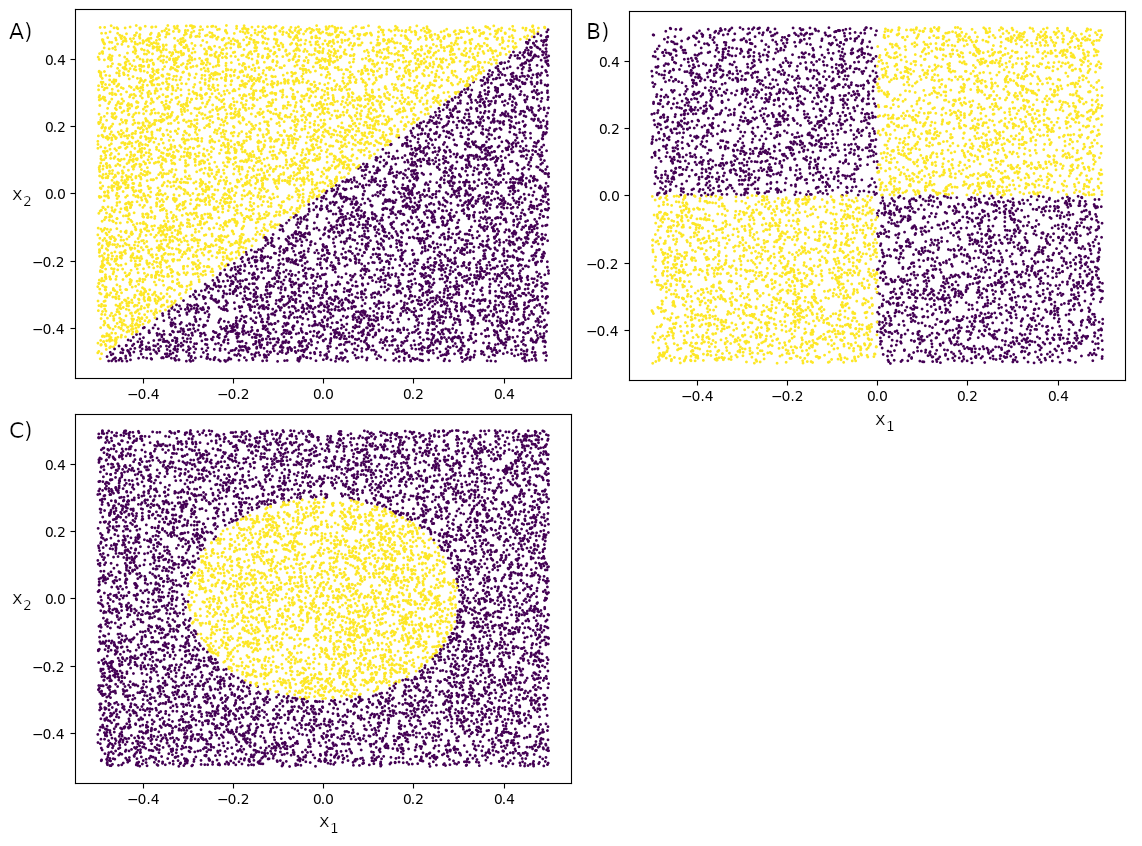
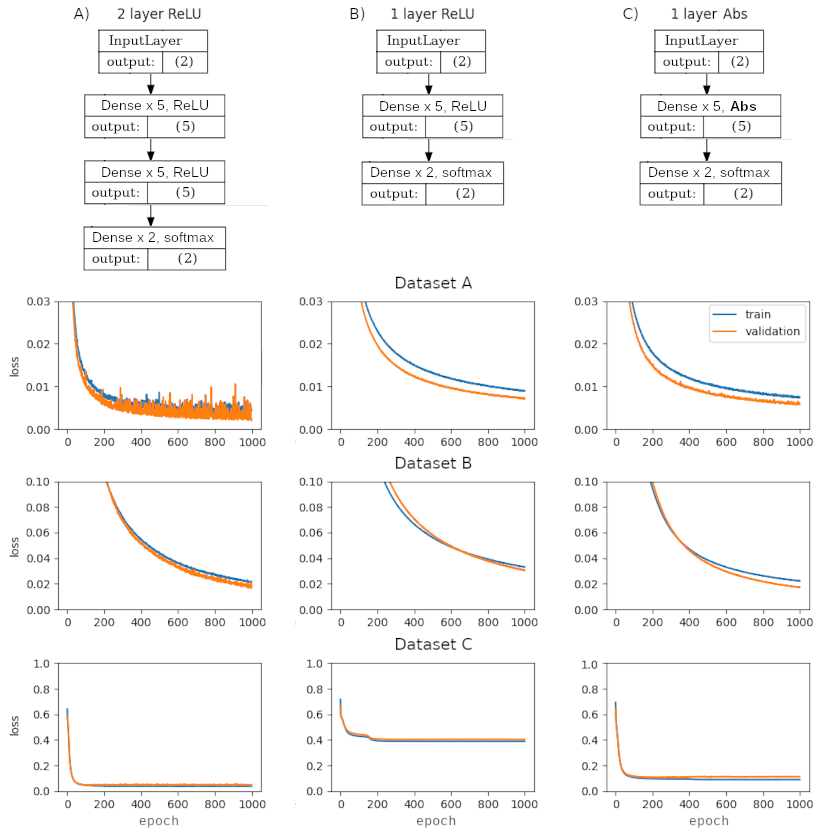
The paper discusses the use of the Absolute activation function in classification neural networks. An examples are shown of using this activation function in simple and more complex problems. Using as a baseline LeNet-5 network for solving the MNIST problem, the efficiency of Absolute activation function is shown in comparison with the use of Tanh, ReLU and SeLU activations. It is shown that in deep networks Absolute activation does not cause vanishing and exploding gradients, and therefore Absolute activation can be used in both simple and deep neural networks. Due to high volatility of training networks with Absolute activation, a special modification of ADAM training algorithm is used, that estimates lower bound of accuracy at any test dataset using validation dataset analysis at each training epoch, and uses this value to stop/decrease learning rate, and re-initializes ADAM algorithm between these steps. It is shown that solving the MNIST problem with the LeNet-like architectures based on Absolute activation allows to significantly reduce the number of trained parameters in the neural network with improving the prediction accuracy.
Motivation & Objective
- To investigate whether the Absolute activation function can serve as a viable alternative to standard activation functions like ReLU, Tanh, and SeLU in classification networks.
- To reduce the number of trainable parameters in LeNet-5-like architectures while improving or maintaining test accuracy.
- To address the challenge of training instability caused by the high volatility of networks using the Absolute activation function.
- To develop a robust training strategy that dynamically adjusts learning rate and stops training based on lower-bound accuracy estimates from validation data.
- To demonstrate that non-monotonic activation functions like Abs can achieve state-of-the-art performance in simple, shallow networks without architectural changes.
Proposed method
- The Absolute activation function is defined as $ \Phi_q(y) = W_q |y| $, replacing standard activation functions in fully connected and convolutional layers.
- A modified ADAM optimizer is introduced that estimates the lower bound of test accuracy using accuracy from half-splits of the validation set and bootstrap resampling at each epoch.
- The learning rate is reduced or training is stopped when the estimated lower bound of test accuracy plateaus, and the optimizer is reinitialized to avoid local minima.
- The method uses majority voting (M.V.) and confidence interval (C.I.) estimation across 20 independent training runs to evaluate ensemble performance.
- Three accuracy prediction variants ($ ACC_{expected@test,1} $, $ ACC_{expected@test,2} $, $ ACC_{expected@test,3} $) are evaluated to determine the optimal training strategy.
- Two architectures are compared: LeNet+Conv120+Abs and LeNet+Conv64+Conv120+Abs, with parameter counts reduced from 368k to 76k and 227k respectively.
Experimental results
Research questions
- RQ1Can the Absolute activation function be used effectively in deep and shallow feedforward networks without causing vanishing or exploding gradients?
- RQ2Does the Absolute activation function enable a significant reduction in the number of trainable parameters while maintaining or improving test accuracy on MNIST?
- RQ3How can training instability associated with the Absolute activation function be mitigated using adaptive learning rate and early stopping strategies?
- RQ4Which accuracy prediction method from validation data yields the most reliable and highest-performing model during training with Abs activation?
- RQ5Can a non-monotonic activation function like Abs achieve performance comparable to or better than ReLU, SeLU, and Tanh in standard classification benchmarks like MNIST?
Key findings
- The Absolute activation function maintains gradient stability because its derivative modulus is 1 almost everywhere, preventing vanishing or exploding gradients.
- The LeNet+Conv120+Abs network achieves a test accuracy of 99.64% (M.V.) with only 76,474 parameters, a 79% reduction from LeNet-5’s 368,000 parameters.
- The deeper LeNet+Conv64+Conv120+Abs architecture reduces parameters to 227,474 and achieves a test accuracy of 99.64% (M.V.), outperforming ReLU, SeLU, and Tanh variants.
- Using $ ACC_{expected@test,3} $ for accuracy prediction during training yields the highest ensemble accuracy and is therefore the preferred strategy.
- The modified ADAM optimizer with lower-bound accuracy estimation successfully stabilizes training, enabling convergence despite high volatility in loss and accuracy curves.
- The Absolute activation function enables a 2-order-of-magnitude reduction in model size while improving or matching state-of-the-art accuracy, demonstrating its potential for efficient network design.
Read this paper
Open the full text in the Nubint reader and ask about any passage as you read.
Read this paper on NubintThis review was generated by AI from the original paper. Please check the paper before citing it.