
[Paper Review] Improving Cross-Modal Retrieval with Set of Diverse Embeddings
This paper proposes a novel set-based embedding framework for cross-modal image-text retrieval that improves performance by modeling semantic ambiguity through a diverse set of embeddings. It introduces smooth-Chamfer similarity to mitigate training issues like sparse supervision and set collapsing, and employs a slot attention-based set prediction module to generate disentangled, semantically distinct embeddings, outperforming prior methods on COCO and Flickr30K with lower inference cost.
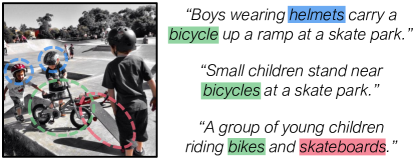
Cross-modal retrieval across image and text modalities is a challenging task due to its inherent ambiguity: An image often exhibits various situations, and a caption can be coupled with diverse images. Set-based embedding has been studied as a solution to this problem. It seeks to encode a sample into a set of different embedding vectors that capture different semantics of the sample. In this paper, we present a novel set-based embedding method, which is distinct from previous work in two aspects. First, we present a new similarity function called smooth-Chamfer similarity, which is designed to alleviate the side effects of existing similarity functions for set-based embedding. Second, we propose a novel set prediction module to produce a set of embedding vectors that effectively captures diverse semantics of input by the slot attention mechanism. Our method is evaluated on the COCO and Flickr30K datasets across different visual backbones, where it outperforms existing methods including ones that demand substantially larger computation at inference.
Motivation & Objective
- Address the inherent ambiguity in cross-modal retrieval where images and captions can have multiple valid interpretations.
- Overcome limitations of existing set-based embedding methods, such as sparse supervision and set collapsing, caused by suboptimal similarity functions.
- Design a set prediction module that produces disentangled, diverse embeddings by leveraging competitive attention mechanisms.
- Enable efficient retrieval via pre-computed embeddings while maintaining high accuracy through improved modeling of semantic ambiguity.
- Achieve state-of-the-art performance on COCO and Flickr30K benchmarks without requiring high computation at inference time.
Proposed method
- Propose a novel similarity function, smooth-Chamfer similarity, which is differentiable and robust to set permutation, reducing side effects like sparse supervision and set collapsing.
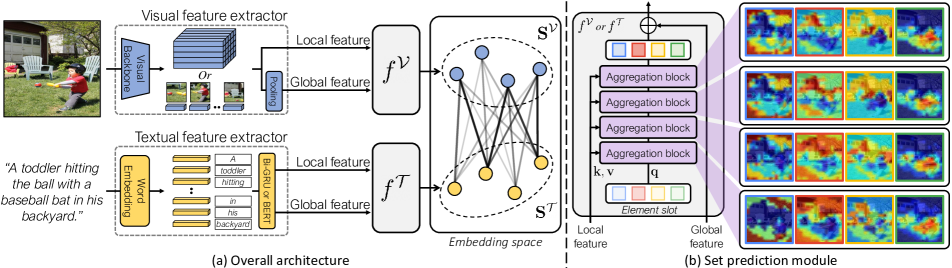
- Design a set prediction module based on slot attention, where learnable element slots iteratively attend to and aggregate distinct semantic features from input images and text.
- Use progressive refinement through multiple aggregation blocks to enhance disentanglement between set elements and improve semantic diversity.
- Train the model using a contrastive loss based on smooth-Chamfer similarity to align matching image-text pairs while encouraging diversity in the embedding set.
- Integrate the set prediction module into a dual-encoder architecture, allowing separate encoding of images and text with set-based outputs for efficient retrieval.
- Apply temperature scaling and hyperparameter tuning (K, T, α) to optimize set cardinality, number of iterations, and similarity sensitivity.
Experimental results
Research questions
- RQ1How can similarity functions for set-based embeddings be improved to reduce training side effects such as sparse supervision and set collapsing?
- RQ2Can a set prediction module based on slot attention effectively generate diverse, disentangled embeddings that capture multiple semantic aspects of an image or caption?
- RQ3To what extent does modeling semantic ambiguity through a set of embeddings improve cross-modal retrieval accuracy compared to single-embedding baselines?
- RQ4Does the proposed method achieve better performance than existing SOTA methods while maintaining low inference cost?
- RQ5How do individual elements of the embedding set contribute to retrieval performance, and what role does their collective use play?
Key findings
- The proposed method achieves a mean Recall@1 (RSUM) of 500.8 on the Flickr30K dataset, surpassing the previous SOTA method (PIE-Net) by 17.5 points.
- On COCO, the model achieves a RSUM of 499.6, outperforming the previous SOTA (PIE-Net) by 16.3 points.
- Ablation studies show that using only one element of the embedding set degrades performance significantly, with the worst drop when using only the second visual slot (RSUM = 309.6), indicating its role in capturing ambiguous semantics.
- The model maintains high performance across different visual backbones and hyperparameter settings, with optimal performance when K > 3, T > 2, and α > 4.
- The smooth-Chamfer similarity function effectively reduces set collapsing and sparse supervision, as evidenced by lower variance in embedding sets and consistent performance gains.
- The slot attention-based set prediction module successfully generates diverse, non-redundant embeddings, as shown by the improved performance when all elements are used together during evaluation.
Read this paper
Open the full text in the Nubint reader and ask about any passage as you read.
Read this paper on NubintThis review was generated by AI from the original paper. Please check the paper before citing it.