
[Paper Review] Improving Expert Specialization in Mixture of Experts
This paper proposes an attentive gating mechanism and a data-driven similarity regularization ($L_s$) to improve expert specialization in Mixture of Experts (MoE) models. By computing gate weights based on expert outputs—similar to attention—the method enables more intuitive task decomposition and better expert utilization, reducing entropy in expert assignment and improving generalization, with $L_s$ outperforming $L_{\text{importance}}$ in sparsity and accuracy on MNIST, FashionMNIST, and CIFAR-100.
Mixture of experts (MoE), introduced over 20 years ago, is the simplest gated modular neural network architecture. There is renewed interest in MoE because the conditional computation allows only parts of the network to be used during each inference, as was recently demonstrated in large scale natural language processing models. MoE is also of potential interest for continual learning, as experts may be reused for new tasks, and new experts introduced. The gate in the MoE architecture learns task decompositions and individual experts learn simpler functions appropriate to the gate's decomposition. In this paper: (1) we show that the original MoE architecture and its training method do not guarantee intuitive task decompositions and good expert utilization, indeed they can fail spectacularly even for simple data such as MNIST and FashionMNIST; (2) we introduce a novel gating architecture, similar to attention, that improves performance and results in a lower entropy task decomposition; and (3) we introduce a novel data-driven regularization that improves expert specialization. We empirically validate our methods on MNIST, FashionMNIST and CIFAR-100 datasets.
Motivation & Objective
- To address poor and unintuitive task decompositions in standard MoE training, which lead to suboptimal expert utilization and performance.
- To improve expert specialization by introducing a novel gating mechanism that dynamically attends to expert outputs, enhancing task decomposition quality.
- To develop a data-driven regularization ($L_s$) that assigns samples to experts based on similarity, promoting efficient and meaningful expert specialization.
- To enable conditional computation in inference despite the lack of it during training in the attentive gating setup, through knowledge distillation.
Proposed method
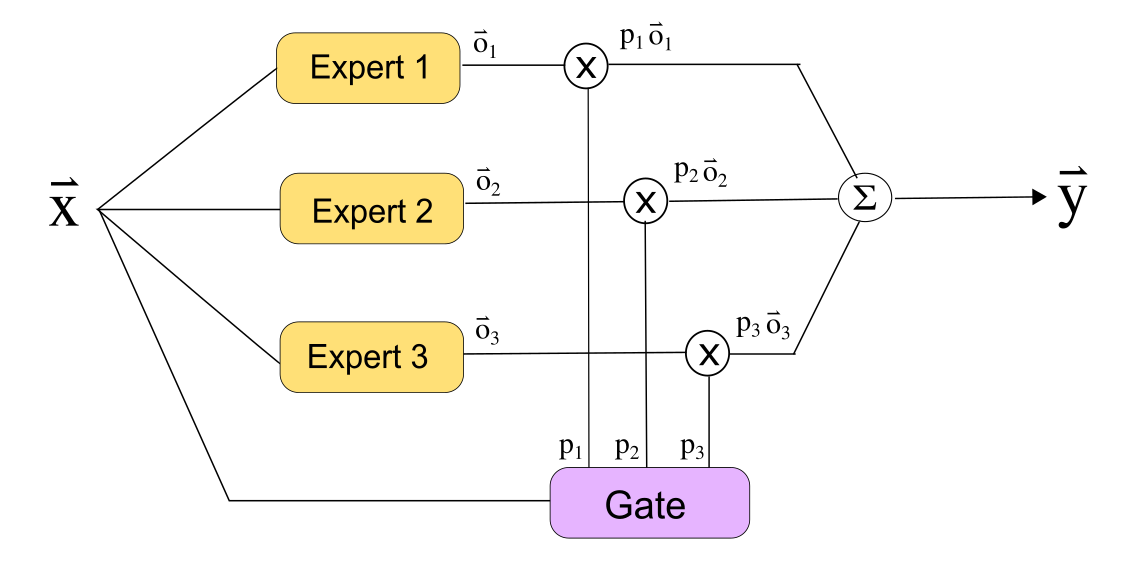
- Introduce an attentive gating mechanism where gate weights are computed as attention scores between the gate and expert outputs for each input sample, enabling dynamic, context-aware expert selection.
- Use a self-attention-like mechanism to compute gate weights: $\text{gate}_i = \text{softmax}(\mathbf{q}_i^T \mathbf{K}_i / \sqrt{d})$, where $\mathbf{q}_i$ is the gate output and $\mathbf{K}_i$ is the expert output for sample $i$.
- Propose a novel regularization term $L_s$ that encourages similar samples to be assigned to the same expert, based on feature similarity in the latent space.
- Train the attentive MoE model with $L_s$ and distill it into a standard MoE architecture to restore conditional computation during inference.
- Apply knowledge distillation to transfer the behavior of the attentive MoE into a standard MoE, enabling efficient inference with sparse expert activation.
- Evaluate performance using standard metrics: test error, mutual information $I(E;Y)$, sparsity $H_s$, and uniformity $H_u$.
Experimental results
Research questions
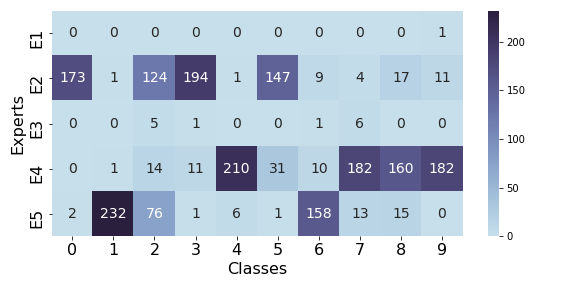
- RQ1Does the original MoE training method lead to intuitive and effective task decompositions, or do they result in poor expert utilization and high error?
- RQ2Can a gating mechanism that attends to expert outputs improve the quality of task decomposition and expert specialization?
- RQ3Does a data-driven similarity regularization ($L_s$) lead to better expert specialization than existing methods like $L_{\text{importance}}$?
- RQ4Can the benefits of attentive gating be preserved in inference through knowledge distillation while maintaining conditional computation?
Key findings
- The attentive gating MoE with $L_s$ regularization achieved the lowest test error of 0.028 ± 0.007 on the MNIST dataset, outperforming vanilla MoE and other variants.
- The $L_s$ regularization reduced gate sparsity entropy ($H_s$) to 0.056 on MNIST and 0.718 on CIFAR-100, indicating better sparsity and more focused expert usage.
- On MNIST, $L_s$ used only 5 out of 15 experts effectively, while $L_{\text{importance}}$ forced equal usage of all experts, suggesting $L_s$ enables more parameter-efficient models.
- The distilled model from attentive gating with $L_s$ achieved 0.482 ± 0.065 test error on CIFAR-100, demonstrating successful transfer of performance to a conditional computation-compatible architecture.
- The attentive gating model reduced task decomposition entropy ($H_s$) from 0.092 (vanilla MoE) to 0.071 on MNIST, indicating more focused and meaningful expert assignment.
- The $L_s$ regularization improved expert uniformity ($H_u$) and mutual information ($I(E;Y)$), indicating better alignment between experts and task subcomponents.
Read this paper
Open the full text in the Nubint reader and ask about any passage as you read.
Read this paper on NubintThis review was generated by AI from the original paper. Please check the paper before citing it.