
[Paper Review] Improving Factuality and Reasoning in Language Models through Multiagent Debate
The paper proposes a multi-agent debate framework where multiple LLM instances generate, critique, and debate responses over several rounds to improve reasoning and factuality, achieving significant gains over single-model baselines across reasoning and factuality tasks.
Large language models (LLMs) have demonstrated remarkable capabilities in language generation, understanding, and few-shot learning in recent years. An extensive body of work has explored how their performance may be further improved through the tools of prompting, ranging from verification, self-consistency, or intermediate scratchpads. In this paper, we present a complementary approach to improve language responses where multiple language model instances propose and debate their individual responses and reasoning processes over multiple rounds to arrive at a common final answer. Our findings indicate that this approach significantly enhances mathematical and strategic reasoning across a number of tasks. We also demonstrate that our approach improves the factual validity of generated content, reducing fallacious answers and hallucinations that contemporary models are prone to. Our approach may be directly applied to existing black-box models and uses identical procedure and prompts for all tasks we investigate. Overall, our findings suggest that such "society of minds" approach has the potential to significantly advance the capabilities of LLMs and pave the way for further breakthroughs in language generation and understanding.
Motivation & Objective
- Motivate: address hallucinations and reasoning errors in large language models (LLMs).
- Propose: a multi-agent debate framework where several LLM instances generate and critique each other’s solutions.
- Demonstrate: improved reasoning and factual accuracy across diverse tasks using only black-box model access.
Proposed method
- Instantiate multiple identical or mixed LLM agents for a given task.
- Each agent independently generates a candidate answer.
- Agents read and critique others’ responses and iterate over multiple rounds to converge on a consensus.
- Use prompts to control debate length and agent stubbornness to influence convergence.
- Demonstrate orthogonality to other prompting methods and combine with chain-of-thought prompting.
Experimental results
Research questions
- RQ1Does multi-agent debate improve reasoning performance relative to single-agent baselines?
- RQ2Does the debate framework improve factual accuracy and reduce hallucinations across diverse tasks?
- RQ3What design choices (number of agents, rounds, prompts) optimize performance?
- RQ4Is the approach compatible with other prompting strategies and model types?
- RQ5Can the method generate robust consensus even when individual agents are uncertain or incorrect?
Key findings
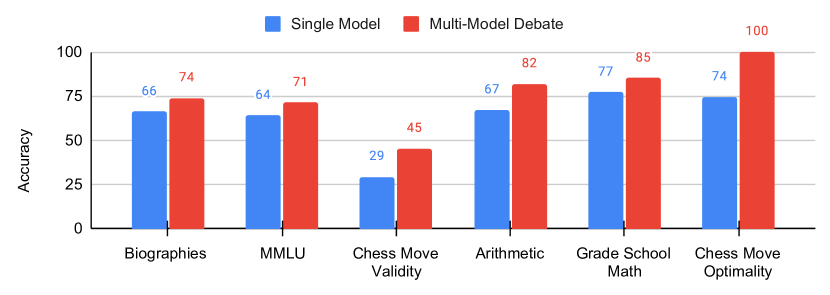
- Multi-agent Debate significantly improves reasoning on arithmetic, GSM8K, and chess move prediction compared to single-agent baselines and reflection. (Arithmetic: 81.8±2.3; GSM8K: 85.0±3.5; Chess: 122.9±7.6 in the ΔPS metric for Debate vs baselines)
- Debate also enhances factual accuracy on biographies, MMLU, and chess-validity tasks, outperforming reflection and single-agent approaches. (Biographies: 73.8±2.3; MMLU: 71.1±4.6; Chess Validity: 45.2±2.9)
- Increasing the number of agents and debate rounds generally improves performance, with diminishing returns beyond a certain point.
- Longer debate prompts slow convergence but can yield higher-quality consensus.
- Different initialization prompts (agent personas) can yield further gains on certain tasks.
- Debate enables convergence to a consensus even when initial answers are incorrect, and can reduce inclusion of uncertain facts.

Better researchstarts right now
From reading papers to final review, dramatically reduce your research time.
No credit card · Free plan available
This review was created by AI and reviewed by human editors.