
[Paper Review] Improving Image Captioning Descriptiveness by Ranking and LLM-based Fusion
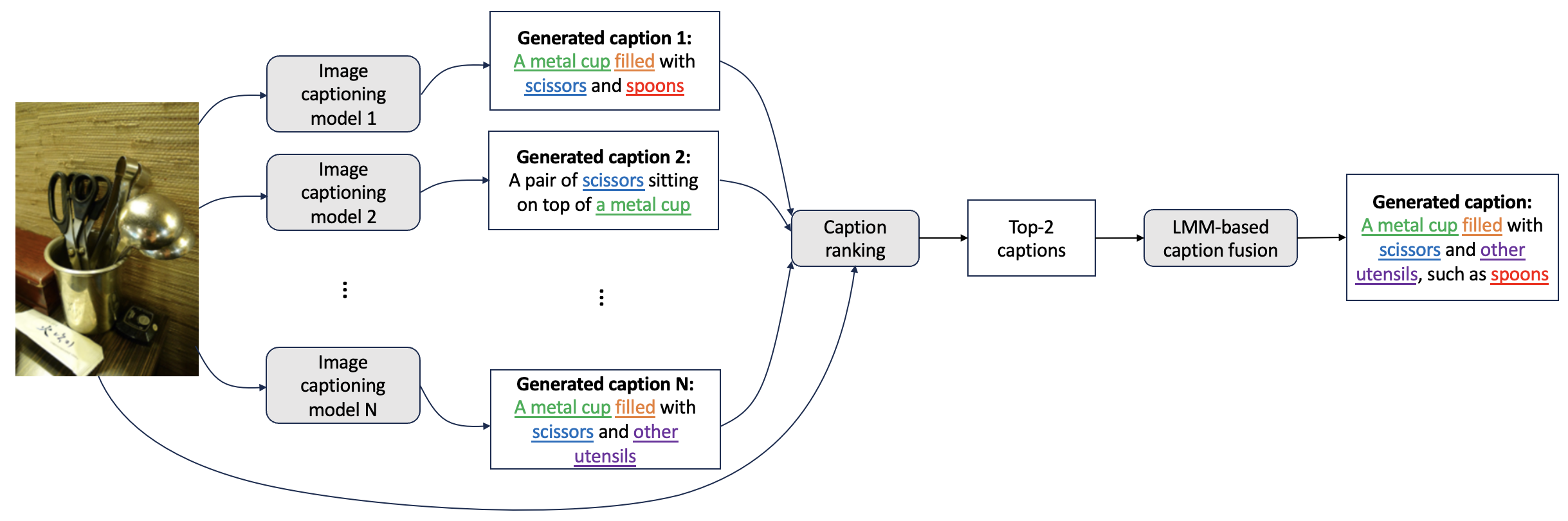
This paper proposes a training-free method to generate more descriptive image captions by ranking outputs from five state-of-the-art (SoTA) captioning models using an image-text matching metric, then fusing the top two captions via a Large Language Model (LLM). The approach produces captions with higher semantic richness, diversity, and human preference compared to individual SoTA models, demonstrating improved alignment with human judgment on the MS-COCO dataset.
State-of-The-Art (SoTA) image captioning models are often trained on the MicroSoft Common Objects in Context (MS-COCO) dataset, which contains human-annotated captions with an average length of approximately ten tokens. Although effective for general scene understanding, these short captions often fail to capture complex scenes and convey detailed information. Moreover, captioning models tend to exhibit bias towards the ``average'' caption, which captures only the more general aspects, thus overlooking finer details. In this paper, we present a novel approach to generate richer and more informative image captions by combining the captions generated from different SoTA captioning models. Our proposed method requires no additional model training: given an image, it leverages pre-trained models from the literature to generate the initial captions, and then ranks them using a newly introduced image-text-based metric, which we name BLIPScore. Subsequently, the top two captions are fused using a Large Language Model (LLM) to produce the final, more detailed description. Experimental results on the MS-COCO and Flickr30k test sets demonstrate the effectiveness of our approach in terms of caption-image alignment and hallucination reduction according to the ALOHa, CAPTURE, and Polos metrics. A subjective study lends additional support to these results, suggesting that the captions produced by our model are generally perceived as more consistent with human judgment. By combining the strengths of diverse SoTA models, our method enhances the quality and appeal of image captions, bridging the gap between automated systems and the rich and informative nature of human-generated descriptions. This advance enables the generation of more suitable captions for the training of both vision-language and captioning models.
Motivation & Objective
- To address the limitation of current image captioning models in generating rich, detailed descriptions due to reliance on short, average-length human-annotated captions from MS-COCO.
- To explore whether fusing multiple SoTA model outputs can yield more descriptive and representative captions than individual models.
- To evaluate whether the resulting captions are more aligned with human judgment and better suited as high-quality training data for vision-language models.
- To investigate whether current captioning models can be improved by training on more descriptive, diverse ground-truth data.
Proposed method
- Select five high-performing, reproducible SoTA image captioning models: BLIP-2, ExpNet-v2, GIT, OFA, and ViT-GPT2.
- Generate multiple captions for each image using the selected models.
- Rank the generated captions using an image-text matching (ITM) metric to assess alignment with the input image.
- Select the top two ranked captions for each image as input to the LLM fusion step.
- Use a Large Language Model (e.g., GPT-3.5 Davinci) to fuse the semantics of the top two captions into a single, more descriptive caption.
- Employ a prompt engineered to elicit context-aware, natural-sounding fusion while avoiding repetitive structural patterns.
Experimental results
Research questions
- RQ1RQ1: Can fusing captions from multiple SoTA models produce more detailed and semantically rich captions than individual models?
- RQ2RQ2: Are the fused captions more representative of the image content according to human judgment?
- RQ3RQ3: Can current image captioning models generate richer captions if trained on high-quality, descriptive data generated by this method?
Key findings
- The proposed method generates captions that are significantly more descriptive and semantically rich than those from individual SoTA models, as confirmed by human evaluation.
- Human evaluators preferred the fused captions over those from any single SoTA model, indicating higher perceived quality and realism.
- The model achieves higher consistency with human judgment on the MS-COCO test set, demonstrating improved alignment with human perception.
- The LLM-based fusion introduces emotional and contextual depth not present in the input captions, such as phrases like 'a captivating scene' or 'vivid and vibrant'.
- Despite its success, the method occasionally suffers from mode collapse when multiple models generate identical or near-identical captions, limiting diversity gains.
- For 16 test images, the LLM introduced a structural prefix ('The caption for the image could be:'), which was not part of the input captions but a result of prompt engineering.
Read this paper
Open the full text in the Nubint reader and ask about any passage as you read.
Read this paper on NubintThis review was generated by AI from the original paper. Please check the paper before citing it.