
[Paper Review] Improving Language Models via Plug-and-Play Retrieval Feedback
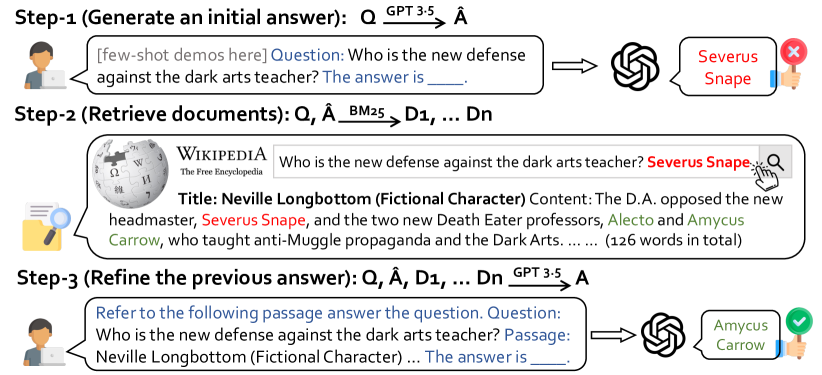
ReFeed introduces a plug-and-play retrieval feedback pipeline that refines LLM outputs by retrieving documents conditioned on initial answers, improving facts in zero-shot and few-shot knowledge-intensive tasks without fine-tuning.
Large language models (LLMs) exhibit remarkable performance across various NLP tasks. However, they often generate incorrect or hallucinated information, which hinders their practical applicability in real-world scenarios. Human feedback has been shown to effectively enhance the factuality and quality of generated content, addressing some of these limitations. However, this approach is resource-intensive, involving manual input and supervision, which can be time-consuming and expensive. Moreover, it cannot be provided during inference, further limiting its practical utility in dynamic and interactive applications. In this paper, we introduce ReFeed, a novel pipeline designed to enhance LLMs by providing automatic retrieval feedback in a plug-and-play framework without the need for expensive fine-tuning. ReFeed first generates initial outputs, then utilizes a retrieval model to acquire relevant information from large document collections, and finally incorporates the retrieved information into the in-context demonstration for output refinement, thereby addressing the limitations of LLMs in a more efficient and cost-effective manner. Experiments on four knowledge-intensive benchmark datasets demonstrate our proposed ReFeed could improve over +6.0% under zero-shot setting and +2.5% under few-shot setting, compared to baselines without using retrieval feedback.
Motivation & Objective
- Motivate reducing hallucinations and factual errors in LLMs without costly fine-tuning.
- Develop a retrieval feedback pipeline that uses retrieved documents to refine initial outputs for knowledge-intensive tasks.
- Explore diversification of initial generation and ensemble strategies to improve reliability of final answers.
Proposed method
- Prompt an LLM to generate initial answers for a query.
- Retrieve top-k documents using the initial answer as part of the retrieval query.
- Refine the initial answer by conditionally incorporating retrieved information.
- Diversify the initial generation to obtain multiple answer candidates for richer feedback.
- Ensemble before-and-after retrieval outputs by ranking via negative log-likelihood to select the final answer.
Experimental results
Research questions
- RQ1Can retrieval feedback be used to improve LLM outputs without fine-tuning, using automatic retrieval rather than human annotations?
- RQ2Can retrieval feedback be integrated in a plug-and-play fashion to refine prior outputs efficiently?
- RQ3Does diversity in initial generation and an ensemble strategy improve correctness and robustness?
Key findings
- ReFeed improves zero-shot EM/F1 on NQ and TriviaQA, achieving over +6.0% in some knowledge-intensive tasks compared to baselines without retrieval feedback.
- ReFeed also shows gains in few-shot settings, with improvements around +2.5% EM/F1 over corresponding baselines.
- Diversity in initial generation and the ensemble method contribute to robustness, with ablations showing performance drops when these components are removed.
- ReFeed can enhance chain-of-thought reasoning for multi-hop QA (HotpotQA) when combined with CoT prompts.
- Case studies illustrate both successful refinements and cases where retrieved documents mislead the model, highlighting the need for the ensemble strategy.

Read this paper
Open the full text in the Nubint reader and ask about any passage as you read.
Read this paper on NubintThis review was generated by AI from the original paper. Please check the paper before citing it.