
[Paper Review] Improving Multimodal Datasets with Image Captioning
The paper shows that adding synthetic captions produced by image captioning models to web-scraped image-text data improves CLIP training, outperforming strong raw-data filtering baselines at small and medium scales and providing insights on caption quality, diversity, and scaling effects.
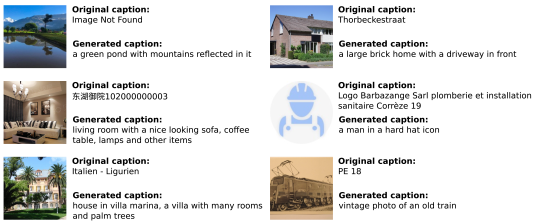
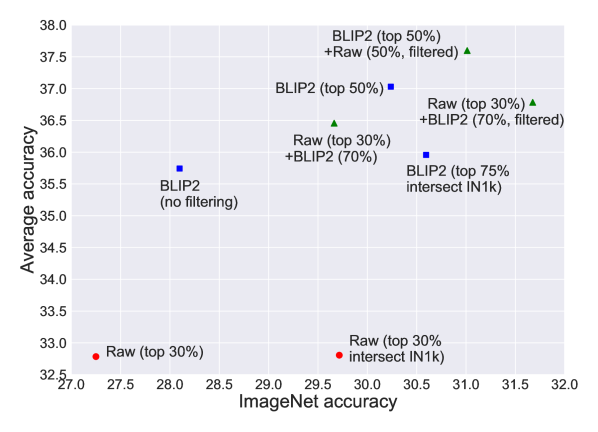
Massive web datasets play a key role in the success of large vision-language models like CLIP and Flamingo. However, the raw web data is noisy, and existing filtering methods to reduce noise often come at the expense of data diversity. Our work focuses on caption quality as one major source of noise, and studies how generated captions can increase the utility of web-scraped datapoints with nondescript text. Through exploring different mixing strategies for raw and generated captions, we outperform the best filtering method proposed by the DataComp benchmark by 2% on ImageNet and 4% on average across 38 tasks, given a candidate pool of 128M image-text pairs. Our best approach is also 2x better at Flickr and MS-COCO retrieval. We then analyze what makes synthetic captions an effective source of text supervision. In experimenting with different image captioning models, we also demonstrate that the performance of a model on standard image captioning benchmarks (e.g., NoCaps CIDEr) is not a reliable indicator of the utility of the captions it generates for multimodal training. Finally, our experiments with using generated captions at DataComp's large scale (1.28B image-text pairs) offer insights into the limitations of synthetic text, as well as the importance of image curation with increasing training data quantity. The synthetic captions used in our experiments are now available on HuggingFace.
Motivation & Objective
- Motivate improving noisy web-scale image-text datasets by focusing on caption quality.
- Evaluate how synthetic captions from BLIP2 and similar models affect multimodal pre-training.
- Compare mixing strategies of raw and synthetic captions versus traditional filtering.
- Analyze caption quality factors such as noise, diversity, and image-text alignment to explain performance gains.
Proposed method
- Generate synthetic captions for web-scraped image-text pairs using captioning models (BLIP, BLIP2, OpenCLIP-CoCa) with top-K sampling.
- Train CLIP models on image-text pairs augmented with synthetic captions across small, medium, and large candidate pools (12.8M, 128M, 1.28B).
- Evaluate zero-shot ImageNet, 38-task average accuracy, and retrieval on Flickr30K and MS-COCO.
- Compare captioning models with and without fine-tuning on MS-COCO to assess impact on downstream CLIP performance.
- Experiment with data mixing strategies, including no-filtering, CLIP-score filtering, and mixing raw with synthetic captions under cosine-similarity thresholds.
Experimental results
Research questions
- RQ1Does synthetic captioning improve CLIP training compared to filtering raw web data alone?
- RQ2How do different captioning models and their training (fine-tuned vs. not) affect multimodal training effectiveness?
- RQ3What mixing strategies of raw and synthetic captions maximize performance, and how does this vary with data scale?
- RQ4What properties of captions (noise, diversity, alignment) drive improvements in downstream tasks?
- RQ5How do benefits of synthetic captions scale from small to ultra-large data pools?
Key findings
- Captioning models not fine-tuned on captioning objectives tend to yield better overall CLIP performance for ImageNet and retrieval than fine-tuned captioners, due to higher text diversity.
- Synthetic captions generally show higher image-text alignment (lower noise) than raw captions, while raw captions offer higher diversity; combining both under a similarity threshold yields better results.
- At medium scale (128M), mixing raw and synthetic captions with a cosine-threshold improves ImageNet and average 38-task performance over the best raw-data baselines by about 2% on ImageNet and 4% average across tasks.
- BLIP2-generated captions substantially boost Flickr and MS-COCO retrieval (over 2x) compared to using only raw captions.
- At large scales (400M–1.28B), benefits on ImageNet diminish without addressing image-content curation and text diversity, while retrieval gains from synthetic captions persist across scales.
Read this paper
Open the full text in the Nubint reader and ask about any passage as you read.
Read this paper on NubintThis review was generated by AI from the original paper. Please check the paper before citing it.