
[Paper Review] Improving Pretraining Data Using Perplexity Correlations
This paper proposes a training-free data selection method that leverages perplexity-benchmark correlations across 90 open-weight LLMs to identify high-quality pretraining data. By selecting data domains with strong correlations between LLM perplexity and downstream benchmark performance, the approach outperforms DSIR on 8 benchmarks at 160M parameters and matches the best method from DataComp-LM without hyperparameter tuning or human curation.
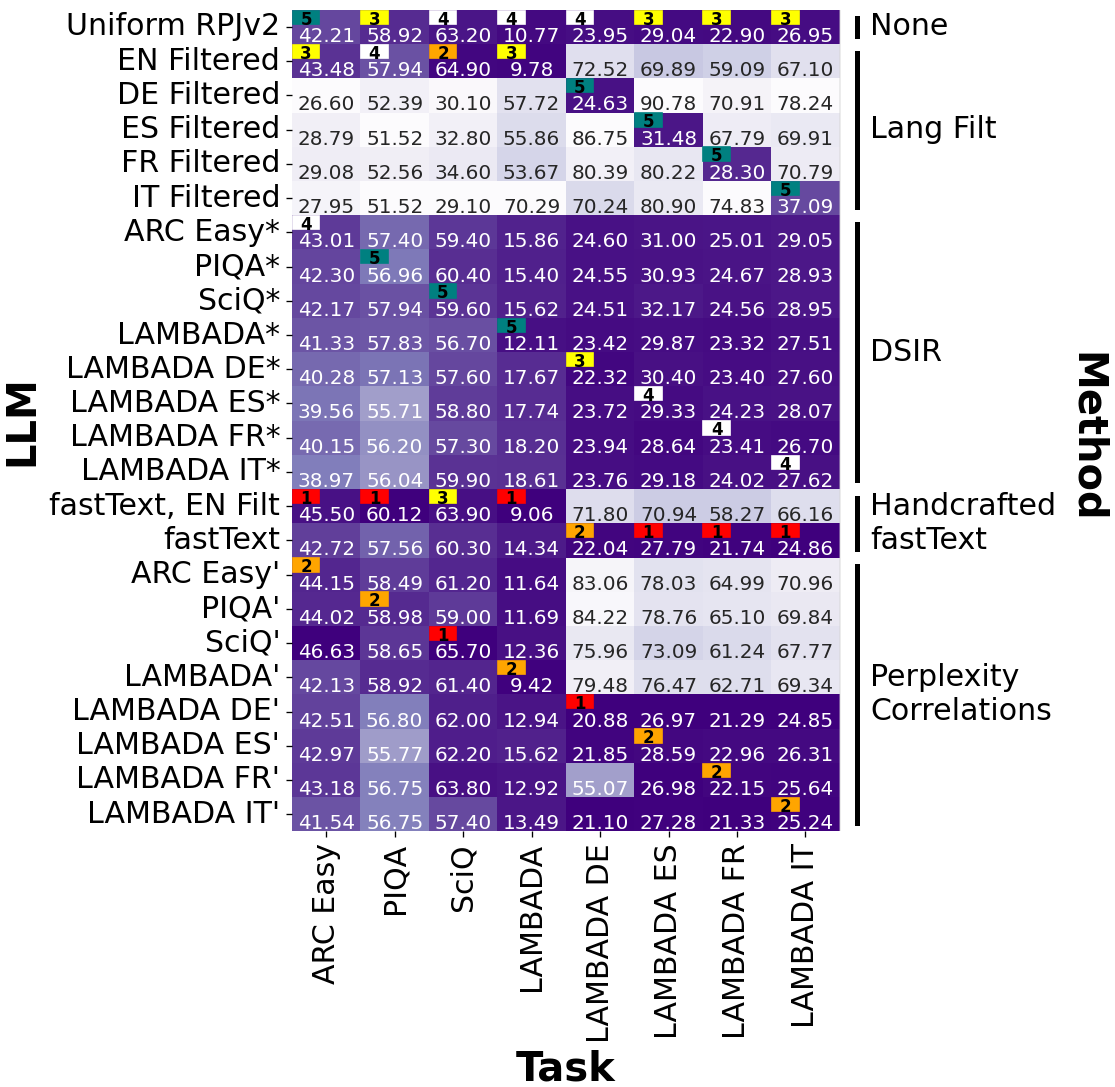
Quality pretraining data is often seen as the key to high-performance language models. However, progress in understanding pretraining data has been slow due to the costly pretraining runs required for data selection experiments. We present a framework that avoids these costs and selects high-quality pretraining data without any LLM training of our own. Our work is based on a simple observation: LLM losses on many pretraining texts are correlated with downstream benchmark performance, and selecting high-correlation documents is an effective pretraining data selection method. We build a new statistical framework for data selection centered around estimates of perplexity-benchmark correlations and perform data selection using a sample of 90 LLMs taken from the Open LLM Leaderboard on texts from tens of thousands of web domains. In controlled pretraining experiments at the 160M parameter scale on 8 benchmarks, our approach outperforms DSIR on every benchmark, while matching the best data selector found in DataComp-LM, a hand-engineered bigram classifier. We have now also updated this paper to include results from preregistered experiments with new pretraining data on an aggregation of 22 benchmarks up to the 1.4B scale, showing increasing improvements of our method over others with more scale. A pip package with full documentation can be found here: https://github.com/TristanThrush/perplexity-correlations.
Motivation & Objective
- To address the high cost of training LLMs for data selection by leveraging existing, publicly available models instead of retraining.
- To investigate whether correlations between LLM perplexity on pretraining data and downstream benchmark performance can serve as reliable surrogates for data quality.
- To develop a statistical framework for estimating perplexity-benchmark correlations across a heterogeneous set of open-weight LLMs.
- To validate the method in controlled pretraining experiments at scale (160M parameters) across 8 benchmarks.
- To preregister and conduct held-out scaling experiments at 1.4B parameters to test external validity and generalization.
Proposed method
- Collect perplexity scores from 90 open-weight LLMs on texts from tens of thousands of web domains via the Hugging Face Open LLM Leaderboard.
- Compute pairwise correlations between each LLM's perplexity on a domain and its downstream benchmark performance across multiple benchmarks.
- Use these correlation estimates as a proxy to rank data domains for pretraining data selection.
- Train a fastText classifier on the correlation-based domain rankings to create a final data selector without any model fine-tuning.
- Perform controlled pretraining experiments at 160M parameters using the selected data on 8 diverse benchmarks.
- Preregister a large-scale evaluation on the DataComp-LM benchmark using the same method at 1.4B parameters, replacing the final filtering step in the pipeline.
Experimental results
Research questions
- RQ1Can perplexity-benchmark correlations across a diverse set of open-weight LLMs reliably predict downstream performance and guide data selection?
- RQ2Does a training-free, correlation-based data selection method outperform existing training-free baselines like DSIR in controlled pretraining experiments?
- RQ3Can the correlation-based method match or exceed the performance of hand-engineered classifiers like the OH-2.5 + ELI5 fastText classifier without any hyperparameter tuning?
- RQ4How generalizable is the method across different model scales and evaluation benchmarks, including multilingual settings?
- RQ5Can preregistered scaling experiments on held-out data improve the trustworthiness and external validity of data selection results?
Key findings
- The correlation-based data selection method outperforms DSIR on all 8 benchmarks in controlled 160M-parameter pretraining experiments.
- The method matches the performance of the best data selector from DataComp-LM (OH-2.5 + ELI5 fastText classifier) without any hyperparameter tuning or human curation.
- Perplexity-benchmark correlations are robust enough to serve as reliable surrogates for downstream performance across diverse LLMs and data domains.
- The approach generalizes effectively to larger-scale experiments, as demonstrated by the preregistered 1.4B-parameter evaluation on DataComp-LM.
- The method achieves strong results even when used as a direct replacement for the final filtering step in a complex pipeline, showing high practical utility.
- Preregistered experiments on multilingual benchmarks confirm the method's effectiveness beyond the core English benchmarks, with comparable performance to the state-of-the-art baseline.

Read this paper
Open the full text in the Nubint reader and ask about any passage as you read.
Read this paper on NubintThis review was generated by AI from the original paper. Please check the paper before citing it.