
[Paper Review] Improving Retrieval-Augmented Generation in Medicine with Iterative Follow-up Questions
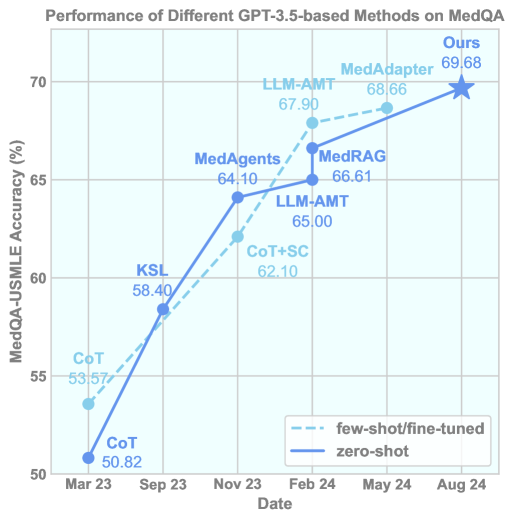
This paper proposes i-MedRAG, a retrieval-augmented generation framework that enables large language models (LLMs) to iteratively generate follow-up questions to enhance medical question answering. By refining queries across multiple rounds using RAG, i-MedRAG achieves a new state-of-the-art zero-shot accuracy of 69.68% on the MedQA dataset with GPT-3.5, outperforming all prior prompt engineering and fine-tuning methods.
The emergent abilities of large language models (LLMs) have demonstrated great potential in solving medical questions. They can possess considerable medical knowledge, but may still hallucinate and are inflexible in the knowledge updates. While Retrieval-Augmented Generation (RAG) has been proposed to enhance the medical question-answering capabilities of LLMs with external knowledge bases, it may still fail in complex cases where multiple rounds of information-seeking are required. To address such an issue, we propose iterative RAG for medicine (i-MedRAG), where LLMs can iteratively ask follow-up queries based on previous information-seeking attempts. In each iteration of i-MedRAG, the follow-up queries will be answered by a conventional RAG system and they will be further used to guide the query generation in the next iteration. Our experiments show the improved performance of various LLMs brought by i-MedRAG compared with conventional RAG on complex questions from clinical vignettes in the United States Medical Licensing Examination (USMLE), as well as various knowledge tests in the Massive Multitask Language Understanding (MMLU) dataset. Notably, our zero-shot i-MedRAG outperforms all existing prompt engineering and fine-tuning methods on GPT-3.5, achieving an accuracy of 69.68% on the MedQA dataset. In addition, we characterize the scaling properties of i-MedRAG with different iterations of follow-up queries and different numbers of queries per iteration. Our case studies show that i-MedRAG can flexibly ask follow-up queries to form reasoning chains, providing an in-depth analysis of medical questions. To the best of our knowledge, this is the first-of-its-kind study on incorporating follow-up queries into medical RAG. The implementation of i-MedRAG is available at https://github.com/Teddy-XiongGZ/MedRAG.
Motivation & Objective
- To address the limitations of vanilla RAG in handling complex, multi-step clinical reasoning tasks in medicine.
- To reduce hallucination and knowledge staleness in LLMs by enabling iterative information-seeking through follow-up queries.
- To develop a generalizable, zero-shot framework that enhances LLM performance on medical question-answering without fine-tuning.
- To characterize the scaling behavior of iterative query generation in terms of iterations and queries per iteration.
- To demonstrate the effectiveness of iterative reasoning chains in solving complex clinical cases through case studies.
Proposed method
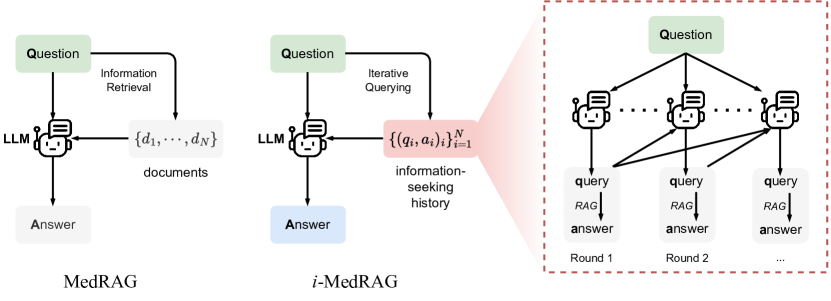
- The framework prompts LLMs to generate follow-up queries based on previous retrieval results and answer history.
- Each follow-up query is processed through a vanilla RAG system to retrieve relevant documents and generate answers.
- The retrieved answers are used to refine the next iteration of query generation, forming a reasoning chain.
- The process is repeated over multiple iterations, with each step improving the focus and relevance of the information sought.
- The final answer is generated by the LLM using the full chain of retrieved information and reasoning steps.
- The method is applied in a zero-shot setting, requiring no fine-tuning or task-specific prompt engineering.
Experimental results
Research questions
- RQ1Can iterative follow-up question generation improve the performance of LLMs on complex medical question-answering tasks?
- RQ2How does the number of iterations and queries per iteration affect the performance of the retrieval-augmented reasoning process?
- RQ3Can i-MedRAG outperform existing prompt engineering and fine-tuning methods without requiring model fine-tuning?
- RQ4How do different LLMs (e.g., GPT-3.5, Llama-3.1-8B) perform with i-MedRAG across diverse medical datasets?
- RQ5What kind of reasoning chains do LLMs form when using iterative queries, and how do they improve answer accuracy?
Key findings
- i-MedRAG achieves a new state-of-the-art zero-shot accuracy of 69.68% on the MedQA dataset using GPT-3.5, surpassing all prior prompt engineering and fine-tuning methods.
- The framework significantly improves performance on complex clinical questions from the USMLE subset of MedQA and on the MMLU-Med dataset.
- Performance scales with the number of iterations and queries per iteration, with diminishing returns observed beyond a certain point.
- Case studies show that i-MedRAG enables LLMs to form coherent reasoning chains by iteratively narrowing down diagnoses and treatments through targeted queries.
- The method effectively reduces hallucination by grounding answers in retrieved evidence across multiple retrieval rounds.
- i-MedRAG demonstrates generalization across both closed-source (GPT-3.5) and open-source (Llama-3.1-8B) LLMs on diverse medical question-answering benchmarks.
Read this paper
Open the full text in the Nubint reader and ask about any passage as you read.
Read this paper on NubintThis review was generated by AI from the original paper. Please check the paper before citing it.