
[Paper Review] Improving Retrieval for RAG based Question Answering Models on Financial Documents
The paper analyzes limitations of standard RAG pipelines for financial documents and proposes techniques to improve retrieval quality, including advanced chunking, query expansion (HyDE), metadata annotations, re-ranking, and embedding fine-tuning.
The effectiveness of Large Language Models (LLMs) in generating accurate responses relies heavily on the quality of input provided, particularly when employing Retrieval Augmented Generation (RAG) techniques. RAG enhances LLMs by sourcing the most relevant text chunk(s) to base queries upon. Despite the significant advancements in LLMs' response quality in recent years, users may still encounter inaccuracies or irrelevant answers; these issues often stem from suboptimal text chunk retrieval by RAG rather than the inherent capabilities of LLMs. To augment the efficacy of LLMs, it is crucial to refine the RAG process. This paper explores the existing constraints of RAG pipelines and introduces methodologies for enhancing text retrieval. It delves into strategies such as sophisticated chunking techniques, query expansion, the incorporation of metadata annotations, the application of re-ranking algorithms, and the fine-tuning of embedding algorithms. Implementing these approaches can substantially improve the retrieval quality, thereby elevating the overall performance and reliability of LLMs in processing and responding to queries.
Motivation & Objective
- Identify limitations of current RAG pipelines in domain-specific (financial) QA tasks.
- Propose and evaluate retrieval enhancements to improve context quality and answer accuracy.
- Demonstrate techniques that mitigate hallucinations and improve reliability in finance-focused Q&A.
Proposed method
- Critically review limitations of uniform chunking and cosine similarity-based retrieval in RAG pipelines.
- Propose adaptive chunking strategies (recursively segmented by document structure such as headings and tables).
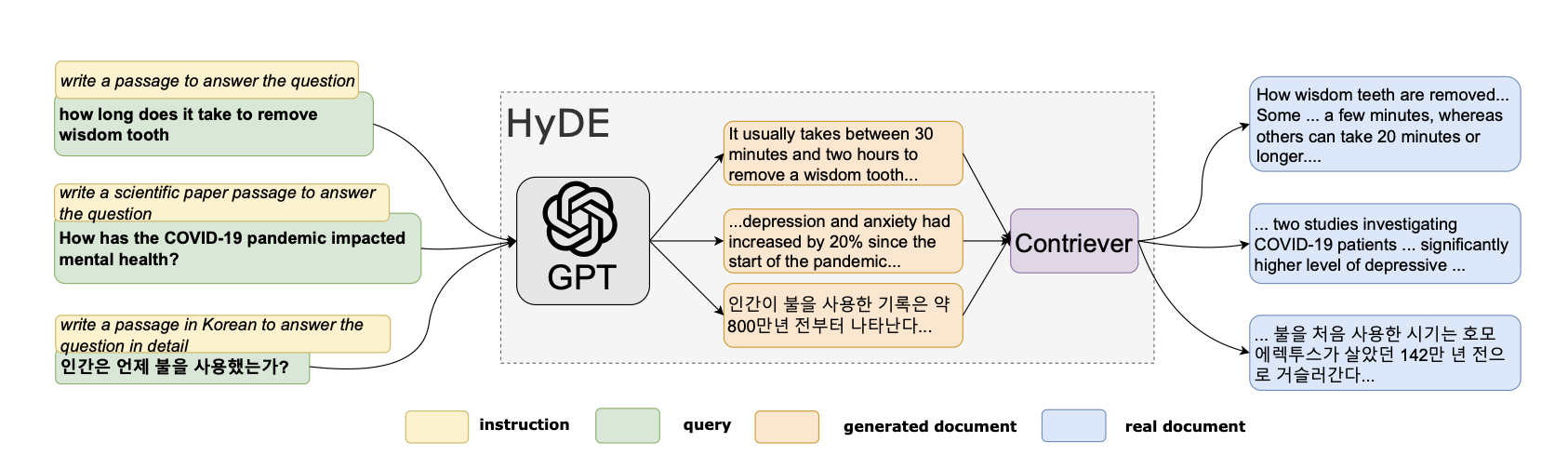
- Explore query expansion with Hypothetical Document Embeddings (HyDE) to improve retrieval guidance.
- Introduce metadata annotations and per-document indexing to preserve document identity and context.
- Apply re-ranking algorithms to prioritize truly relevant chunks over merely similar ones.
- Suggest fine-tuning embeddings on domain-specific data to capture financial terminology and nuance.
Experimental results
Research questions
- RQ1How do current RAG pipelines fall short for multi-document financial Q&A tasks?
- RQ2Can improved retrieval strategies (chunking, HyDE, metadata, re-ranking, domain-specific embeddings) enhance answer quality and reliability in finance documents?
- RQ3What evaluation strategies best capture retrieval quality and answer faithfulness in structured financial datasets?
Key findings
- Retrieval quality and answer faithfulness can be improved by moving beyond uniform chunking to document-structure-aware chunking.
- HyDE-style query expansion helps locate context beyond the user’s original question and reduces retrieval errors.
- Metadata annotations reduce cross-document confusion and improve context preservation across multiple documents.
- Re-ranking can prioritize context relevance over mere similarity, improving the quality of retrieved chunks.
- Embedding fine-tuning on domain data can enhance retrieval in finance-specific contexts.
- FinanceBench (10-K, 10-Q, 8-K, earnings reports) provides ground-truth for structured evaluation of retrieval and QA performance.
Read this paper
Open the full text in the Nubint reader and ask about any passage as you read.
Read this paper on NubintThis review was generated by AI from the original paper. Please check the paper before citing it.