
[Paper Review] Improving the Model Consistency of Decentralized Federated Learning
The paper proposes DFedSAM and DFedSAM-MGS, integrating Sharpness Aware Minimization and multiple gossip steps into decentralized federated learning to reduce local model inconsistency, with theoretical convergence guarantees and competitive empirical results versus centralized FL.
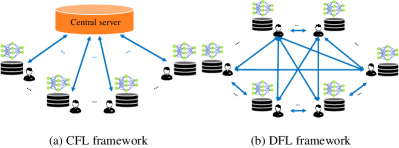
To mitigate the privacy leakages and communication burdens of Federated Learning (FL), decentralized FL (DFL) discards the central server and each client only communicates with its neighbors in a decentralized communication network. However, existing DFL suffers from high inconsistency among local clients, which results in severe distribution shift and inferior performance compared with centralized FL (CFL), especially on heterogeneous data or sparse communication topology. To alleviate this issue, we propose two DFL algorithms named DFedSAM and DFedSAM-MGS to improve the performance of DFL. Specifically, DFedSAM leverages gradient perturbation to generate local flat models via Sharpness Aware Minimization (SAM), which searches for models with uniformly low loss values. DFedSAM-MGS further boosts DFedSAM by adopting Multiple Gossip Steps (MGS) for better model consistency, which accelerates the aggregation of local flat models and better balances communication complexity and generalization. Theoretically, we present improved convergence rates $\small \mathcal{O}\big(\frac{1}{\sqrt{KT}}+\frac{1}{T}+\frac{1}{K^{1/2}T^{3/2}(1-λ)^2}\big)$ and $\small \mathcal{O}\big(\frac{1}{\sqrt{KT}}+\frac{1}{T}+\frac{λ^Q+1}{K^{1/2}T^{3/2}(1-λ^Q)^2}\big)$ in non-convex setting for DFedSAM and DFedSAM-MGS, respectively, where $1-λ$ is the spectral gap of gossip matrix and $Q$ is the number of MGS. Empirically, our methods can achieve competitive performance compared with CFL methods and outperform existing DFL methods.
Motivation & Objective
- Motivate and address high inconsistency among local models in decentralized federated learning (DFL).
- Propose DFedSAM to generate local flat models via Sharpness Aware Minimization (SAM).
- Enhance DFedSAM with Multiple Gossip Steps (MGS) in DFedSAM-MGS to improve consensus and balance communication and generalization.
- Provide non-convex convergence guarantees that capture the effects of topology (spectral gap), data heterogeneity, SAM perturbation, and MGS.
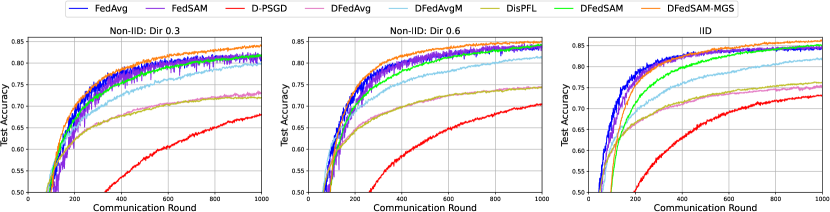
- Demonstrate empirically that the proposed methods achieve competitive performance with CFL and outperform existing DFL baselines on CIFAR-10/100.
Proposed method
- Define the DFL objective with neighbor-only communication on a connected graph.
- Apply SAM-based local updates: y^{t,k+1}(i)=y^{t,k}(i) - η ∇F_i(y^{t,k}(i) + δ(y^{t,k}); ξ) with δ(y)=ρ g/||g||_2.
- Perform K local inner iterations before communication to obtain z^{t}(i) and then aggregate: x^{t+1}(i) = ∑_{l∈N(i)} w_{i,l} z^{t}(l).
- For DFedSAM-MGS, introduce Q gossip steps per round, updating x^{t,q+1}(i)=∑_{l∈N(i)} w_{i,l} z^{t,q}(l) and z^{t,q+1}(i)=x^{t,q+1}(i) for q=0,...,Q-1.
- Provide theoretical convergence bounds in non-convex settings: O(1/√(KT) + 1/T + terms depending on (1−λ) and Q).
- Compare to baselines (FedAvg, FedSAM, D-PSGD, DFedAvg, DisPFL) through experiments on CIFAR-10/100 under IID and non-IID partitions.
Experimental results
Research questions
- RQ1Can SAM reduce local model overfitting and improve generalization in decentralized FL?
- RQ2Does increasing gossip steps (MGS) improve model consensus and close the gap to CFL across diverse topologies?
- RQ3What are the convergence guarantees for DFedSAM and DFedSAM-MGS in stochastic non-convex decentralized settings?
- RQ4How do data heterogeneity and topology (spectral gap) affect performance and how do the proposed methods mitigate these effects?
- RQ5Do DFedSAM and DFedSAM-MGS achieve competitive or superior performance compared to CFL and existing DFL baselines on standard datasets?
Key findings
- DFedSAM and especially DFedSAM-MGS achieve competitive performance with centralized FedSAM on CIFAR-10/100 under IID and non-IID settings.
- DFedSAM-MGS consistently improves topology robustness, with performance gains across ring, grid, exponential, and fully connected networks compared to other DFL baselines.
- The methods reduce generalization error and produce flatter loss landscapes, indicating improved model consistency among clients.
- Theoretical convergence rates show improvements depending on topology (spectral gap), MGS steps Q, and perturbation radius ρ, aligning with empirical results.
- Empirical results demonstrate that larger Q (multiple gossip steps) improves consensus and mitigates topology-induced degradation, with DFedSAM-MGS often outperforming DFedSAM and other baselines.
Read this paper
Open the full text in the Nubint reader and ask about any passage as you read.
Read this paper on NubintThis review was generated by AI from the original paper. Please check the paper before citing it.