
[Paper Review] Improving the open cluster census. II. An all-sky cluster catalogue with Gaia DR3
This paper presents the largest all-sky open cluster catalogue to date, using Gaia DR3 data and the HDBSCAN clustering algorithm to detect 7,167 star clusters, including 2,387 new candidates. It validates clusters via photometric colour-magnitude diagrams and Bayesian classification, inferring astrometry, ages, extinctions, and distances, while identifying many literature clusters as likely non-real due to detection failure in Gaia data.
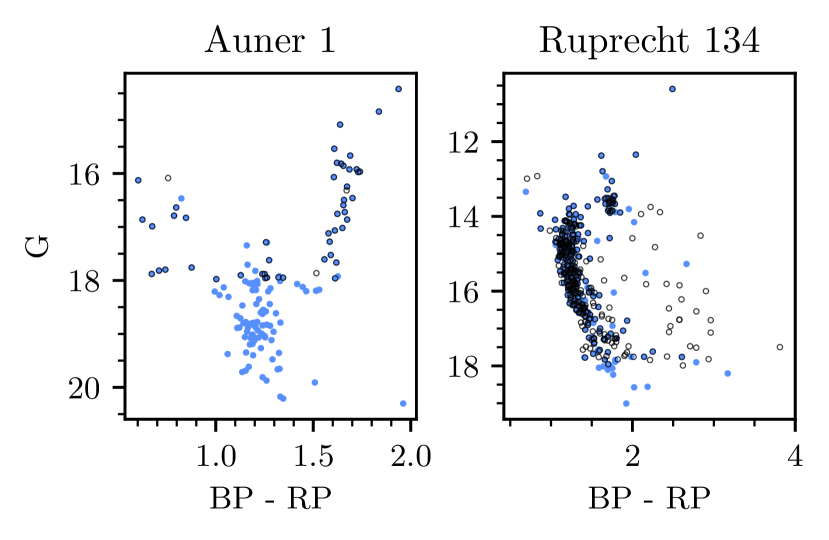
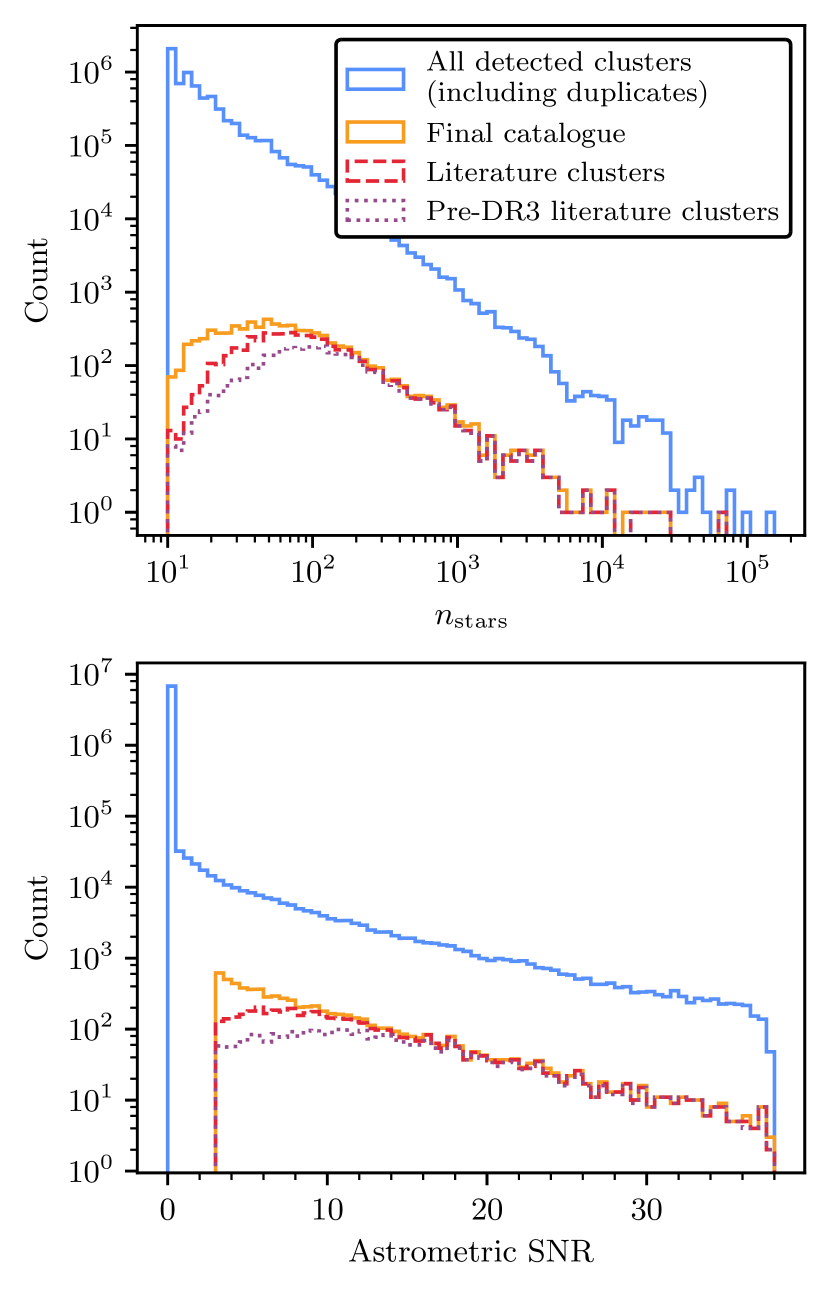
Data from the Gaia satellite are revolutionising our understanding of the Milky Way. With every new data release, there is a need to update the census of open clusters. We aim to conduct a blind, all-sky search for open clusters using 729 million sources from Gaia DR3 down to magnitude $G\sim20$, creating a homogeneous catalogue of clusters including many new objects. We used the Hierarchical Density-Based Spatial Clustering of Applications with Noise (HDBSCAN) algorithm to recover clusters. We validated our clusters using a statistical density test and a Bayesian convolutional neural network for colour-magnitude diagram classification. We inferred basic astrometric parameters, ages, extinctions, and distances for the clusters in the catalogue. We recovered 7167 clusters, 2387 of which are candidate new objects and 4782 of which crossmatch to objects in the literature, including 134 globular clusters. A more stringent cut of our catalogue contains 4105 highly reliable clusters, 739 of which are new. Owing to the scope of our methodology, we are able to tentatively suggest that many of the clusters we are unable to detect may not be real, including 1152 clusters from the Milky Way Star Cluster (MWSC) catalogue that should have been detectable in Gaia data. Our cluster membership lists include many new members and often include tidal tails. Our catalogue's distribution traces the galactic warp, the spiral arm structure, and the dust distribution of the Milky Way. While much of the content of our catalogue contains bound open and globular clusters, as many as a few thousand of our clusters are more compatible with unbound moving groups, which we will classify in an upcoming work. We have conducted the largest search for open clusters to date, producing a single homogeneous star cluster catalogue which we make available with this paper.
Motivation & Objective
- To conduct a blind, all-sky search for open clusters using Gaia DR3’s 729 million sources down to G ~ 20 magnitude.
- To create a homogeneous, statistically validated catalogue of star clusters with inferred astrophysical parameters including age, extinction, and distance.
- To assess the reliability of previously reported open clusters by testing their detectability in Gaia DR3 data.
- To distinguish between bound open clusters and unbound moving groups through statistical and photometric analysis.
- To improve the completeness and purity of the Milky Way’s open cluster census using advanced clustering and machine learning techniques.
Proposed method
- Applied the HDBSCAN algorithm to perform density-based spatial clustering on Gaia DR3 astrometric and photometric data across the entire sky.
- Implemented quality cuts on Gaia sources to remove unreliable measurements, focusing on high-precision astrometry and photometry.
- Validated cluster candidates using a statistical density test to assess significance of spatial overdensities.
- Employed a Bayesian convolutional neural network to classify colour-magnitude diagrams and assign reliability scores to cluster candidates.
- Inferred cluster parameters (age, extinction, distance) by fitting isochrones to photometric data using Bayesian inference.
- Used a multi-step post-processing pipeline to remove false positives and refine membership lists, including tidal tail detection.
Experimental results
Research questions
- RQ1What is the true number of open clusters in the Milky Way, and how many remain undetected in current catalogues?
- RQ2Can the HDBSCAN algorithm reliably recover open clusters across the entire sky with high sensitivity and low false positive rates?
- RQ3Why are many clusters reported in pre-Gaia catalogues not detectable in Gaia DR3 data, and what does this imply about their reality?
- RQ4To what extent do the detected clusters trace galactic structures such as spiral arms, the warp, and dust distribution?
- RQ5How can we distinguish between bound open clusters and unbound moving groups using Gaia data and photometric diagnostics?
Key findings
- The study recovered 7,167 star clusters in total, with 2,387 being new candidate clusters not previously reported in the literature.
- Of the 4,782 clusters crossmatching with literature, 1,152 from the Milky Way Star Cluster (MWSC) catalogue should have been detectable in Gaia DR3 but were not, suggesting they may not be real clusters.
- A stringent subset of 4,105 clusters was identified as highly reliable, of which 739 are new and have median CMD classification scores > 0.5 and S/N > 5σ.
- The spatial and age distribution of the catalogue traces the Milky Way’s spiral arms, galactic warp, and dust structures, consistent with known galactic morphology.
- Many of the newly detected clusters are more compatible with unbound moving groups than bound open clusters, indicating a need for future dynamical analysis using the virial theorem.
- The catalogue demonstrates that many clusters reported before Gaia are likely asterisms or non-existent, challenging the assumption that Gaia misses clusters due to extinction alone.
Better researchstarts right now
From reading papers to final review, dramatically reduce your research time.
No credit card · Free plan available
This review was created by AI and reviewed by human editors.