
[Paper Review] In-Context Learning Creates Task Vectors
This paper proposes that in-context learning (ICL) in large language models (LLMs) operates by compressing demonstrations into a single task vector, which then modulates the model’s output for a query. The authors demonstrate that ICL can be viewed as a hypothesis class learning mechanism where the task vector captures the task rule, enabling accurate predictions without direct access to the demonstrations, with empirical validation across multiple models and tasks.
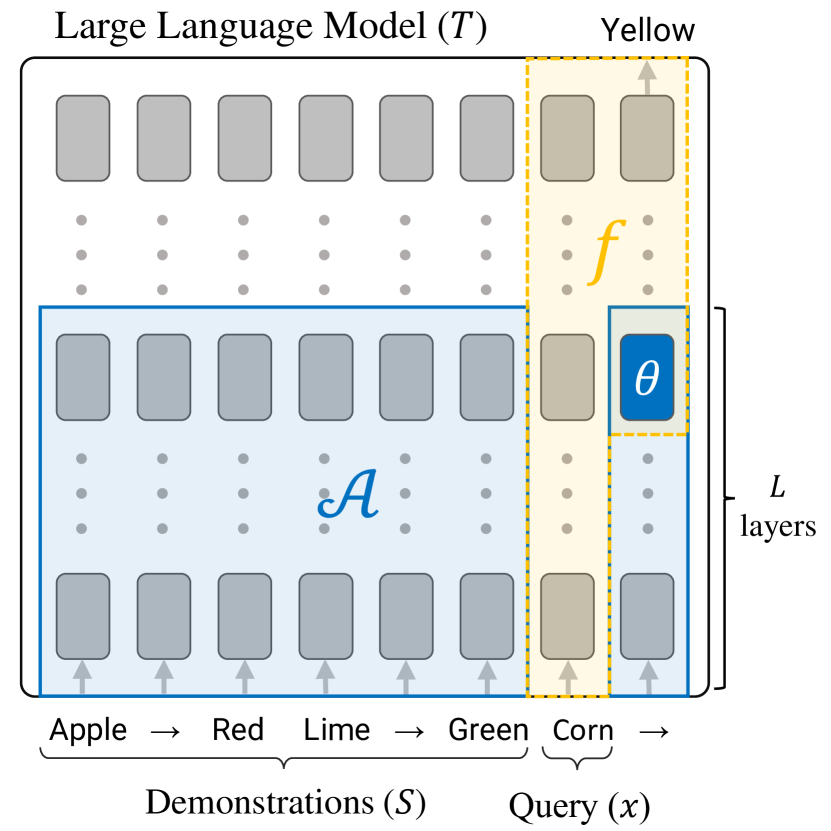
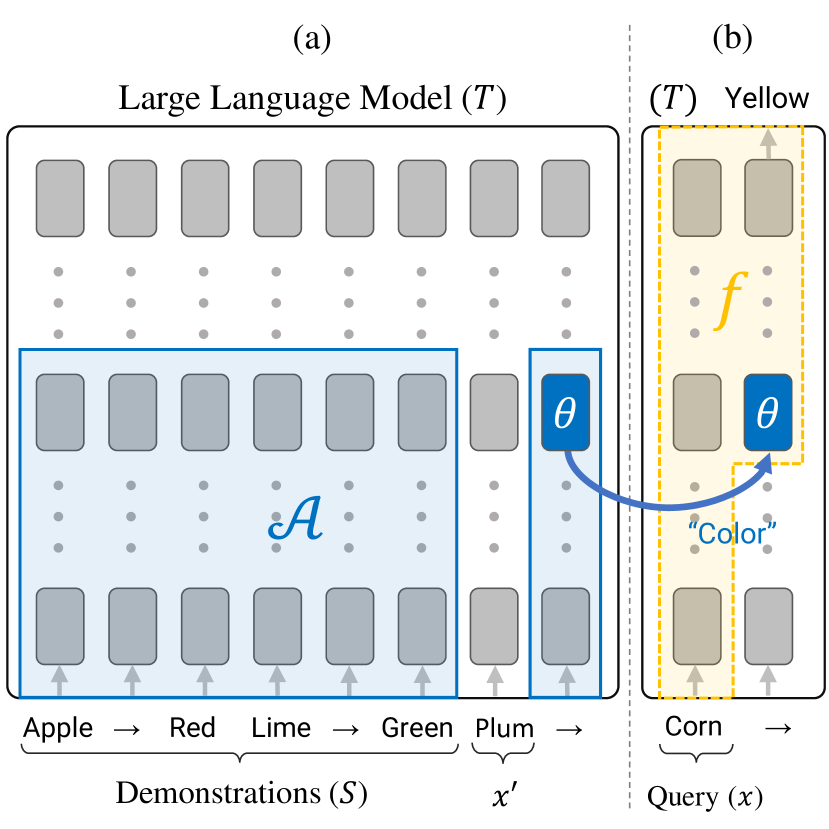
In-context learning (ICL) in Large Language Models (LLMs) has emerged as a powerful new learning paradigm. However, its underlying mechanism is still not well understood. In particular, it is challenging to map it to the "standard" machine learning framework, where one uses a training set $S$ to find a best-fitting function $f(x)$ in some hypothesis class. Here we make progress on this problem by showing that the functions learned by ICL often have a very simple structure: they correspond to the transformer LLM whose only inputs are the query $x$ and a single "task vector" calculated from the training set. Thus, ICL can be seen as compressing $S$ into a single task vector $\boldsymbolθ(S)$ and then using this task vector to modulate the transformer to produce the output. We support the above claim via comprehensive experiments across a range of models and tasks.
Motivation & Objective
- To understand the underlying mechanism of in-context learning (ICL) in large language models (LLMs), which remains poorly understood despite its empirical success.
- To map ICL to a formal learning-theoretic framework by identifying a hypothesis class where ICL operates.
- To investigate whether ICL can be decomposed into a two-stage process: learning a task vector from demonstrations, followed by applying it to a query.
- To validate that the task vector captures meaningful, task-specific semantic information independent of the input demonstrations.
- To explore the implications of this mechanism for efficient and interpretable LLM adaptation to new tasks.
Proposed method
- Propose a hypothesis class view of ICL, where the model learns a task vector θ(S) from demonstrations S, independent of the query x.
- Define a two-part mechanism: (1) a 'learning algorithm' 𝒜 that computes θ(S) from S, and (2) a 'rule application' f that uses θ(S) and x to generate the output, without direct access to S.
- Use attention mechanisms in decoder-only transformers to extract the task vector as a hidden state representation after processing S and x.
- Project the task vector into the vocabulary space via a linear projection to interpret its semantic content.
- Train and evaluate the method on diverse NLP tasks, including translation, word sense disambiguation, and arithmetic reasoning.
- Compare performance using the task vector-based method against standard ICL and baseline models to validate effectiveness and generalization.
Experimental results
Research questions
- RQ1Can in-context learning in LLMs be formalized as a hypothesis class learning mechanism, where a single task vector θ(S) encodes the rule from demonstrations S?
- RQ2Is the task vector θ(S) independent of the query x, such that it can be applied to any new query without reprocessing S?
- RQ3Does the task vector θ(S) contain meaningful, interpretable semantic information about the task, even when the task-specific terms do not appear in the input?
- RQ4Can the task vector approach generalize across different models and tasks while maintaining high accuracy?
- RQ5How does the performance of the task vector-based method compare to standard ICL and baseline models across diverse tasks?
Key findings
- The task vector θ(S) successfully captures the underlying rule from demonstrations S, enabling accurate prediction on unseen queries without direct access to S.
- On the translation task, the model achieved 96% accuracy using the task vector, demonstrating strong generalization from few-shot examples.
- The top tokens in the task vector projection for the French-to-English translation task included 'English' and 'translate', indicating that the vector encodes semantic task information not present in the input.
- For the 'Present to Past' task, the model achieved 95% accuracy, showing robust performance across diverse linguistic transformations.
- The method generalizes across models, with strong results observed on LLaMA 13B, GPT-3, and other models across multiple tasks.
- The task vector approach provides a mechanistic interpretation of ICL, suggesting that LLMs compress demonstrations into a single, interpretable vector that modulates the model's behavior.
Better researchstarts right now
From reading papers to final review, dramatically reduce your research time.
No credit card · Free plan available
This review was created by AI and reviewed by human editors.