
[Paper Review] In-situ vs accreted Milky Way globular clusters: a new classification method and implications for cluster formation
This paper introduces a new classification method for Milky Way globular clusters (GCs) as in-situ or accreted, using total energy and z-component of angular momentum, calibrated with [Al/Fe] abundance ratios. The method successfully separates in-situ and accreted GCs, revealing distinct spatial, kinematic, and chemical properties—with in-situ GCs showing a disc-like distribution and a spin-up signature in rotation velocity at [Fe/H] ≈ −1.3 to −1.0, indicating formation during disc assembly ~11.7–12.7 Gyr ago.
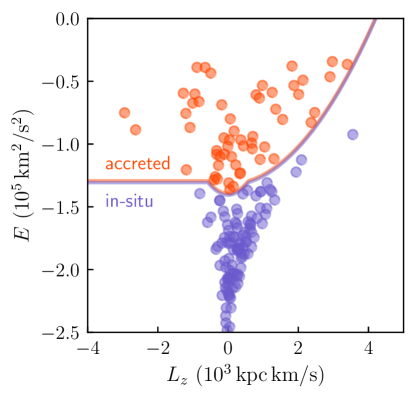
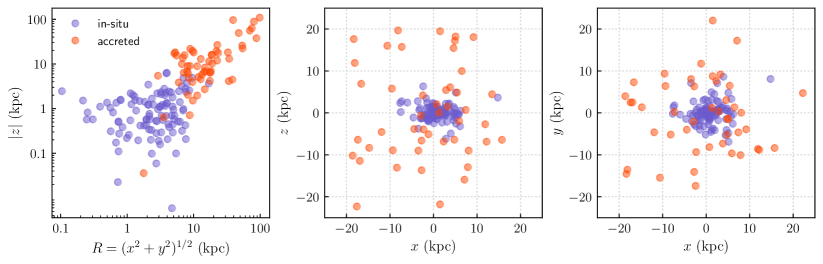
We present a new scheme for the classification of the in-situ and accreted globular clusters (GCs). The scheme uses total energy $E$ and $z$-component of the orbital angular momentum and is calibrated using [Al/Fe] abundance ratio. We demonstrate that such classification results in the GC populations with distinct spatial, kinematic, and chemical abundance distributions. The in-situ GCs are distributed within the central 10 kpc of the Galaxy in a flattened configuration aligned with the MW disc, while the accreted GCs have a wide distribution of distances and a spatial distribution close to spherical. In-situ and accreted GCs have different $ m [Fe/H]$ distributions with the well-known bimodality present only in the metallicity distribution of the in-situ GCs. Furthermore, the accreted and in-situ GCs are well separated in the plane of $ m [Al/Fe]-[Mg/Fe]$ abundance ratios and follow distinct sequences in the age--$ m [Fe/H]$ plane. The in-situ GCs in our classification show a clear disc spin-up signature -- the increase of median $V_ϕ$ at metallicities $ m [Fe/H]\approx -1.3÷-1$ similar to the spin-up in the in-situ field stars. This signature signals the MW's disc formation, which occurred $\approx 11.7-12.7$ Gyrs ago (or at $z\approx 3.1-5.3$) according to GC ages. In-situ GCs with metallicities of $ m [Fe/H]\gtrsim -1.3$ were thus born in the Milky Way disc, while lower metallicity in-situ GCs were born during early, turbulent, pre-disc stages of the evolution of the Galaxy and are part of its Aurora stellar component.
Motivation & Objective
- To develop a robust, data-driven classification scheme for distinguishing in-situ from accreted globular clusters in the Milky Way using only energy and angular momentum.
- To calibrate the classification using the [Al/Fe] abundance ratio, which serves as a tracer of formation environment and cluster origin.
- To investigate the spatial, kinematic, and chemical differences between in-situ and accreted GC populations.
- To link the observed kinematic trends in in-situ GCs to the formation epoch of the Milky Way's disc and its early evolutionary phases.
- To validate the classification against cosmological simulations (FIRE-2), ensuring consistency with galaxy formation models.
Proposed method
- The classification is based on total energy (E) and z-component of orbital angular momentum (Lz), which are available for all Milky Way GCs in Gaia data.
- The method is calibrated using the [Al/Fe] abundance ratio, which distinguishes between in-situ (higher [Al/Fe]) and accreted (lower [Al/Fe]) clusters.
- Clusters are assigned as in-situ or accreted based on their position in the E–Lz plane, with a decision boundary informed by chemical abundance data.
- The method is tested against the FIRE-2 cosmological simulations, comparing radial and velocity distributions of in-situ and accreted GCs to observed data.
- The classification is refined using additional abundance ratios like [Mg/Fe] and [Al/Fe], particularly for clusters with known anomalies such as ω Cen and NGC 6273.
- Statistical validation estimates misclassification rate at ≤10% for in-situ clusters, with known outliers flagged in the catalog.
Experimental results
Research questions
- RQ1Can a classification of Milky Way globular clusters into in-situ and accreted populations be reliably performed using only energy and angular momentum?
- RQ2How do the spatial, kinematic, and chemical properties of in-situ and accreted GCs differ, and can these differences be quantified?
- RQ3Do in-situ GCs exhibit a kinematic signature of disc formation, such as a spin-up in rotational velocity at specific metallicities?
- RQ4Is the observed distribution of in-situ and accreted GCs consistent with predictions from cosmological simulations of galaxy formation?
- RQ5To what extent do abundance ratios like [Al/Fe] and [Mg/Fe] help distinguish cluster origins and refine the classification?
Key findings
- In-situ globular clusters are confined within the central 10 kpc of the Milky Way and exhibit a flattened, disc-aligned spatial distribution, while accreted GCs show a nearly spherical distribution.
- The in-situ GC population displays bimodal metallicity distribution in [Fe/H], with a peak at [Fe/H] ≈ −1.3 to −1.0, while the accreted population shows a unimodal, metal-poor distribution.
- In-situ GCs exhibit a clear spin-up signature: median Vϕ increases at [Fe/H] ≈ −1.3 to −1.0, matching the kinematic trend seen in in-situ field stars.
- The age of the disc formation is constrained to ≈11.7–12.7 Gyr ago (z ≈ 3.1–5.3), based on the timing of the spin-up in in-situ GCs.
- In-situ and accreted GCs are well separated in the [Al/Fe]–[Mg/Fe] abundance plane, with distinct sequences indicating different formation environments.
- The radial and velocity distributions of in-situ and accreted GCs in the Milky Way closely match those of in-situ and accreted stellar particles in FIRE-2 simulations when metallicity-matched, supporting the model that GCs form during gas-rich, merger-prone epochs.
Read this paper
Open the full text in the Nubint reader and ask about any passage as you read.
Read this paper on NubintThis review was generated by AI from the original paper. Please check the paper before citing it.