
[Paper Review] Inference-Time Intervention: Eliciting Truthful Answers from a Language Model
ITI selectively shifts activations in a sparse set of truth-related attention heads during inference to boost truthfulness on TruthfulQA, with trade-offs in helpfulness and minimal extra computation.
We introduce Inference-Time Intervention (ITI), a technique designed to enhance the "truthfulness" of large language models (LLMs). ITI operates by shifting model activations during inference, following a set of directions across a limited number of attention heads. This intervention significantly improves the performance of LLaMA models on the TruthfulQA benchmark. On an instruction-finetuned LLaMA called Alpaca, ITI improves its truthfulness from 32.5% to 65.1%. We identify a tradeoff between truthfulness and helpfulness and demonstrate how to balance it by tuning the intervention strength. ITI is minimally invasive and computationally inexpensive. Moreover, the technique is data efficient: while approaches like RLHF require extensive annotations, ITI locates truthful directions using only few hundred examples. Our findings suggest that LLMs may have an internal representation of the likelihood of something being true, even as they produce falsehoods on the surface.
Motivation & Objective
- Investigate whether LLMs contain latent truth representations that are not expressed in outputs.
- Develop a minimally invasive method to elicit truthful outputs without full model fine-tuning.
- Assess ITI performance on TruthfulQA and related benchmarks and analyze trade-offs with helpfulness.
- Evaluate data efficiency and computational overhead of the approach.
- Explore generalization of ITI to other datasets and instruction-tuned models.
Proposed method
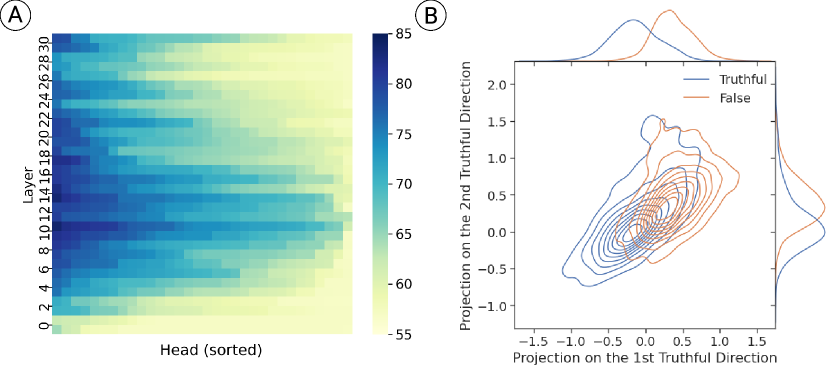
- Identify a sparse set of attention heads whose activations correlate with truthfulness via probing on TruthfulQA.
- Compute truthful directions in the activation space (probing directions).
- During inference, intervene by shifting activations along truthful directions for the top K heads using a strength parameter alpha (x_{l+1}=x_{l}+ sum_h Q_l^h(Att_l^h(P_l^h x_l)) + alpha sigma_l^h theta_l^h).
- Autoregressively apply the intervention at each token prediction.
- Tune K and alpha to balance truthfulness (true*informative score) and potential degradation in other aspects (measured by CE and KL).
- Compare ITI to baselines (SFT, Few-shot prompting, IFT variants) and other direction strategies (probe weight, mass mean shift, CCS).

Experimental results
Research questions
- RQ1Can latent truth-related directions in LLM activations be identified and exploited to improve truthful outputs without retraining?
- RQ2Does a minimally invasive inference-time intervention meaningfully improve TruthfulQA performance, and at what cost to model behavior and efficiency?
- RQ3How does ITI generalize to instruction-finetuned models and other truth-related benchmarks beyond TruthfulQA?
- RQ4What is the optimal balance between truthfulness and helpfulness, and how do hyperparameters K and alpha influence this trade-off?
- RQ5Are truth-related directions sparse and localized to a subset of heads, and what is their geometric structure?
Key findings
- ITI yields substantial gains on TruthfulQA (e.g., Alpaca from 32.5% to 65.1% true*info with ITI; Vicuna from 51.5% to 74.0% true*info).
- Intervening on a sparse set of top truth-related heads is effective and minimally invasive.
- Mass mean shift generally outperforms other directions (including random and CCS) for the intervention vector.
- ITI preserves or modestly alters overall generation distribution (CE and KL remain relatively low with proper tuning).
- ITI provides some gains on additional benchmarks beyond TruthfulQA, with smaller improvements on Natural Questions and TriviaQA and larger on MMLU, indicating partial generalization.
- Truthful directions appear to be learnable with only a few hundred labeled examples and can be found with data-efficient probing.
Read this paper
Open the full text in the Nubint reader and ask about any passage as you read.
Read this paper on NubintThis review was generated by AI from the original paper. Please check the paper before citing it.