
[Paper Review] Inference without Interference: Disaggregate LLM Inference for Mixed Downstream Workloads
TetriInfer disaggregates prefill and decode phases and uses chunking, two-level scheduling, and length prediction to reduce interference in mixed LLM inference workloads, achieving major gains in TTFT, JCT, and efficiency while highlighting limits for extreme workloads.
Transformer-based large language model (LLM) inference serving is now the backbone of many cloud services. LLM inference consists of a prefill phase and a decode phase. However, existing LLM deployment practices often overlook the distinct characteristics of these phases, leading to significant interference. To mitigate interference, our insight is to carefully schedule and group inference requests based on their characteristics. We realize this idea in TetriInfer through three pillars. First, it partitions prompts into fixed-size chunks so that the accelerator always runs close to its computationsaturated limit. Second, it disaggregates prefill and decode instances so each can run independently. Finally, it uses a smart two-level scheduling algorithm augmented with predicted resource usage to avoid decode scheduling hotspots. Results show that TetriInfer improves time-to-first-token (TTFT), job completion time (JCT), and inference efficiency in turns of performance per dollar by a large margin, e.g., it uses 38% less resources all the while lowering average TTFT and average JCT by 97% and 47%, respectively.
Motivation & Objective
- Motivate and quantify interference in mixed LLM inference requests across prefill and decode phases.
- Develop a cloud-scale inference serving system to minimize interference by phase disaggregation and workload-aware scheduling.
- Demonstrate a practical implementation (TetriInfer) that outperforms vanilla vLLM on common workloads and analyze its limitations.
Proposed method
- Partition prompts into fixed-size chunks to keep accelerators computation-saturated during prefill.
- Disaggregate prefill and decode phases so they run on independent instances with KV cache transfer between them.
- Implement a two-level scheduling system with length-prediction to steer decode workloads and avoid hotspots.
- Use a small LLM-based length predictor to estimate generated token counts and guide decode scheduling.
- Adopt chunked prefill and a dispatcher to balance decode instances based on predicted resource usage.
- Extend vLLM with working-set-aware decode scheduling policies to reduce memory thrashing.
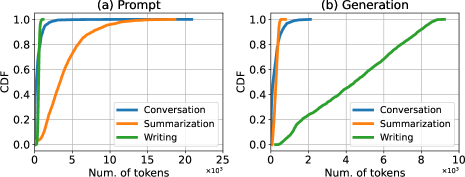
Experimental results
Research questions
- RQ1How do mixed LLM prefill and decode requests perform when run together under current deployment practices?
- RQ2How can a distributed LLM inference serving system minimize interference between prefill and decode, as well as among decode requests, in cloud-scale deployments?
Key findings
- TetriInfer significantly reduces interference and improves efficiency on mixed workloads compared with vanilla vLLM.
- For light prefill and heavy decode workloads, TetriInfer improves perf/$ by 2.4x.
- For common mixed workloads, TetriInfer improves average TTFT by 85% and average JCT by 50%.
- TetriInfer is not ideal for heavy prefill and heavy decode workloads, where gains are marginal and overhead is not offset.
Read this paper
Open the full text in the Nubint reader and ask about any passage as you read.
Read this paper on NubintThis review was generated by AI from the original paper. Please check the paper before citing it.