
[Paper Review] Inform Product Change through Experimentation with Data-Driven Behavioral Segmentation
This paper proposes a data-driven behavioral segmentation framework for A/B testing in web product development, using pre-experiment user engagement with product components to create meaningful user segments. By analyzing treatment effects at the segment level, the method revealed that a Yahoo Finance redesign caused a 10.3% drop in content per visit (CPV) among users focused on quotes and message boards—driven by reduced user-generated content in test groups—leading to a targeted design fix that recovered CPV by 6.1% and increased APV by 35.1%.
Online controlled experimentation is widely adopted for evaluating new features in the rapid development cycle for web products and mobile applications. Measurement of the overall experiment sample is a common practice to quantify the overall treatment effect. In order to understand why the treatment effect occurs in a certain way, segmentation becomes a valuable approach to a finer analysis of experiment results. This paper introduces a framework for creating and utilizing user behavioral segments in online experimentation. By using the data of user engagement with individual product components as input, this method defines segments that are closely related to the features being evaluated in the product development cycle. With a real-world example, we demonstrate that the analysis with such behavioral segments offered deep, actionable insights that successfully informed product decision-making.
Motivation & Objective
- To address the 'why' behind treatment effects in A/B tests, beyond overall metric changes.
- To develop a method for creating behaviorally relevant user segments tied to product features.
- To enable actionable insights for product development through segment-level analysis of experiment results.
- To prevent bias by ensuring segments are defined using pre-experiment data independent of treatment.
- To demonstrate the framework's impact on real product decisions with measurable improvements.
Proposed method
- Define behavioral features based on user engagement with specific product components (e.g., homepage, quotes, message boards).
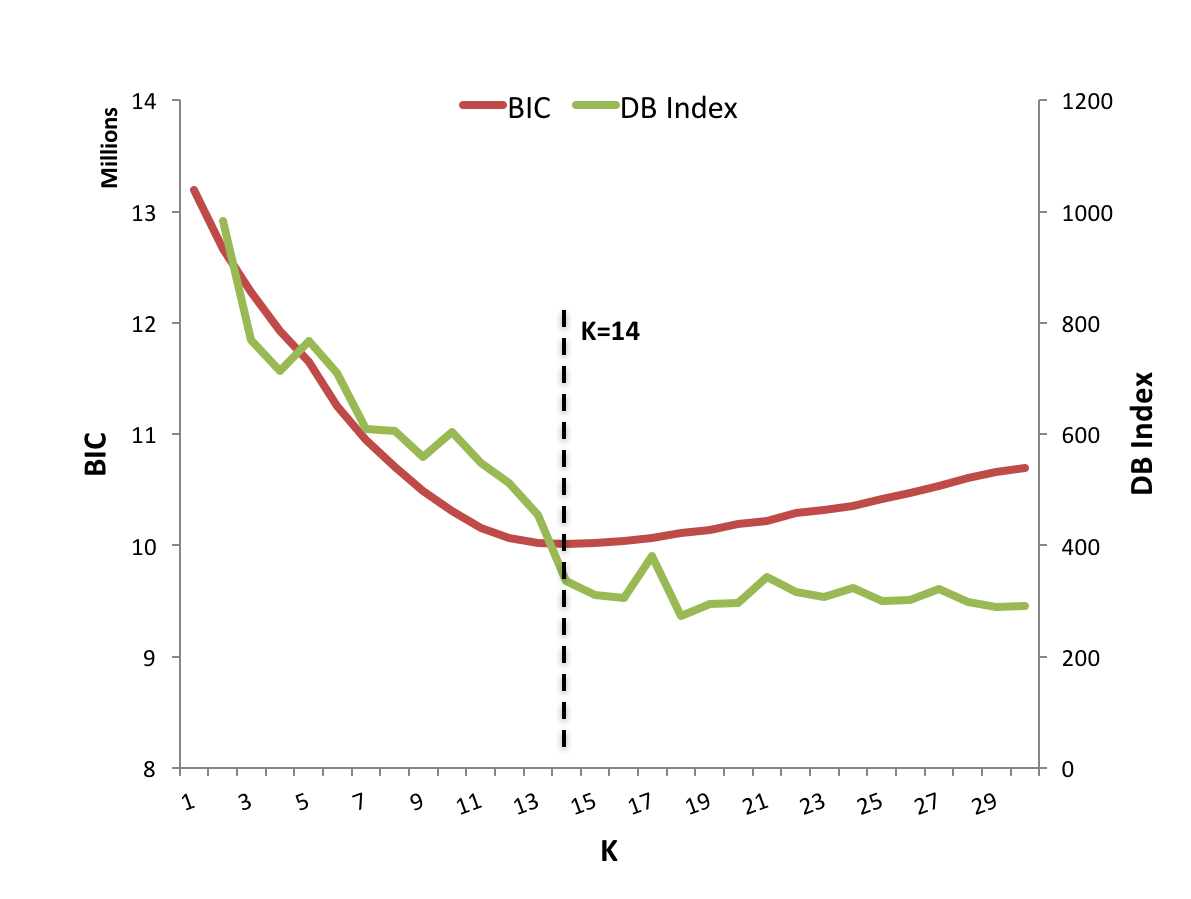
- Use pre-experiment data to cluster users into mutually exclusive, collective exhaustive segments via unsupervised learning.
- Apply distance-based clustering to group users by their engagement patterns across functional components.
- Ensure segment definitions are independent of the experiment treatment by using only pre-experiment behavior data.
- Perform segment-level analysis of treatment effects on key metrics like CPV, APV, and sessions.
- Validate fixes through follow-up A/B tests and compare segment-level outcomes before and after changes.
Experimental results
Research questions
- RQ1How can behavioral segmentation improve the interpretation of A/B test results beyond aggregate metrics?
- RQ2What user engagement patterns are most predictive of treatment effect variation in product experiments?
- RQ3How can segment-level insights guide actionable product development decisions?
- RQ4What are the risks of biased segment definition when using experiment-period data?
- RQ5To what extent can segment-level analysis reveal root causes of unexpected treatment effects?
Key findings
- The Yahoo Finance redesign caused a significant 10.3% drop in content per visit (CPV) in the overall population, primarily driven by the 'Quotes & Message Board' segment.
- Segment-level analysis revealed that the CPV decline in the 'Quotes & Message Board' group was due to reduced user-generated content in the test group, a network effect from smaller sample size.
- After adding back quote-related modules to the homepage, CPV recovered to a 6.1% decrease, and APV increased by 35.1% in the follow-up test.
- The 'Homepage & Hybrid High' and 'Homepage & Hybrid Moderate' segments showed the largest improvements post-fix, with CPV increases of 9% and 6% respectively.
- The overall treatment effect remained significant post-fix, but segment-level analysis was critical to identify the root cause and guide the solution.
- The framework successfully prevented bias by defining segments using pre-experiment data, ensuring valid comparisons between treatment and control groups.
Read this paper
Open the full text in the Nubint reader and ask about any passage as you read.
Read this paper on NubintThis review was generated by AI from the original paper. Please check the paper before citing it.