
[論文レビュー] Inherently Interpretable Multi-Label Classification Using Class-Specific Counterfactuals
Attri-Net は、予測を画素単位で説明するクラス固有の反事後的帰属マップを生成する、まったく新しい本質的解釈可能なマルチラベル分類モデルであり、後処理手法やベースラインの CoDA-Nets よりも優れたクラス感受性と臨床的に整合性のある説明を達成している。分類性能は最先端のブラックボックスモデルと同等を維持している。
Interpretability is essential for machine learning algorithms in high-stakes application fields such as medical image analysis. However, high-performing black-box neural networks do not provide explanations for their predictions, which can lead to mistrust and suboptimal human-ML collaboration. Post-hoc explanation techniques, which are widely used in practice, have been shown to suffer from severe conceptual problems. Furthermore, as we show in this paper, current explanation techniques do not perform adequately in the multi-label scenario, in which multiple medical findings may co-occur in a single image. We propose Attri-Net, an inherently interpretable model for multi-label classification. Attri-Net is a powerful classifier that provides transparent, trustworthy, and human-understandable explanations. The model first generates class-specific attribution maps based on counterfactuals to identify which image regions correspond to certain medical findings. Then a simple logistic regression classifier is used to make predictions based solely on these attribution maps. We compare Attri-Net to five post-hoc explanation techniques and one inherently interpretable classifier on three chest X-ray datasets. We find that Attri-Net produces high-quality multi-label explanations consistent with clinical knowledge and has comparable classification performance to state-of-the-art classification models.
研究の動機と目的
- 複数の病変が共存する状況においても、忠実で人間が理解可能な説明が得られない高リスク医療AIの課題に対処すること。
- モデルの真の意思決定メカニズムを反映しないことが保証されていない、後処理的手法の概念的欠陥と一貫性の欠如を克服すること。
- 説明が意思決定プロセスそのものである本質的解釈可能なモデルを開発し、忠実性と透明性を保証すること。
- 反事後的推論を組み込むことで、より臨床的に意味のある局所化された帰属マップを生成する点で、既存の本質的解釈可能なモデルを改善すること。
- 提案手法が臨床知識と整合的であり、定量的および定性的な評価において、後処理手法およびベースラインの本質的解釈可能なモデルを上回ることを実証すること。
提案手法
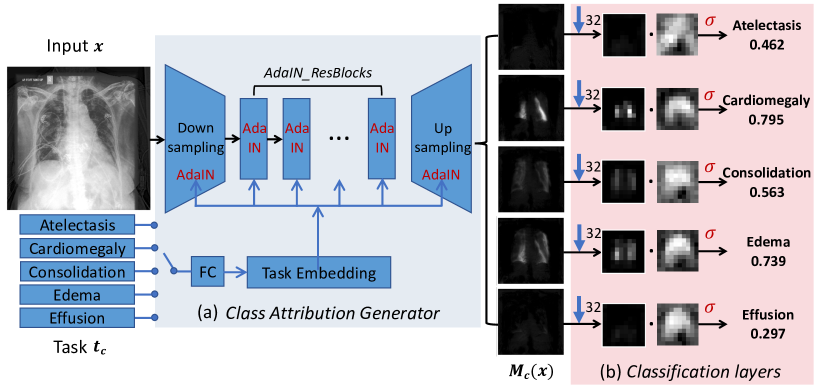
- 入力画像から各医学的所見の影響を現実的に除去するクラス固有の反事後的画像を生成する視覚的特徴帰属生成器を学習する。
- 元の画像と反事後的画像の差分を用いて、各クラスに対応する領域を強調する画素単位の帰属マップを生成する。
- 生成された帰属マップに基づいてのみ予測を行う単純なロジスティック回帰分類器を適用し、透明性と解釈可能性を確保する。
- 帰属マップが各病変の有無に敏感であることを保証するため、再構成損失とクラス固有の損失を用いて帰属生成器を最適化する。
- 帰属マップを線形意思決定関数に統合し、モデルの予測がこれらの人間が読める特徴の重み付き和であることを可能にし、直接的な解釈可能性を実現する。
- 入力画像の再構成と各クラスの正確な帰属マップの生成を同時に最適化するマルチタスク学習の枠組みを活用する。
実験結果
リサーチクエスチョン
- RQ1反事後的帰属マップは、マルチラベル医療画像分類において、後処理手法よりも忠実で臨床的に意味のある説明を提供できるか?
- RQ2Attri-Net がクラス感受性の高い帰属マップを生成する性能は、最先端の本質的解釈可能なモデル CoDA-Nets と比べてどの程度か?
- RQ3Attri-Net が生成する帰属マップは、特定の病変に関連する臨床的境界ボックスや解剖学的領域とどの程度一致するか?
- RQ4クラス固有の反事後的を用いることで、勾配ベースや摂動ベースの手法と比較して、異なる画像や病変においてより一貫性があり信頼性の高い説明が得られるか?
- RQ5本質的解釈可能なモデルは、最先端のブラックボックスモデルと同等の分類精度を維持しながら、透明で画素単位の説明を提供できるか?
主な発見
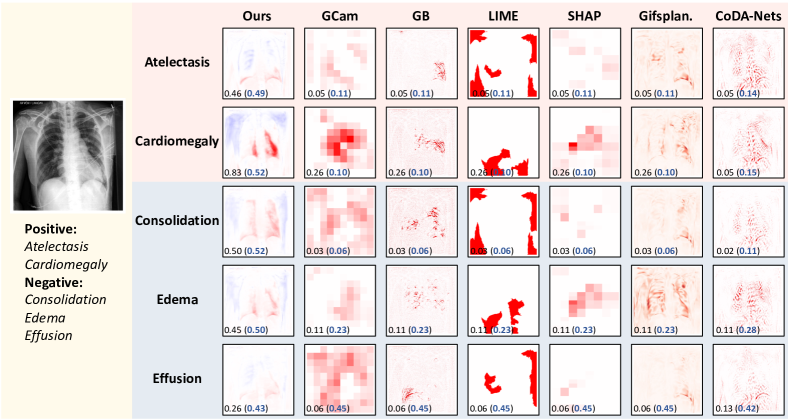
- Attri-Net は、3つのチーチェストX線データセットすべてにおいて CoDA-Nets よりも顕著に高いクラス感受性を達成し、平均感受性値が最適な1.0に著しく近づいていた。これは、帰属マップが病変陽性領域に的確に局所化されていることを示している。
- 定量的および定性的な両面で、5つの後処理説明手法(Guided Backpropagation、GradCAM、LIME、SHAP、Gifsplanation)をすべて上回った。SHAP や Gifsplanation が最も近いが、依然として Attri-Net に劣っていた。
- 定性的分析の結果、Attri-Net の帰属マップは、例えば不張塞塞、胸水、心臓肥大といった特定の病変に関連する解剖学的領域を明確に強調しており、高い信頼性の予測ではより集中的かつ正確な帰属が得られていた。
- 一方、CoDA-Nets はすべてのクラスで視覚的に類似した、特徴が乏しく判別性に欠ける帰属マップを生成しており、特異性と臨床的関連性に欠けていた。
- Attri-Net の帰属マップはクラスごとに明確に異なり、異なる解剖学的領域に焦点を当てており、病変特徴の有効な分離が図られていた。
- 臨床的境界ボックスの外側の領域でも、Attri-Net は強い帰属を生成しており、標準的な評価プロトコルで捉えきれない微細な相関効果を検出できている可能性があり、臨床的に有用な情報である可能性がある。
より良い研究を、今すぐ始めましょう
論文の読解から最終レビューまで、研究時間を劇的に削減しましょう。
クレジットカード登録不要
このレビューはAIが作成し、人間の編集者が確認しました。