
[Paper Review] Inroads into Autonomous Network Defence using Explained Reinforcement Learning
This paper proposes a hierarchical deep reinforcement learning (DRL) framework for autonomous network defense, using explained RL to visualize attacker behavior and improve decision-making. It introduces two enhanced controller architectures—heuristic and bandit-based—that significantly boost defense accuracy over prior methods, validated through feature ablation and SHAP-based explainability analysis.
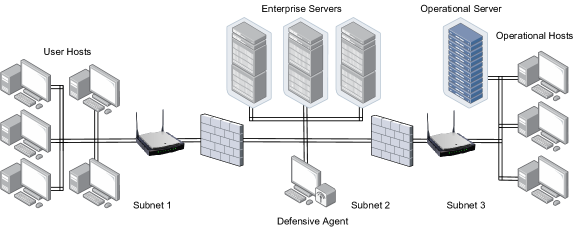
Computer network defence is a complicated task that has necessitated a high degree of human involvement. However, with recent advancements in machine learning, fully autonomous network defence is becoming increasingly plausible. This paper introduces an end-to-end methodology for studying attack strategies, designing defence agents and explaining their operation. First, using state diagrams, we visualise adversarial behaviour to gain insight about potential points of intervention and inform the design of our defensive models. We opt to use a set of deep reinforcement learning agents trained on different parts of the task and organised in a shallow hierarchy. Our evaluation shows that the resulting design achieves a substantial performance improvement compared to prior work. Finally, to better investigate the decision-making process of our agents, we complete our analysis with a feature ablation and importance study.
Motivation & Objective
- Address the high operational cost and complexity of human-led network defense by enabling fully autonomous, AI-driven defense systems.
- Overcome the lack of explainability in deep reinforcement learning agents, which hinders trust and development in security-critical applications.
- Improve defense performance by leveraging insights from visualized adversarial behavior using state diagrams to inform agent architecture design.
- Develop specialized subagents and controllers that outperform baseline models in detecting and mitigating diverse adversary strategies in the CybORG environment.
- Provide post-training interpretability through feature ablation and SHAP analysis to understand which observation components most influence agent decisions.
Proposed method
- Use state diagrams to visualize and analyze adversarial behavior in the CybORG environment, identifying key intervention points for defense design.
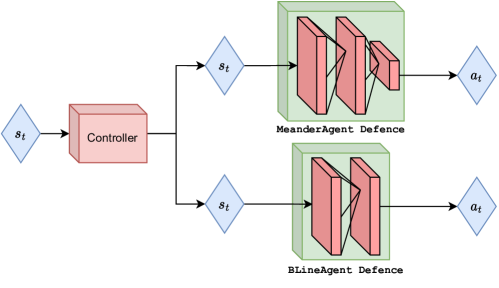
- Implement a hierarchical DRL architecture with a controller coordinating specialized subagents, each trained via Proximal Policy Optimization (PPO) for specific attack types.
- Integrate curiosity-driven exploration via the Intrinsic Curiosity Module (ICM) to enhance exploration in sparse-reward defense scenarios.
- Design two improved controller models: a heuristic controller based on observed adversary patterns and a bandit-based controller for dynamic strategy selection.
- Apply SHAP (SHapley Additive exPlanations) to perform post-hoc feature importance analysis, identifying critical elements in the observation space.
- Conduct feature ablation studies to evaluate the impact of individual features on agent performance, validating model robustness and interpretability.
Experimental results
Research questions
- RQ1How can adversarial behavior in network defense environments be visualized and analyzed to inform the design of more effective defensive agents?
- RQ2Can hierarchical DRL with specialized subagents and improved controllers outperform existing baseline models in autonomous network defense tasks?
- RQ3To what extent do specific features in the observation space influence the decision-making of defensive agents, and which are most critical for performance?
- RQ4How can explainable AI (XAI) techniques like SHAP and ablation studies enhance understanding of DRL agent behavior in cyber defense?
- RQ5Does integrating intrinsic curiosity and explainability into the training pipeline lead to more robust and interpretable defense policies?
Key findings
- The proposed heuristic and bandit-based controller architectures achieve substantial performance improvements over baseline models in classifying adversary behavior within the CybORG environment.
- Feature ablation studies reveal that the 'host access' feature has the highest importance for defensive agents, with its removal significantly degrading performance.
- SHAP analysis confirms that the 'host access' feature is the most influential in determining agent rewards, followed by 'service status' and 'process state' features.
- The model with the bandit-based controller outperforms both the baseline and PPO-only models, demonstrating the value of adaptive strategy selection.
- Even features with low overall importance, such as 'network connection', still contribute meaningfully to agent performance, especially in failure recovery scenarios.
- Post-hoc explainability via SHAP and ablation provides actionable insights into agent decision-making, enhancing trust and facilitating model refinement.
Read this paper
Open the full text in the Nubint reader and ask about any passage as you read.
Read this paper on NubintThis review was generated by AI from the original paper. Please check the paper before citing it.