
[Paper Review] InstaFormer: Instance-Aware Image-to-Image Translation with Transformer
InstaFormer proposes a Transformer-based architecture for instance-aware image-to-image translation that jointly models global and instance-level features using self-attention, enhancing object-level translation fidelity. By integrating instance-level content contrastive loss and adaptive instance normalization, it achieves state-of-the-art performance on content-rich scene translation and domain adaptive object detection.
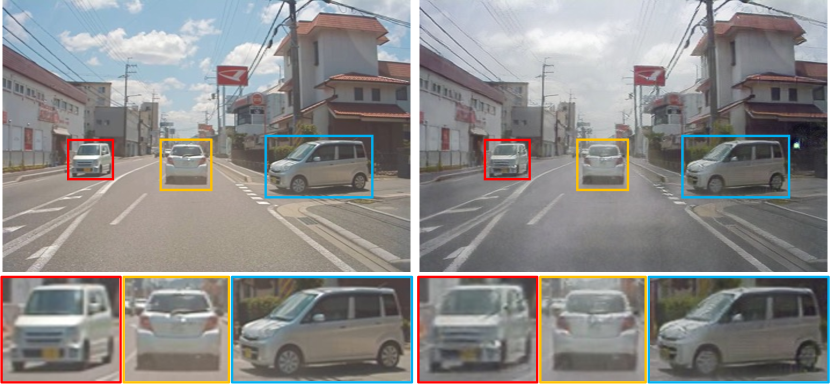
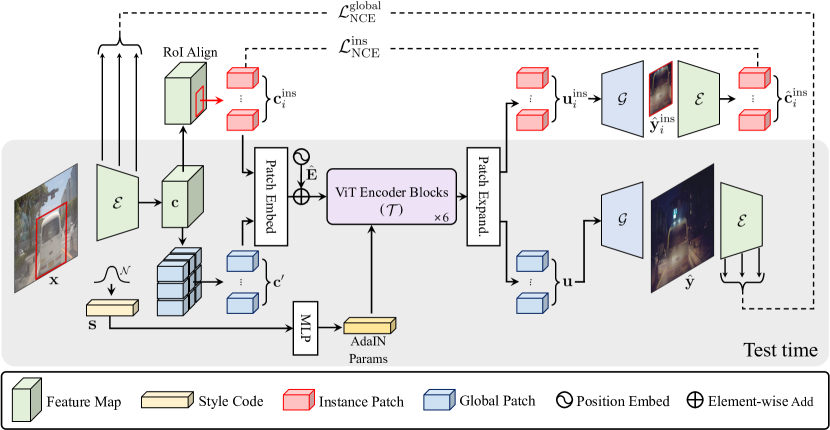
We present a novel Transformer-based network architecture for instance-aware image-to-image translation, dubbed InstaFormer, to effectively integrate global- and instance-level information. By considering extracted content features from an image as tokens, our networks discover global consensus of content features by considering context information through a self-attention module in Transformers. By augmenting such tokens with an instance-level feature extracted from the content feature with respect to bounding box information, our framework is capable of learning an interaction between object instances and the global image, thus boosting the instance-awareness. We replace layer normalization (LayerNorm) in standard Transformers with adaptive instance normalization (AdaIN) to enable a multi-modal translation with style codes. In addition, to improve the instance-awareness and translation quality at object regions, we present an instance-level content contrastive loss defined between input and translated image. We conduct experiments to demonstrate the effectiveness of our InstaFormer over the latest methods and provide extensive ablation studies.
Motivation & Objective
- Address the limitation of existing image-to-image translation methods in handling content-rich scenes with multiple object instances.
- Improve instance-awareness in translation by modeling interactions between object instances and the global image context.
- Enhance translation quality at object regions through a novel instance-level content contrastive loss.
- Enable multi-modal translation using style codes by replacing LayerNorm with AdaIN in the Transformer encoder.
- Demonstrate superior performance on instance-aware translation and downstream tasks like domain adaptive object detection.
Proposed method
- Treat content features extracted from an image as tokens in a Transformer encoder to model global context via self-attention.
- Augment global tokens with instance-level features derived from content features using bounding box information to enhance instance-aware representation.
- Integrate position embeddings to jointly model global and instance-level patches for improved spatial awareness.
- Replace standard LayerNorm with Adaptive Instance Normalization (AdaIN) to support multi-modal translation with style codes.
- Apply convolutional patch embedding and deconvolutional modules at the input and output of the Transformer to reduce computational cost.
- Introduce an instance-level content contrastive loss between input and translated images to improve feature alignment at object regions.
Experimental results
Research questions
- RQ1Can a Transformer-based architecture effectively integrate global and instance-level features for instance-aware image-to-image translation?
- RQ2How does the proposed instance-level contrastive loss improve object-level translation fidelity compared to standard contrastive losses?
- RQ3To what extent does replacing LayerNorm with AdaIN enhance multi-modal translation capability in the absence of cycle-consistency?
- RQ4How does InstaFormer perform on downstream tasks such as domain adaptive object detection compared to existing SOTA methods?
- RQ5What is the contribution of each component (e.g., Transformer encoder, contrastive loss, AdaIN) to the overall translation quality and instance-awareness?
Key findings
- InstaFormer achieves state-of-the-art performance on instance-aware image-to-image translation benchmarks, outperforming CUT, DUNIT, and MGUIT.
- The ablation study confirms that the instance-level contrastive loss significantly improves object-level clarity and reduces blurring, especially in complex scenes.
- Replacing the Transformer encoder with MLP-Mixer shows comparable performance, indicating the framework's robustness to backbone choice.
- InstaFormer achieves a mAP of 55.5 on the KITTI→Cityscapes domain adaptation detection benchmark, surpassing DUNIT (54.1) and MGUIT (54.6).
- Human evaluation confirms that InstaFormer outperforms baselines in overall image quality, semantic consistency, and style consistency.
- The removal of AdaIN leads to single-modal outputs and degraded style preservation, demonstrating its importance in multi-modal translation.
Read this paper
Open the full text in the Nubint reader and ask about any passage as you read.
Read this paper on NubintThis review was generated by AI from the original paper. Please check the paper before citing it.