
[Paper Review] InstanT: Semi-supervised Learning with Instance-dependent Thresholds
InstanT proposes a novel semi-supervised learning method that assigns instance-dependent confidence thresholds to unlabeled samples based on their individual ambiguity and predicted error rates, ensuring a bounded probability of correct pseudo-label assignment. The method achieves state-of-the-art performance on benchmark datasets by dynamically adjusting thresholds to reduce noise while maintaining high efficiency.
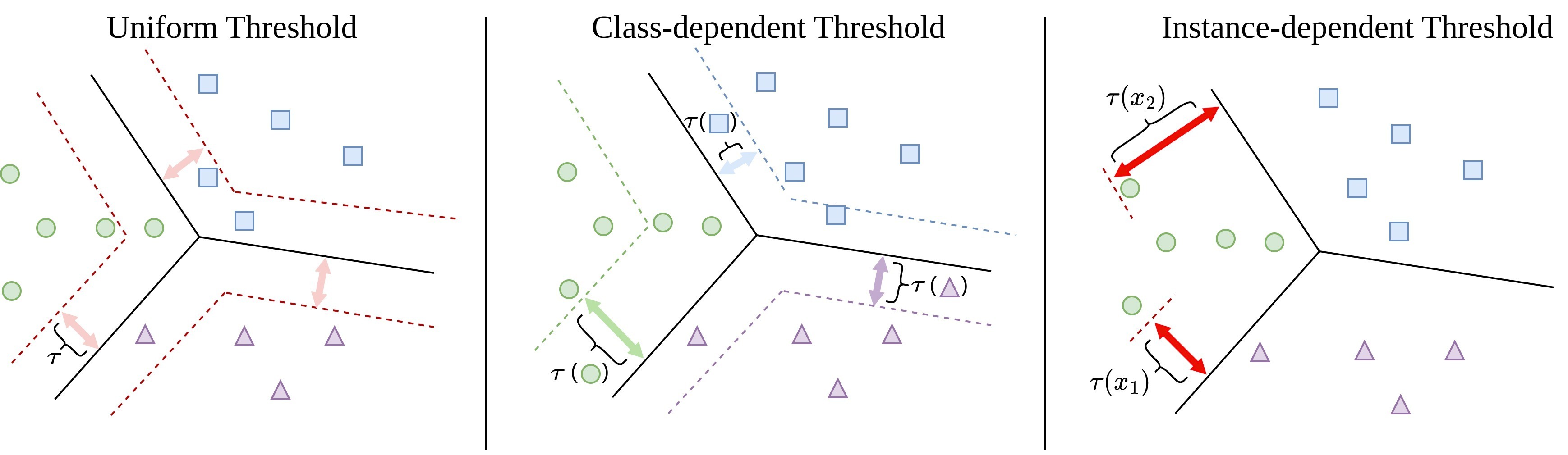
Semi-supervised learning (SSL) has been a fundamental challenge in machine learning for decades. The primary family of SSL algorithms, known as pseudo-labeling, involves assigning pseudo-labels to confident unlabeled instances and incorporating them into the training set. Therefore, the selection criteria of confident instances are crucial to the success of SSL. Recently, there has been growing interest in the development of SSL methods that use dynamic or adaptive thresholds. Yet, these methods typically apply the same threshold to all samples, or use class-dependent thresholds for instances belonging to a certain class, while neglecting instance-level information. In this paper, we propose the study of instance-dependent thresholds, which has the highest degree of freedom compared with existing methods. Specifically, we devise a novel instance-dependent threshold function for all unlabeled instances by utilizing their instance-level ambiguity and the instance-dependent error rates of pseudo-labels, so instances that are more likely to have incorrect pseudo-labels will have higher thresholds. Furthermore, we demonstrate that our instance-dependent threshold function provides a bounded probabilistic guarantee for the correctness of the pseudo-labels it assigns.
Motivation & Objective
- To address the limitation of uniform or class-dependent thresholds in pseudo-labeling by introducing instance-level adaptivity.
- To model instance-dependent label noise and prediction ambiguity to guide threshold selection.
- To provide a theoretical lower-bound on the correctness probability of assigned pseudo-labels.
- To improve the balance between quantity and quality of pseudo-labeled samples for better generalization.
Proposed method
- The method defines an instance-dependent threshold function that increases for samples with higher predicted error rates and greater ambiguity in class posterior.
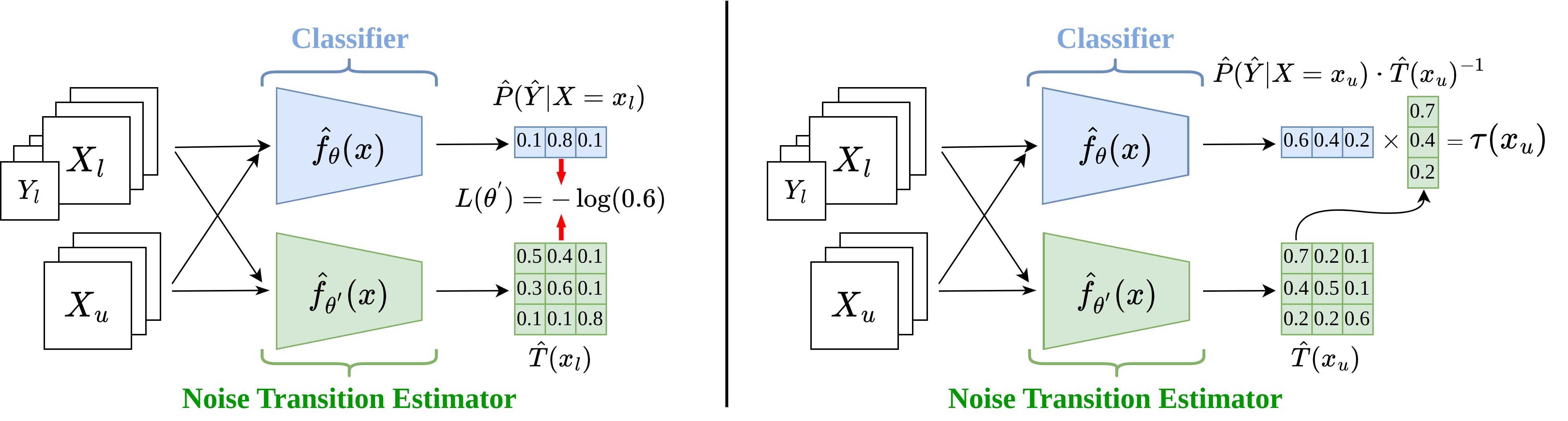
- It estimates instance-level label noise using a transition matrix estimator trained on labeled data.
- The threshold function is derived from the predicted clean class posterior and the estimated error rate per instance.
- It integrates with standard SSL training by applying the dynamic threshold to select high-confidence pseudo-labeled samples at each iteration.
- The approach maintains computational efficiency by avoiding heavy retraining, with minimal overhead compared to FixMatch and AdaMatch.
- Theoretical analysis proves that the probability of correct pseudo-label assignment is lower-bounded and asymptotically approaches one as training progresses.
Experimental results
Research questions
- RQ1Can instance-dependent thresholds improve the reliability of pseudo-labels in semi-supervised learning compared to uniform or class-dependent thresholds?
- RQ2What is the theoretical guarantee on the correctness of pseudo-labels when using instance-dependent thresholds?
- RQ3How does the proposed method balance the trade-off between the number of pseudo-labeled samples and their quality?
- RQ4Does the method maintain high efficiency while achieving superior performance on standard benchmarks?
Key findings
- InstanT achieves 85.09% top-1 accuracy on STL-10 with 40 labeled samples, surpassing AdaMatch (83.50%) and FixMatch (77.72%).
- On CIFAR-100 with 400 labeled samples, InstanT outperforms FreeMatch in later training stages despite lower unlabeled sample utilization.
- The ablation study shows a 2.2% improvement over FixMatch when only instance-dependent thresholds are added, confirming their effectiveness.
- InstanT maintains high pseudo-label accuracy (82.97% with DA, 85.09% with both DA and RT) while using fewer noisy samples than FreeMatch.
- The method introduces negligible computational overhead, with training time comparable to FixMatch and AdaMatch.
- The theoretical guarantee ensures that the probability of assigning a correct pseudo-label increases asymptotically toward one, providing reliability assurance.
Read this paper
Open the full text in the Nubint reader and ask about any passage as you read.
Read this paper on NubintThis review was generated by AI from the original paper. Please check the paper before citing it.