
[Paper Review] Instant3D: Fast Text-to-3D with Sparse-View Generation and Large Reconstruction Model
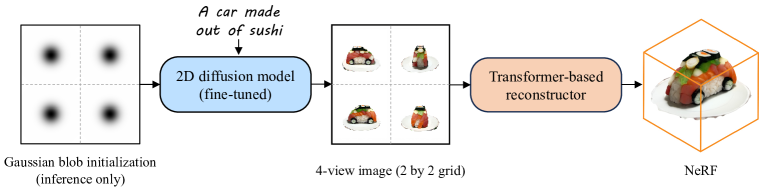
Instant3D uses a two-stage feed-forward pipeline: (1) fine-tunes a 2D diffusion model to produce a 2x2 sparse-view image grid from text, and (2) employs a transformer-based sparse-view reconstructor to regress a NeRF, delivering high-quality 3D assets in about 20 seconds.
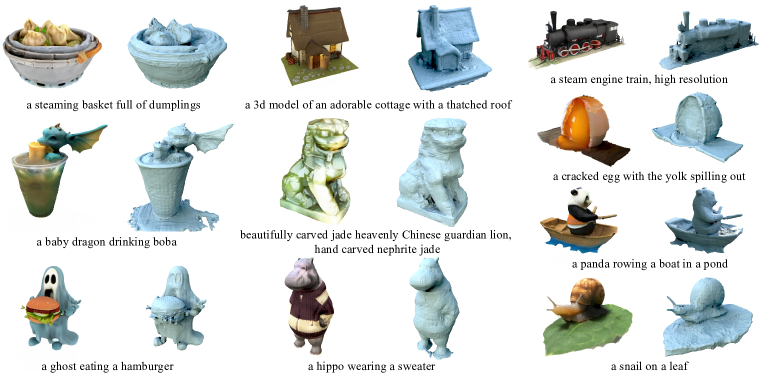
Text-to-3D with diffusion models has achieved remarkable progress in recent years. However, existing methods either rely on score distillation-based optimization which suffer from slow inference, low diversity and Janus problems, or are feed-forward methods that generate low-quality results due to the scarcity of 3D training data. In this paper, we propose Instant3D, a novel method that generates high-quality and diverse 3D assets from text prompts in a feed-forward manner. We adopt a two-stage paradigm, which first generates a sparse set of four structured and consistent views from text in one shot with a fine-tuned 2D text-to-image diffusion model, and then directly regresses the NeRF from the generated images with a novel transformer-based sparse-view reconstructor. Through extensive experiments, we demonstrate that our method can generate diverse 3D assets of high visual quality within 20 seconds, which is two orders of magnitude faster than previous optimization-based methods that can take 1 to 10 hours. Our project webpage: https://jiahao.ai/instant3d/.
Motivation & Objective
- Overcome slow optimization-based text-to-3D methods by enabling fast, diverse generation.
- Leverage pretrained 2D diffusion priors to guide 3D reconstruction with sparse views.
- Develop a two-stage pipeline: sparse-view 2D generation followed by large Transformer-based NeRF reconstruction.
- Achieve high visual quality and view consistency while maintaining rapid inference.
Proposed method
- Fine-tune a pretrained 2D text-to-image diffusion model (SDXL) to generate a 2x2 grid of four views in a single denoising pass.
- Initialize inference with Gaussian blobs to promote white-background outputs and improve second-stage reconstruction.
- Curate a dataset from Objaverse (≈750K objects) and train with lightweight fine-tuning (10K steps, 10K curated samples) to produce consistent multi-view images.
- Introduce a transformer-based sparse-view large reconstruction model that regresses a triplane NeRF from four pose-aware image tokens.
- Use a ViT-based image encoder with camera modulation to produce pose-aware tokens, followed by an image-to-triplane decoder with cross-attention and self-attention, and a NeRF MLP for density and color with volume rendering.
- Train on Objaverse renderings (512x512) with random views for robustness; inference uses fixed camera poses from the first stage.
Experimental results
Research questions
- RQ1Can a text prompt be transformed into a consistent sparse 4-view image grid that captures the requested concept?
- RQ2Can a large transformer-based model reconstruct a NeRF from four sparse views without per-scene optimization?
- RQ3Does a two-stage, feed-forward approach achieve competitive or superior quality and diversity versus optimization-based methods, while delivering substantial speedups?
Key findings
- Generates a 3D asset in about 20 seconds, roughly 200x faster than prior optimization-based methods.
- Outperforms Shap-E and DreamFusion in CLIP-based text-3D alignment and is competitive with ProlificDreamer in alignment and quality.
- A 2x2 sparse-view image grid yields good view consistency when generated with a fine-tuned SDXL model.
- A transformer-based sparse-view reconstructor achieves higher PSNR (26.54) and SSIM (0.8934) with lower LPIPS (0.0643) than SparseNeus on the GSO dataset.
- Inferencing with Instant3D shows substantial speedups (20s vs 1.5h for DreamFusion and 10h for ProlificDreamer).
- The CLIP-based evaluation indicates strong text-3D alignment, with the method achieving CLIP scores (ViT-L/14: 26.87; ViT-bigG-14: 41.77) surpassing Shap-E and approaching ProlificDreamer.
Read this paper
Open the full text in the Nubint reader and ask about any passage as you read.
Read this paper on NubintThis review was generated by AI from the original paper. Please check the paper before citing it.