
[Paper Review] InstantMesh: Efficient 3D Mesh Generation from a Single Image with Sparse-view Large Reconstruction Models
InstantMesh provides a fast, feed-forward single-image to 3D mesh pipeline by combining a multi-view diffusion model with a sparse-view Large Reconstruction Model (LRM) and differentiable iso-surface extraction, achieving state-of-the-art image-to-3D results in about 10 seconds.
We present InstantMesh, a feed-forward framework for instant 3D mesh generation from a single image, featuring state-of-the-art generation quality and significant training scalability. By synergizing the strengths of an off-the-shelf multiview diffusion model and a sparse-view reconstruction model based on the LRM architecture, InstantMesh is able to create diverse 3D assets within 10 seconds. To enhance the training efficiency and exploit more geometric supervisions, e.g, depths and normals, we integrate a differentiable iso-surface extraction module into our framework and directly optimize on the mesh representation. Experimental results on public datasets demonstrate that InstantMesh significantly outperforms other latest image-to-3D baselines, both qualitatively and quantitatively. We release all the code, weights, and demo of InstantMesh, with the intention that it can make substantial contributions to the community of 3D generative AI and empower both researchers and content creators.
Motivation & Objective
- Motivate fast, scalable single-image to 3D mesh generation for broad applications (VR/AR, design, games).
- Leverage open-world 3D priors via large reconstruction models to improve generalization.
- Integrate multi-view diffusion with a mesh-centric reconstruction and differen tiable supervision (depths/normals) to enhance geometry and texture.
- Enable training efficiency and scalability on large datasets through mesh-based supervision and staged training.
Proposed method
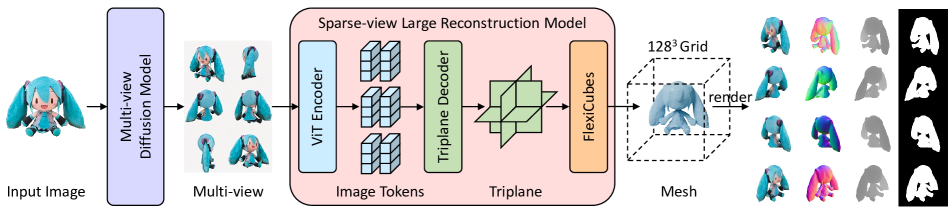
- Use a multi-view diffusion model to generate six consistent novel views from a single input image.
- Employ a transformer-based sparse-view Large Reconstruction Model (LRM) to predict a 3D mesh directly from the generated views.
- Represent geometry as a mesh and integrate a differentiable iso-surface extraction module (FlexiCubes) for efficient surface extraction and supervision.
- Two-stage training: (Stage 1) train on triplane NeRF representation with image/mask losses; (Stage 2) switch to mesh representation with depth/normal supervision and regularization.
- Fine-tune a diffusion model (Zero123++) for white-background, six-view outputs to ensure stable downstream mesh reconstruction.
- Provide four model variants (NeRF/base, NeRF/large, Mesh/base, Mesh/large) with released weights for practical use.
Experimental results
Research questions
- RQ1Can a single input image be converted into high-quality 3D meshes in seconds using a combination of diffusion-based multi-view generation and sparse-view LRMs?
- RQ2Does integrating differentiable iso-surface extraction and direct mesh supervision improve geometry and texture compared to triplane/NeRF-based approaches?
- RQ3How do mesh-based reconstructions compare to NeRF-based reconstructions under multi-view supervision in terms of 2D view quality and 3D geometric accuracy?
- RQ4What is the impact of different input-view counts and training strategies on scalability and generalization to open-world objects?
Key findings
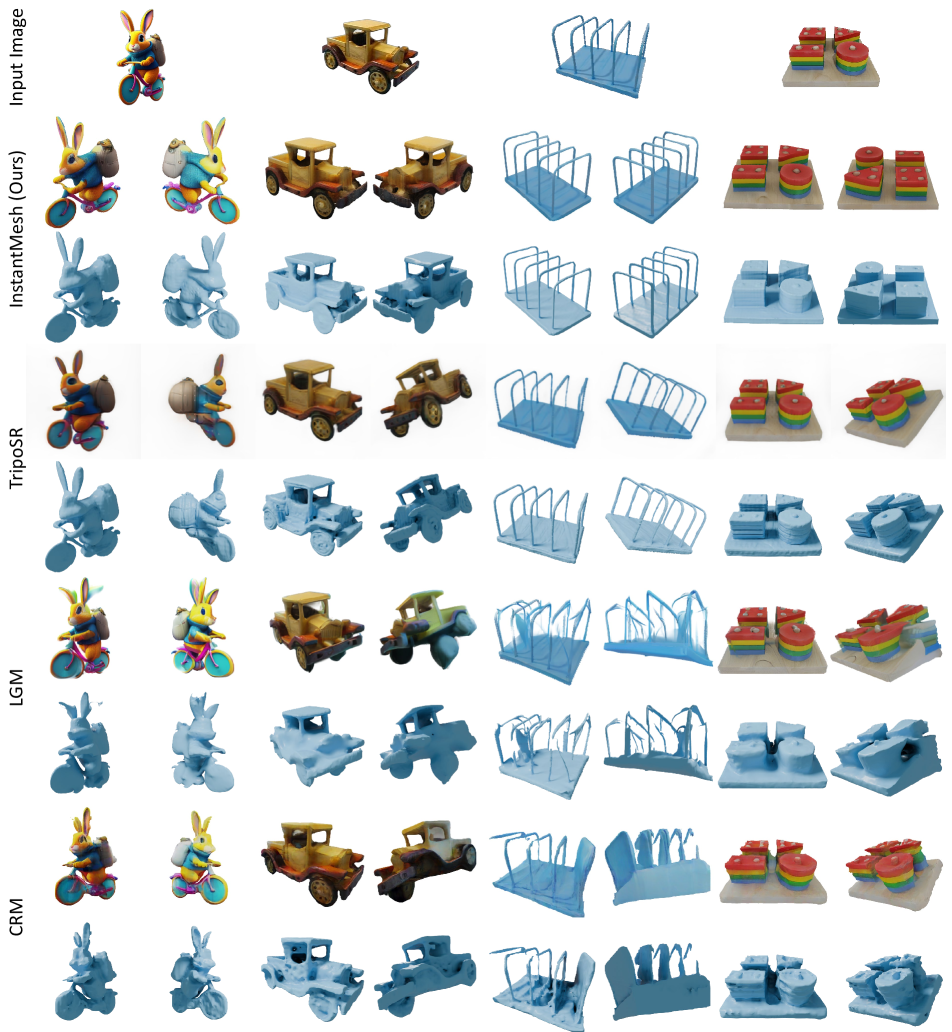
- InstantMesh achieves state-of-the-art image-to-3D performance on public datasets, outperforming baselines in 2D novel-view quality (SSIM, LPIPS) and 3D geometry (Chamfer CD, F-Score).
- The mesh-based variant with FlexiCubes provides smoother surfaces and better geometric supervision than triplane NeRF-based methods.
- The framework can generate diverse high-quality 3D assets from a single image within around 10 seconds.
- Four model variants (NeRF/base, NeRF/large, Mesh/base, Mesh/large) are released to support different application needs.
- Training on large-to-very-large data is enabled by the LRM-based architecture and the mesh-focused supervision strategy.
Read this paper
Open the full text in the Nubint reader and ask about any passage as you read.
Read this paper on NubintThis review was generated by AI from the original paper. Please check the paper before citing it.