
[Paper Review] Instruct2Act: Mapping Multi-modality Instructions to Robotic Actions with Large Language Model
Instruct2Act uses an LLM to generate Python policies that orchestrate perception via SAM/CLIP, planning, and execution for robotic tabletop tasks, enabling zero-shot multi-modal instruction grounding without fine-tuning.
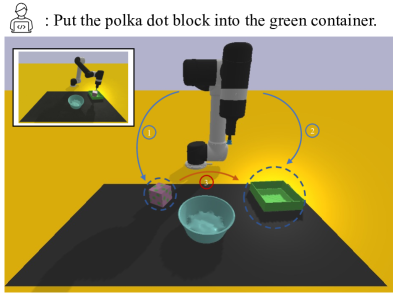
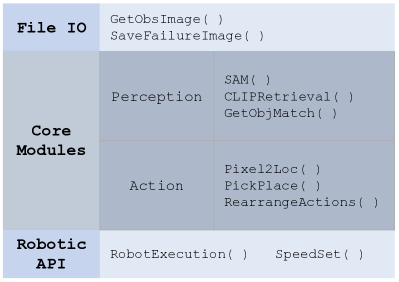
Foundation models have made significant strides in various applications, including text-to-image generation, panoptic segmentation, and natural language processing. This paper presents Instruct2Act, a framework that utilizes Large Language Models to map multi-modal instructions to sequential actions for robotic manipulation tasks. Specifically, Instruct2Act employs the LLM model to generate Python programs that constitute a comprehensive perception, planning, and action loop for robotic tasks. In the perception section, pre-defined APIs are used to access multiple foundation models where the Segment Anything Model (SAM) accurately locates candidate objects, and CLIP classifies them. In this way, the framework leverages the expertise of foundation models and robotic abilities to convert complex high-level instructions into precise policy codes. Our approach is adjustable and flexible in accommodating various instruction modalities and input types and catering to specific task demands. We validated the practicality and efficiency of our approach by assessing it on robotic tasks in different scenarios within tabletop manipulation domains. Furthermore, our zero-shot method outperformed many state-of-the-art learning-based policies in several tasks. The code for our proposed approach is available at https://github.com/OpenGVLab/Instruct2Act, serving as a robust benchmark for high-level robotic instruction tasks with assorted modality inputs.
Motivation & Objective
- Leverage large language models to translate multi-modal instructions into executable robotic action sequences.
- Integrate perception APIs (SAM and CLIP) with LLM-generated control code to create a perception–planning–action loop.
- Evaluate zero-shot performance on diverse tabletop manipulation tasks to test generalization across modalities and scenarios.
Proposed method
- Provide a structured prompt to the LLM that includes API definitions, library imports, and in-context examples to generate a main() Python function.
- Use SAM to generate segmentation masks and CLIP to classify object crops for semantic grounding.
- Translate image-space information into robot action space via a predefined transformation and boundary clamping.
- Incorporate a flexible modality manager to handle pure-language, language-visual, and pointing-language instructions.
- Apply processing modules (image pre-processing, mask post-processing, NMS) to improve perception reliability.
- Evaluate with VIMABench meta-tasks to compare zero-shot performance against SOTA baselines.
Experimental results
Research questions
- RQ1Can an LLM generate executable, modular policy code that maps multi-modal inputs to robotic actions without task-specific training?
- RQ2How do perception foundation models (SAM/CLIP) integrate with LLM reasoning to ground instructions in real robot actions?
- RQ3What is the impact of processing steps and backbone choices on zero-shot manipulation success across tasks and modalities?
- RQ4How does Instruct2Act generalize across L1/L2/L3 generalization settings in VIMABench?
- RQ5What are the limitations and robustness characteristics of a fully zero-shot, foundation-model–driven robotic system?
Key findings
- Instruct2Act achieves competitive average performance with SOTA VIMA on six VIMABench meta-tasks in a zero-shot setting.
- Multimodal instructions generally outperform unimodal ones due to richer contextual grounding.
- Ablations show mask post-processing and image pre-processing collectively raise success rate to 84.1% on average.
- Larger SAM/CLIP backbones improve SR% across experiments.
- The approach remains robust to variations like human intervention, misspellings, and synonyms in instructions.
- Different LLMs (ChatGPT, LLaMA-Adapter) can yield plausible results, with performance improving with generation retries.
Read this paper
Open the full text in the Nubint reader and ask about any passage as you read.
Read this paper on NubintThis review was generated by AI from the original paper. Please check the paper before citing it.